Determine energy levels of a electron in a hydrogen atom

Click For Summary

Homework Help Overview

The discussion revolves around determining the principal quantum numbers n1 and n2 for an electron transition in a hydrogen atom, given the emitted light's wavelength of 658.1 nm. The context is rooted in the Bohr model of the hydrogen atom.

Discussion Character

  • Exploratory, Conceptual clarification, Mathematical reasoning, Assumption checking

Approaches and Questions Raised

  • Participants attempt to calculate the energy associated with the given wavelength and relate it to the quantum numbers using the Bohr model equations. Some express confusion over negative values arising in their calculations and the challenge of having two unknowns. Others suggest using the Rydberg formula and exploring the relationship between energy levels through conservation of energy.

Discussion Status

The discussion is ongoing, with participants exploring various methods to identify the quantum numbers. Some have suggested trial and error for finding suitable values for n1 and n2, while others reference the Balmer series for guidance on visible emission lines. There is an acknowledgment of the complexity of the problem, with no explicit consensus reached yet.

Contextual Notes

Participants note the constraints of working with positive integers for quantum numbers and the reliance on known emission line ranges for hydrogen. There is also mention of potential missing theoretical understanding that may be affecting their calculations.

Jonas Persson
Messages
1
Reaction score
0

Homework Statement


When an electron in a hydrogen atom makes a transiton between two levels with prinicipal quantum numbers n1 and n2, light is emitted with wavelength of 658.1 nm. If we assume that the energy levels of the atom are in agreement with the Bohr model, what are n1 and n2?

Homework Equations


The Attempt at a Solution

I tried to calculate:
E = hc/λ = 3.022 * 10-19
which is the Energy for the wavelength.

E = -hcR/n^2

n^2 = -hcR/E
n^2 = -R/λ
which result in negative value(?)

Then I tried with
λ = (n1^2 - n2^2)/R

but then I always get two unknowns, and can't really come any further than that. Maybe I am looking in the wrong way or missing some theory.
 
Last edited by a moderator:
Physics news on Phys.org
Jonas Persson said:
Assignment
When an electron in a hydrogen atom makes a transiton between two levels with prinicipal quantum numbers n1 and n2, light is emitted with wavelength of 658.1 nm. If we assume that the energy levels of the atom are in agreement with the Bohr model, what are n1 and n2?

Attempt
I tried to calculate:
E = hc/λ = 3.022 * 10-19
which is the Energy for the wavelength.

E = -hcR/n^2

n^2 = -hcR/E
n^2 = -R/λ
which result in negative value(?)

Then I tried with
λ = (n1^2 - n2^2)/R

but then I always get two unknowns, and can't really come any further than that. Maybe I am looking in the wrong way or missing some theory.

First, get straight what the story is of how the photon is produced:

  1. The electron originally has energy E_1 (which can be written in terms of the quantum number n_1)
  2. It emits a photon of energy E (which you calculate above).
  3. Afterward, the electron has energy E_2 (which can be written in terms of n_2)
So by conservation of energy, what is the relationship between E_1, E_2 and E?

You're right, you will have two unknowns, n_1 and n_2. But they are positive integers. So you can just try various values for n_1 and n_2 to see which combination works.
 
  • Like
Likes   Reactions: lekh2003
Jonas Persson said:
Assignment
When an electron in a hydrogen atom makes a transiton between two levels with prinicipal quantum numbers n1 and n2, light is emitted with wavelength of 658.1 nm. If we assume that the energy levels of the atom are in agreement with the Bohr model, what are n1 and n2?
Jonas Persson said:
Attempt
I tried to calculate:
E = hc/λ = 3.022 * 10-19
which is the Energy for the wavelength.

E = -hcR/n^2

n^2 = -hcR/E
n^2 = -R/λ
which result in negative value(?)

Then I tried with
λ = (n1^2 - n2^2)/R

but then I always get two unknowns, and can't really come any further than that. Maybe I am looking in the wrong way or missing some theory.
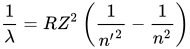
You use wrong formula. The wavelength is attributed to two levels, according to the Rydberg formula.
25b1437b6d7203b25493f3a6b399aaf2c591e352

where Z is the atomic number (1 for Hydrogen atom) and n , n' are the energy levels, n'<n. R is the Rydberg constant. (RH = 0.010972 nm-1)
 
I tried adjacent orbits - no luck!
 
rude man said:
I tried adjacent orbits - no luck!
Don't expect the equation is exactly valid for any pair of n and n', but the emitted light is visible, what can be n'?
 
ehild said:
Don't expect the equation is exactly valid for any pair of n and n', but the emitted light is visible, what can be n'?
Once n is picked, n' is easy to determine - but how to pick n other than by trial and error?
 
rude man said:
Once n is picked, n' is easy to determine - but how to pick n other than by trial and error?
You know the wavelength ranges of the emission lines of Hydrogen atom. They are well separated according to the lower level. Emission in the visible range corresponds to the Balmer series, with n'=2 as lower level.
 
Last edited:
  • Like
Likes   Reactions: rude man
stevendaryl said:
You're right, you will have two unknowns, n1n1n_1 and n2n2n_2. But they are positive integers. So you can just try various values for n1n1n_1 and n2n2n_2 to see which combination works.
I think this solution is the simplest. If you are learning about electron transitions, then you must surely have learned about the different series. Either you can check your textbook (or online) for the energy values of the different transitions from different "n" states.

The value you calculate, E, is simply the difference between energy states. If you still don't understand what the value of E really is, take a look at this link:
http://www.kentchemistry.com/links/AtomicStructure/waveenergy.htm
 
Re search: something like this perhaps. Spot the 'candidate' !

## \begin{array}{|c|c|c|c|c|c|}
\hline & m & 1 & 2 & 3 & 4 & 5 \\
\hline n \\
\hline 1 & & & 0.750 & 0.889 & 0.938 & 0.960\\
\hline 2 & & & & 0.139 & 0.188 & 0.210\\
\hline 3 & & & & &0.049 & 0.071\\
\hline 4 & & & & & & 0.023\\
\hline
\end{array}##
 
  • Like
Likes   Reactions: lekh2003

Similar threads

Replies
12
Views
1K
  • · Replies 2 ·
Replies
2
Views
2K
  • · Replies 2 ·
Replies
2
Views
2K
  • · Replies 3 ·
Replies
3
Views
2K
  • · Replies 22 ·
Replies
22
Views
4K
  • · Replies 1 ·
Replies
1
Views
1K
Replies
2
Views
2K
  • · Replies 3 ·
Replies
3
Views
4K
Replies
3
Views
2K
Replies
1
Views
2K