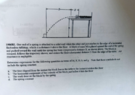
Determine expressions for the following in terms of M, X, D, h and g

  • Thread starter Thread starter paulimerci
  • Start date Start date
  • Tags Tags
    Expressions Terms
Click For Summary
SUMMARY

The discussion focuses on deriving expressions related to the motion of a block pushed against a spring and subsequently released, leading to projectile motion. Key equations include the conservation of energy, represented as \( mgh + \frac{1}{2}kx^2 = \frac{1}{2}mv_f^2 \), and the relationship for spring constant \( k = m\frac{D^2}{x^2} \frac{g}{2h} \). Participants clarify the use of kinematic relationships and the implications of constant versus varying acceleration in the horizontal direction. The final expressions derived are essential for understanding the dynamics of the system.

PREREQUISITES
  • Understanding of conservation of energy principles
  • Familiarity with kinematic equations for projectile motion
  • Knowledge of spring mechanics and Hooke's Law
  • Basic algebra for manipulating equations
NEXT STEPS
  • Explore the derivation of kinematic equations for projectile motion
  • Study the principles of energy conservation in mechanical systems
  • Learn about the dynamics of springs and their applications in physics
  • Investigate the effects of varying forces on motion in different directions
USEFUL FOR

Students in physics, engineers working with mechanical systems, and anyone interested in the principles of energy conservation and projectile motion dynamics.

paulimerci
Messages
287
Reaction score
47
Homework Statement
Attached image below!
Relevant Equations
Conservation of energy, kinematic equations
d) The block of mass m is pushed toward the wall until the spring has been compressed, and so the spring has stored PE, and when the block is released, it follows a projectile motion and strikes the floor ##stored PE\rightarrow K.E ##.
By law of conservation of energy,
$$ E_i = E_f $$
$$ mgh + \frac{1}{2}kx^2 = \frac {1}{2}mv_f^2$$
$$ k = \frac{2m}{x^2} (\frac {v^2}{2} - gh)$$
a) The time elapsed from the instant the block leaves the table to the instant it strikes the floor is taken as ##\Delta t##.
$$ E_i = E_f $$
$$ mgh + \frac{1}{2}kx^2 = \frac {1}{2}mv_f^2$$
I replace ##v_f## in the above equation with range D over elapsed time.
$$mgh + \frac{1}{2}kx^2 = \frac{1}{2}m \frac{D^2}{\Delta t^2}$$
In the above equation I substitute for k which I got from part d.
$$\Delta t = \sqrt {\frac {D}{V}}$$

b) When the block takes a projectile motion, it has uniform motion at constant velocity in the horizontal direction.
There fore ## (v_x)_f = (v_x)_i## = constant
c) The work done on the block by the spring is given by
$$ W.D_{sp} = \frac{1}{2}kx^2$$
Substituting k in the above equation we get,
$$ W.D_{sp} = m (\frac {v^2}{2} - gh)$$

Have I done it right?
 

Attachments

  • Screen Shot 2023-01-11 at 10.54.26 AM.png
    Screen Shot 2023-01-11 at 10.54.26 AM.png
    103 KB · Views: 125
Physics news on Phys.org
Doesn't look right to me.

For part d first figure out the velocity of the block at the top of the table, then just apply kinematic relationships.
 
paulimerci said:
I replace vf in the above equation with range D over elapsed time.
That would be right if ##v_f## is just the final horizontal velocity, but in your energy equation you used it as the entire final velocity.
 
haruspex said:
That would be right if ##v_f## is just the final horizontal velocity, but in your energy equation you used it as the entire final velocit
erobz said:
Doesn't look right to me.

For part d first figure out the velocity of the block at the top of the table, then just apply kinematic relationships.
Distance fallen by a mass is given by
$$\Delta y = v_{iy} t - \frac{1}{2}gt^2$$
$$\Delta y = -\frac{1}{2}gt^2$$ since v_{iy} = 0
The block when released has initial constant velocity, it covers a distance D,
$$ \Delta x = v_{ix}t + \frac{1}{2}at^2$$
$$ \Delta x = v_{ix} t$$ where a =0
$$ v_{ix} = \frac{\Delta x}{t}$$
 
paulimerci said:
Distance fallen by a mass is given by
$$\Delta y = v_{iy} t - \frac{1}{2}gt^2$$
$$\Delta y = -\frac{1}{2}gt^2$$ since v_{iy} = 0
The block when released has initial constant velocity, it covers a distance D,
$$ \Delta x = v_{ix}t + \frac{1}{2}at^2$$
$$ \Delta x = v_{ix} t$$ where a =0
$$ v_{ix} = \frac{\Delta x}{t}$$
Better.
Now substitute the given variables M, D, x, as appropriate and find ##v_{ix}##.
 
haruspex said:
Better.
Now substitute the given variables M, D, x, as appropriate and find ##v_{ix}##.
Any hints?
 
paulimerci said:
Any hints?
using law of conservation of energy,
$$mgh +\frac{1}{2}kx^2 = \frac{1}{2}mv_{ix}^2 +mgh$$
$$v_{ix} = \sqrt {\frac {k}{m}} x$$
sSubstituting for ##v_{ix} =\frac {D}{t}## in the above equation we get for k is
$$k =\frac{D}{t} ^2 m x$$
The above equation is D squared over t squared.
 
paulimerci said:
using law of conservation of energy,
$$mgh +\frac{1}{2}kx^2 = \frac{1}{2}mv_{ix}^2 +mgh$$
$$v_{ix} = \sqrt {\frac {k}{m}} x$$
sSubstituting for ##v_{ix} =\frac {D}{t}## in the above equation we get for k is
$$k =\frac{D}{t} ^2 m x$$
The above equation is D squared over t squared.

$$ v_{ix}t = D$$

You have an expression for ##v_{ix}##, and you have an expression for ##t## from falling a distance ##h##.
 
erobz said:
$$ v_{ix}t = D$$

You have an expression for ##v_{ix}##, and you have an expression for ##t## from falling a distance ##h##.
I honestly don't know how to do this. It's quite tricky.
 
  • #10
paulimerci said:
I honestly don't know how to do this. It's quite tricky.
Expression for ##v_{ix} =\frac{D}{t}## and for ##t = \frac {D} {v_{ix}}##
 
  • #11
paulimerci said:
Expression for ##v_{ix} =\frac{D}{t}## and for ##t = \frac {D} {v_{ix}}##
Is it like this?
 
  • #12
paulimerci said:
Is it like this?
No, you have another expression which you can use to eliminate time ##t##. Its the first part of your post#4
 
  • Like
Likes   Reactions: paulimerci
  • #13
erobz said:
No, you have another expression which you can use to eliminate time ##t##. Its the first part of your post#4
Okay,
$$ h = \frac{1}{2}gt^2$$
$$ t = \sqrt {\frac{2h}{g}}$$
Substituting t in equation for v_{ix} we get
$$ D = v_{ix} \sqrt {\frac{2h}{g}}$$
 
  • #14
paulimerci said:
Okay,
$$ h = \frac{1}{2}gt^2$$
$$ t = \sqrt {\frac{2h}{g}}$$
Substituting t in equation for v_{ix} we get
$$ D = v_{ix} \sqrt {\frac{2h}{g}}$$
Right. Now combine that with an equation relating ##v_{ix}## to k.
 
  • Like
Likes   Reactions: paulimerci
  • #15
haruspex said:
Right. Now combine that with an equation relating ##v_{ix}## to k.
$$\frac{1}{2}kx^2 = \frac{1}{2}mv_{ix}^2$$
substituting ##v_{ix} = D^2 \frac{g}{2h}## in the above equation
$$k = m\frac{D^2}{x^2} \frac{g}{2h}$$
In the above equation x is squared.
 
Last edited:
  • #16
paulimerci said:
$$\frac{1}{2}kx^2 = \frac{1}{2}mv_{ix}^2$$
substituting ##v_{ix} = D^2 \frac{g}{2h}## in the above equation
$$k = m\frac{D}{x}^2 \frac{g}{2h}$$
In the above equation x is squared.
work done on the block by spring
$$W{sp} = \frac{1}{2} kx^2$$
$$ W{sp} = \frac {mD^2g}{4h}$$
 
Last edited:
  • Like
Likes   Reactions: erobz
  • #17
paulimerci said:
In the above equation x is squared.

You can always just edit if it didn't parse like you suspected.

$$ k = m\frac{D^2}{x^2} \frac{g}{2h}$$
 
  • #18
paulimerci said:
substituting ##v_{ix} = D^2 \frac{g}{2h}## in the above equation
You mean ##v_{ix}^2 = D^2 \frac{g}{2h}##.
paulimerci said:
$$k = m\frac{D}{x}^2 \frac{g}{2h}$$
In the above equation x is squared.
So write $$k = m(\frac{D}{x})^2 \frac{g}{2h}$$ or $$k = m\frac{D^2}{x^2 }\frac{g}{2h}$$
paulimerci said:
work done on the block by spring
$$W.D_{sp} = \frac{1}{2} kx^2$$
$$ W.D_{sp} = \frac {mD^2g}{4h}$$
You've lost me. Is W supposed to be the work done? What is Dsp? Sounds like it is the same as x, but why would you multiply the work with the displacement?
 
  • #19
erobz said:
You can always just edit if it didn't parse like you suspected.

$$ k = m\frac{D^2}{x^2} \frac{g}{2h}$$
I did the same thing as you, but latex was not working.
 
  • #20
haruspex said:
You mean ##v_{ix}^2 = D^2 \frac{g}{2h}##.

So write $$k = m(\frac{D}{x})^2 \frac{g}{2h}$$ or $$k = m\frac{D^2}{x^2 }\frac{g}{2h}$$

You've lost me. Is W supposed to be the work done? What is Dsp? Sounds like it is the same as x, but why would you multiply the work with the displacement?
No, no, it's just work done with W, not W.D. I'll edit it now.
 
  • #21
paulimerci said:
I did the same thing as you, but latex was not working.

No you didn't. You did the following:

k = m\frac{D}{x}^2 \frac{g}{2h}

the proper codes are:

$$k = m\frac{D^2}{x^2} \frac{g}{2h}$$ ##k = m\frac{D^2}{x^2} \frac{g}{2h}##

or

$$k = m \left( \frac{D}{x} \right)^2 \frac{g}{2h}$$ ## k = m \left( \frac{D}{x} \right)^2 \frac{g}{2h}##
 
  • #22
paulimerci said:
I did the same thing as you, but latex was not working.
You didn't. Use edit on your reply to see what the LaTeX is in erobz' version and compare it with yours.
 
  • #23
haruspex said:
You didn't. Use edit on your reply to see what the LaTeX is in erobz' version and compare it with yours.
I did it!
 
  • #24
paulimerci said:
No, no, it's just work done with W, not W.D. I'll edit it now.
ok
 
  • #25
Thank you so much @erobz and @haruspex for your great help. I thought I wouldn't be able to complete it and felt the problem was tricky. The reason I started finding for k with energy conservation and not Newtonian mechanics was because I thought acceleration is not constant because spring force is a varying one, which in turn leads to the understanding that acceleration is not constant in the horizontal direction.
 
  • Like
Likes   Reactions: erobz
  • #26
erobz said:
Doesn't look right to me.

For part d first figure out the velocity of the block at the top of the table, then just apply kinematic relationships.
I’m not sure whether I’m saying it right. If the spring has varying force when it is released then the block’s velocity can’t be constant that means acceleration is not constant along the horizontal direction. Right?
 
  • #27
paulimerci said:
I’m not sure whether I’m saying it right. If the spring has varying force when it is released then the block’s velocity can’t be constant that means acceleration is not constant along the horizontal direction. Right?
I believe @erobz only meant you to apply the kinematic relationships after the block leaves the table.
 
  • Like
Likes   Reactions: erobz
  • #28
haruspex said:
I believe @erobz only meant you to apply the kinematic relationships after the block leaves the table.
But we find velocity in part b for horizontal direction where we take acceleration to be zero. This applies only when the block moves with constant velocity. Right?
 
  • #29
paulimerci said:
But we find velocity in part b for horizontal direction where we take acceleration to be zero. This applies only when the block moves with constant velocity. Right?
Is the acceleration along x direction is zero or not zero?
 
  • #30
paulimerci said:
But we find velocity in part b for horizontal direction where we take acceleration to be zero. This applies only when the block moves with constant velocity. Right?
Why "but"?
Yes, for part b we only need to consider motion after the block leaves the table, and in that phase vertical acceleration is constant, g, and horizontal acceleration is constant, 0. So we can apply the kinematic equations for constant acceleration.
 
  • Like
Likes   Reactions: paulimerci

Similar threads

  • · Replies 12 ·
Replies
12
Views
3K
  • · Replies 6 ·
Replies
6
Views
1K
  • · Replies 15 ·
Replies
15
Views
2K
Replies
24
Views
4K
Replies
7
Views
1K
  • · Replies 33 ·
2
Replies
33
Views
2K
Replies
44
Views
6K
Replies
1
Views
2K
Replies
8
Views
6K
  • · Replies 12 ·
Replies
12
Views
2K