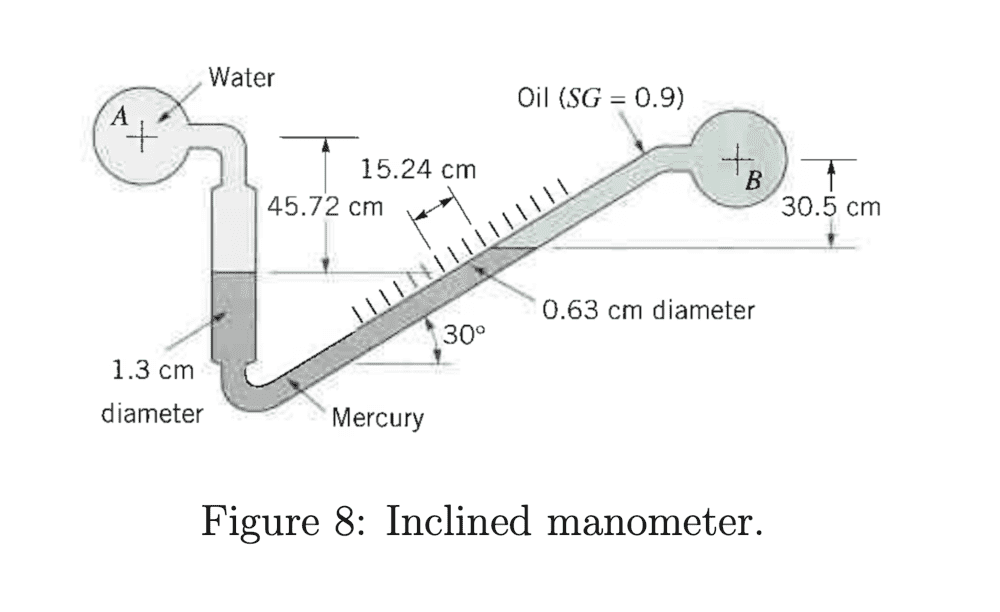
Determine the change in elevation of mercury in this manometer

Click For Summary
SUMMARY

The discussion centers on calculating the change in elevation of mercury in a manometer when the pressure in pipe A increases by 34.4 kPa. The participants analyze the relationships between the heights of the mercury (h2), water (h3), and oil (h1) columns, ultimately deriving equations to express these changes in terms of a variable x. The final calculated change in mercury elevation is 0.088 m, while the expected answer is 0.083 m, leading to a discussion on potential discrepancies in calculations and the relevance of initial measurements.

PREREQUISITES
  • Understanding of fluid mechanics principles, particularly manometer behavior.
  • Familiarity with pressure differential calculations in fluid systems.
  • Knowledge of hydrostatic pressure equations and their applications.
  • Ability to manipulate and solve algebraic equations involving multiple variables.
NEXT STEPS
  • Study hydrostatic pressure calculations in manometers.
  • Learn about the relationship between pressure, height, and density in fluid mechanics.
  • Explore the derivation of equations for pressure changes in fluid columns.
  • Investigate common sources of error in fluid measurement and calculation.
USEFUL FOR

Students and professionals in engineering, physics, and fluid dynamics who are involved in pressure measurement and analysis using manometers.

Bolter
Messages
262
Reaction score
31
Homework Statement
See below
Relevant Equations
pressure = rho x g x h
Having some trouble in answering this question

Screenshot 2020-10-01 at 18.53.18.png

Screenshot 2020-10-01 at 18.53.35.png

What I have done so far is calculate the initial pressure difference, then used that to find the new pressure difference when pipe's A pressure increases by 34.4 kPa
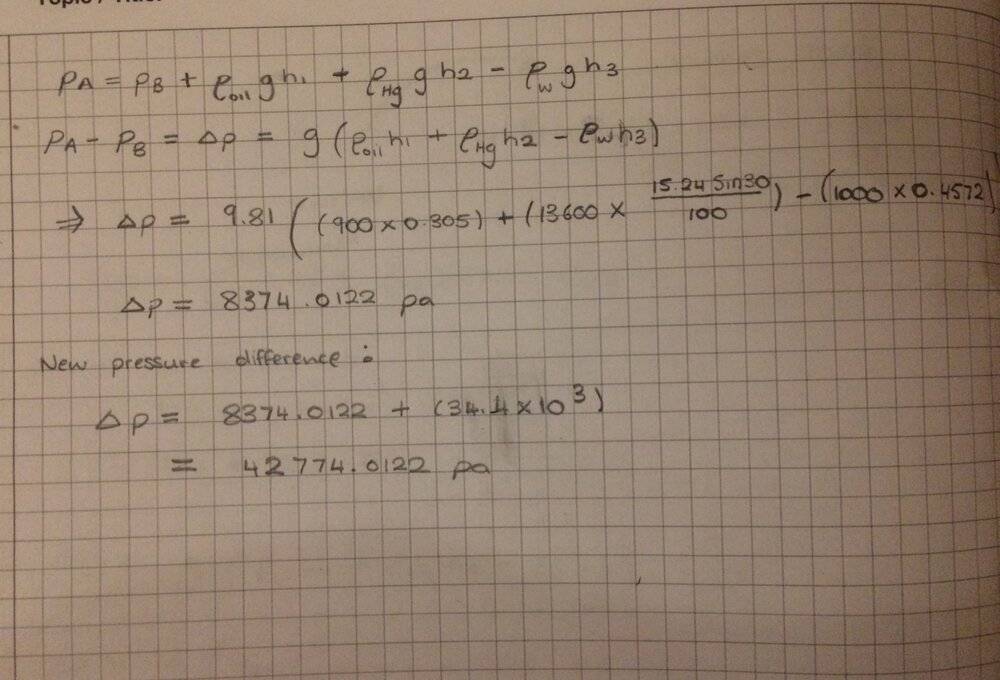
IMG_5310.JPG


Not too sure of where to carry on from here? All I know is that if pipe A is exerting a bigger pressure then the mercury level on the left arm would decrease. But I can't seem to figure by how much this decrease would be

I would be grateful for any help. Thanks!
 
Physics news on Phys.org
Go back to your equations where h1, h2, h3 are variables. As the pressure increases, all three will change, but in a related way. What is the relationship between the changes?
 
haruspex said:
Go back to your equations where h1, h2, h3 are variables. As the pressure increases, all three will change, but in a related way. What is the relationship between the changes?

Well of course depth of water column (h3) would increase by x
and mercury column (h2) would also increase but by y
and oil column (h1) would decrease by y

I can’t seem to express the changes of h1,h2 and h3 in terms of x or y only
as I’m dealing with left arm and right arm having 2 different radii
 
Bolter said:
Well of course depth of water column (h3) would increase by x
and mercury column (h2) would also increase but by y
and oil column (h1) would decrease by y

I can’t seem to express the changes of h1,h2 and h3 in terms of x or y only
as I’m dealing with left arm and right arm having 2 different radii
Think about the volume of the mercury.
 
haruspex said:
Think about the volume of the mercury.

Is it that the volume of mercury that gets displaced in the left arm is equal to the same volume of mercury that gets pushed up in the right arm?
 
Bolter said:
Is it that the volume of mercury that gets displaced in the left arm is equal to the same volume of mercury that gets pushed up in the right arm?
Well, the total volume of mercury is not going to change, is it?
 
haruspex said:
Well, the total volume of mercury is not going to change, is it?

No it wouldn't. This is what I have done

IMG_5312.jpg


I let x be the thing we're trying to find i.e. the change in depth of mercury in left arm

Therefore can I say:
water column depth increases to 0.4572 + x
oil column depth decreases to 0.305 - (4.2579x *sin30)

And the difference in height of mercury columns must increase to 0.0762 + x + (4.2579x *sin30)

Is this alright?
 
Bolter said:
No it wouldn't. This is what I have done

View attachment 270317

I let x be the thing we're trying to find i.e. the change in depth of mercury in left arm

Therefore can I say:
water column depth increases to 0.4572 + x
oil column depth decreases to 0.305 - (4.2579x *sin30)

And the difference in height of mercury columns must increase to 0.0762 + x + (4.2579x *sin30)

Is this alright?
I don't know how you get the 0.0762m, but it doesn’t matter; what matters is the change in the differential height of the mercury arms.
 
haruspex said:
I don't know how you get the 0.0762m, but it doesn’t matter; what matters is the change in the differential height of the mercury arms.

0.0762m was the initial depth of mercury column from doing 15.24cm * sin30 = 0.0762m
 
  • #10
Bolter said:
0.0762m was the initial depth of mercury column from doing 15.24cm * sin30 = 0.0762m
Ok
 
  • #11
haruspex said:
Ok

Thanks so now taking all those as my new variables (all in terms of x) in replacement of h1,h2 and h3, I get the following

IMG_5313.JPG


I'm sure I done the math right but I got the new change in elevation of mercury to be 0.077m whereas the correct answer is actually 0.083m? Not entirely sure what I did wrong
 
  • #12
Bolter said:
Thanks so now taking all those as my new variables (all in terms of x) in replacement of h1,h2 and h3, I get the following

View attachment 270319

I'm sure I done the math right but I got the new change in elevation of mercury to be 0.077m whereas the correct answer is actually 0.083m? Not entirely sure what I did wrong
You seem to be confused over the meaning of ##\Delta P##. The information given is the change in pressure at A, but your calculations look like you are treating it as the difference in pressure between A and B.
As I noted, the given 15.24 cm is irrelevant; likewise the 30.5cm and 45.72cm.
Anyway, I got 8.85cm.
 
  • #13
haruspex said:
You seem to be confused over the meaning of ##\Delta P##. The information given is the change in pressure at A, but your calculations look like you are treating it as the difference in pressure between A and B.
As I noted, the given 15.24 cm is irrelevant; likewise the 30.5cm and 45.72cm.
Anyway, I got 8.85cm.

But wait I realized I did make a mistake in my workings in post #11 as I should've written -1000(0.4572 + x) on my third line and not -1000x

IMG_5314.JPG

so now I got an answer of 0.088m or 8.8cm. I could of got 8.85cm if I rounded to more decimal places

I'm sorry but I don't understand though, why would 15.24cm, 30.5cm and 45.72cm be irrelevant if I used them in my calculations to help me get to an answer of 8.8cm
 
  • #14
Bolter said:
But wait I realized I did make a mistake in my workings in post #11 as I should've written -1000(0.4572 + x) on my third line and not -1000x

View attachment 270323
so now I got an answer of 0.088m or 8.8cm. I could of got 8.85cm if I rounded to more decimal places

I'm sorry but I don't understand though, why would 15.24cm, 30.5cm and 45.72cm be irrelevant if I used them in my calculations to help me get to an answer of 8.8cm
Ok, I see now what you did. In your first post you calculated a ΔP as the initial difference in pressure between A and B, then in post #11 you calculated a new 'ΔP' in terms of x. I misinterpreted that as the change in pressure at A.
But you can see that the whole of your original ΔP canceled out, so you did not need to have calculated it. You could just have used
##34.4kPa=gx(\rho_{Hg}-\rho_w+\frac 12\frac{D^2}{d^2}(\rho_{Hg}-\rho_{oil}))##.
 
  • Like
Likes   Reactions: Bolter
  • #15
haruspex said:
Ok, I see now what you did. In your first post you calculated a ΔP as the initial difference in pressure between A and B, then in post #11 you calculated a new 'ΔP' in terms of x. I misinterpreted that as the change in pressure at A.
But you can see that the whole of your original ΔP canceled out, so you did not need to have calculated it. You could just have used
##34.4kPa=gx(\rho_{Hg}-\rho_w+\frac 12\frac{D^2}{d^2}(\rho_{Hg}-\rho_{oil}))##.

I would have never been able to make such a concise expression for the change in pressure from the one you have shown above, but I believe I could have stuck to only the change in pressure at A and done this. Which still gives me the same answer as before

IMG_5315.jpg
 
  • #16
haruspex said:
Ok, I see now what you did. In your first post you calculated a ΔP as the initial difference in pressure between A and B, then in post #11 you calculated a new 'ΔP' in terms of x. I misinterpreted that as the change in pressure at A.
But you can see that the whole of your original ΔP canceled out, so you did not need to have calculated it. You could just have used
##34.4kPa=gx(\rho_{Hg}-\rho_w+\frac 12\frac{D^2}{d^2}(\rho_{Hg}-\rho_{oil}))##.

Also if the answer is 0.0885m is the answer in the textbook wrong? They gave 0.083m instead
 
  • #17
I get 0.089 m
 
  • #18
Chestermiller said:
I get 0.089 m

Yeah 0.089 m and 0.088 m (from rounding 0.0884656m) are close enough, there is probably a minimal difference caused due to using slightly rounded values in the prior calculations
 

Similar threads

  • · Replies 12 ·
Replies
12
Views
3K
Replies
2
Views
1K
  • · Replies 2 ·
Replies
2
Views
2K
  • · Replies 5 ·
Replies
5
Views
2K
  • · Replies 23 ·
Replies
23
Views
3K
  • · Replies 7 ·
Replies
7
Views
2K
  • · Replies 1 ·
Replies
1
Views
4K
  • · Replies 26 ·
Replies
26
Views
2K
  • · Replies 20 ·
Replies
20
Views
8K
  • · Replies 3 ·
Replies
3
Views
2K