Determining the Poynting Vector for Loop Antennas

Click For Summary
SUMMARY

This discussion focuses on determining the Poynting vector for loop antennas, contrasting it with dipole antennas. The right-hand rule is essential for identifying the Poynting vector's direction, which lies on the X-axis for certain points on the loop. The conversation highlights that while dipole antennas radiate consistently, loop antennas exhibit a figure-of-eight radiation pattern due to phase cancellation, with maximum radiation in the plane of the loop. The Poynting vector diverges outward, illustrating energy flow, but cannot be represented as a continuous line or plane due to its branching nature.

PREREQUISITES
  • Understanding of Poynting vector and its significance in electromagnetic theory
  • Familiarity with the right-hand rule for determining vector directions
  • Knowledge of dipole and loop antenna radiation patterns
  • Basic concepts of near and far field effects in antenna theory
NEXT STEPS
  • Study the Poynting vector in detail, focusing on its application in various antenna types
  • Explore the radiation patterns of loop antennas and their implications for design
  • Investigate the differences between near field and far field effects in antenna radiation
  • Examine the role of charge acceleration in radiation for different antenna geometries
USEFUL FOR

Electrical engineers, antenna designers, and physics students interested in electromagnetic radiation and antenna theory will benefit from this discussion.

Mat1289
Messages
1
Reaction score
0
So I came across the following image (from Wikipedia)
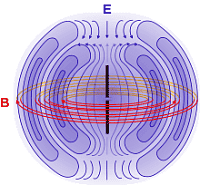
131284d1470296397t-220px-felder_um_dipol.svg.png

where the electric and magnetic field lines are depicted for a dipole antenna. From the field lines, it is possible to determine the direction of the poynting vector, using the right-hand rule. If all possible combinations of poynting vectors are considered, an entire plane is described, perpendicular to the antenna axis.

I was wondering if there is an analogous consideration for loop antennas. I came up with the following sketch
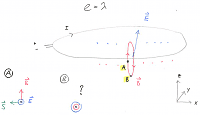
131285d1470296671t-loopconfiguration.png

whereby the loop is situated in the XY plane. I drew in one possible electric and magnetic field line for a certain time instance. If the "A" is considered and the right-hand rule is applied, the poynting vector lies on the X-axis. If however point "B" is considered, the magnetic field and electric field are opposite to each other and the poynting vector can't be resolved.

1) Is my assumption of the field lines possible/correct?
2) How to determine the poynting vector in the case of the loop antenna?
3) How about near/far field effects; under which circumstances are such considerations valid? Is the dipole an exceptional example that "always" works?

Constructive and elaborated answers are appreciated.
 
Engineering news on Phys.org
Mat1289 said:
So I came across the following image (from Wikipedia)
131284d1470296397t-220px-felder_um_dipol.svg.png

where the electric and magnetic field lines are depicted for a dipole antenna. From the field lines, it is possible to determine the direction of the poynting vector, using the right-hand rule. If all possible combinations of poynting vectors are considered, an entire plane is described, perpendicular to the antenna axis.

I was wondering if there is an analogous consideration for loop antennas. I came up with the following sketch
131285d1470296671t-loopconfiguration.png

whereby the loop is situated in the XY plane. I drew in one possible electric and magnetic field line for a certain time instance. If the "A" is considered and the right-hand rule is applied, the poynting vector lies on the X-axis. If however point "B" is considered, the magnetic field and electric field are opposite to each other and the poynting vector can't be resolved.

1) Is my assumption of the field lines possible/correct?
2) How to determine the poynting vector in the case of the loop antenna?
3) How about near/far field effects; under which circumstances are such considerations valid? Is the dipole an exceptional example that "always" works?

Constructive and elaborated answers are appreciated.
(My views on this do not meet with universal agreement).
For both antennas, radiation is caused by the acceleration of charges. This is the case for any antenna, whatever the shape, including slots and loops.
Now think of a square loop.
For this loop antenna, each side of the loop is just a wire, and radiates the same as a dipole.
The two wires create a figure-of-eight radiation pattern when viewed at a long distance, due to phase cancellation. There is zero radiation broadside to the loop and maximum in the plane of the loop.
Do not be confused by the induction fields of the two types of antennas, which are just local energy stores and not germane to radiation.
 
The poynting vector shows the direction of energy flow. Since the antenna radiates, the poynting vectors will be diverging outwards like pins in a pin cushion. Since the poynting vectors branch and get thinner it is not possible to draw them as continuous line or plane.
 

Similar threads

  • · Replies 14 ·
Replies
14
Views
3K
  • · Replies 3 ·
Replies
3
Views
3K
  • · Replies 16 ·
Replies
16
Views
5K
  • · Replies 1 ·
Replies
1
Views
1K
  • · Replies 4 ·
Replies
4
Views
963
  • · Replies 7 ·
Replies
7
Views
2K
  • · Replies 8 ·
Replies
8
Views
5K
  • · Replies 1 ·
Replies
1
Views
2K
Replies
1
Views
2K
  • · Replies 4 ·
Replies
4
Views
2K