Different formulas for electric flux

Join the discussion
Registration is free. Ask a follow-up in this thread, or start your own.
10 replies · 2K views
Alex Schaller
Messages
26
Reaction score
8
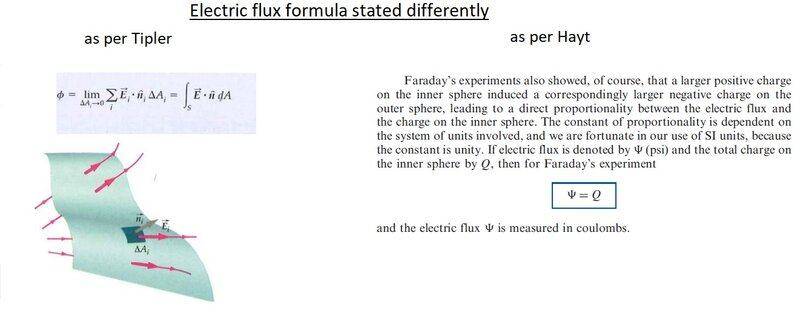
I noticed that in some textbooks (Physics - Tipler) the electric flux formula is different than in other textbooks (Engineering Electromagnetics -W. Hayt)

Which one should we use?
electric flux stated differently.jpg
 
Physics news on Phys.org
Tipler gives the standard definition of flux through a surface. Use that one.

Hayt seems to be talking about the total flux through an enclosed surface. Look up Gauss' law in Tipler for more.
 
  • Like
Likes   Reactions: vanhees71, bob012345 and Alex Schaller
  • Like
Likes   Reactions: Alex Schaller
Be careful to distinguish between electric flux and electric flux density.
 
  • Like
Likes   Reactions: alan123hk
Doc Al said:
Be careful to distinguish between electric flux and electric flux density.
Yes, you are correct.

Hayt conveys "electric flux" as the integration of "electric flux density D" over a surface, whereas Tipler conveys "electric flux" as the integration of "electric field E" over a surface.
Hayt.jpg
 

Attachments

  • Hayt.jpg
    Hayt.jpg
    4.9 KB · Views: 165
Last edited:
  • Like
Likes   Reactions: alan123hk
Because electric flux is defined as ##~ d \Phi_e = \mathbf {E} \cdot d\mathbf {S}~##, it is very reminiscent that the electric field strength or electric field intensity ##~E = \frac {\Phi_e} {S~cos\phi}~## itself represents the electric flux density, but on the other hand, the electric flux density is defined as ##~\mathbf {D}=\epsilon\mathbf {E} ~ ~##(there is an extra symbol##~\epsilon~## before ## \mathbf E ##) , which is really a bit confusing to me.😓

Perhaps we better not call ## ~\mathbf {D}~## the electric flux density, the name electric displacement field may be more suitable for it.

https://en.wikipedia.org/wiki/Electric_flux
https://en.wikipedia.org/wiki/Electric_displacement_field
 
Last edited:
  • Like
Likes   Reactions: Alex Schaller
Thanks for your reply Alan,
I agree with you, perhaps D should be called "displacement flux density" or "displacement density" and not "electric flux density".

On the other hand, flux as per Hayt (Φ = Q) is simpler to understand, but does not yield the same equation as flux according to Tipler (Φ = Q/ε0).

Maybe we should send a suggestion to the editor of Hayt's textbook to look it over?
 
Alex Schaller said:
Maybe we should send a suggestion to the editor of Hayt's textbook to look it over?

Looking at it from another angle, this matter is actually not a big deal. When we express the same thing, we will use different units. For example, the unit of weight can be mg, kg or pound, etc., and the unit of distance can be meter, kilometer or light-year, etc., so just indicate the unit to avoid misunderstanding.

The unit of electric flux based on ## ~ \Phi_e = E S~cos\phi~ ## is volt meters (Vm).

Because the unit of ## ~\epsilon~## is ## \frac {C} {Vm} ~##, the unit of electric flux based on ## ~ \Phi_e =DS~cos\phi = ~\epsilon~E S~cos\phi~ ## is ## \left(\frac {C} {Vm} \right) \left( Vm \right) = C~##. That's why I mentioned earlier that I prefer the expression ##~\Phi_e =Q ~##, which seems to be more concise and beautiful in my opinion.

On the other hand, this is also in line with symmetry.
## ~ \Phi_e = D S~cos\phi~ ##, where D is called the electric flux density
## ~ \Phi_m = B S~cos\phi~ ##, where B is called the magnetic flux density
 
Last edited:
  • Like
Likes   Reactions: Alex Schaller
Thanks Alan!

Talking about symmetry I thought B was more related to E, as H was more related to D (both E and B take into account all the charges present -free and bond-, whereas H and D only consider the free charges).
 
  • Like
Likes   Reactions: alan123hk and vanhees71
Indeed, ##\vec{E}## and ##\vec{B}## belong together and ##\vec{D}## and ##\vec{H}##. This becomes very clear in the more consistent manifestly covariant relativistic formulation of electrodynamics, where ##\vec{E}## and ##\vec{B}## are the 6 independent components of an antisymmetric four-tensor ##F_{\mu \nu}## and ##\vec{D}## and ##\vec{H}## of another such tensor ##D_{\mu \nu}##.
 
  • Like
Likes   Reactions: alan123hk and Alex Schaller
