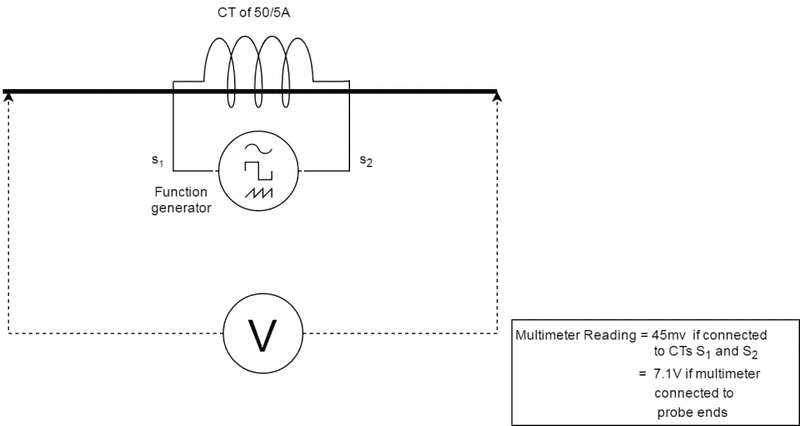
Different voltage measure while probe connected to 50/5A CT

Click For Summary
SUMMARY

The forum discussion centers on the unexpected voltage readings when connecting a probe to the secondary of a 50/5A current transformer (CT). Users observed a 7.1V AC reading at the probe ends, but only 45mV AC when connected to the CT. The low impedance of the CT secondary, approximately 0.2 Ohms, effectively short circuits the signal generator output. Recommendations include using a power amplifier, such as an automotive audio amplifier rated for low impedance, to buffer the signal before feeding it into the CT.

PREREQUISITES
  • Understanding of current transformers (CT) and their operation
  • Knowledge of signal generators and their output characteristics
  • Familiarity with audio amplifiers and their specifications
  • Basic concepts of impedance and voltage ratios in electrical circuits
NEXT STEPS
  • Research automotive audio amplifiers suitable for low impedance applications
  • Learn about the implications of using current transformers in reverse configurations
  • Investigate methods to increase the turns ratio on a CT for different output voltages
  • Explore the use of signal generators and their limitations in driving low impedance loads
USEFUL FOR

Electrical engineers, technicians working with current transformers, and anyone involved in signal amplification and measurement in electrical circuits.

Nikhil N
Messages
80
Reaction score
2
I have connected the probe to secondary of ring type CT and placed a wire as primary with one multi-meter connected at both ends. When I am checking the probe ends, its 7.1V AC, but it reading 45mV AC when connected to CT. Why this is happening?
ct_testing.png
 
Last edited by a moderator:
Engineering news on Phys.org
Nikhil N said:
I have connected the prob to secondary of ring type CT and placed a wire as primary with one multi-meter connected at both ends. When I am checking the prob ends, its 7.1V AC, but it reading 45mV AC when connected to CT. Why this is happening?

so if you disconnect the CT coil from the function generator and you measure the output of the generator ... what is it's output ?
 
The 10 turn secondary of a CT, (designed to conduct 5 amp), will have a very low impedance. It will effectively short circuit the output of a signal generator.

It would be necessary to buffer or amplify the signal generator with something like an automotive audio power amplifier, rated to drive a 2 ohm speaker.
 
davenn said:
so if you disconnect the CT coil from the function generator and you measure the output of the generator ... what is it's output ?
7.1 V
 
Baluncore said:
The 10 turn secondary of a CT, (designed to conduct 5 amp), will have a very low impedance. It will effectively short circuit the output of a signal generator.

It would be necessary to buffer or amplify the signal generator with something like an automotive audio power amplifier, rated to drive a 2 ohm speaker.
Yah. The secondary has only 0.2 Ohm resistance. So what you are suggesting is to amplify the signal from signal generator and feeding to secondary of CT right? Can you give me the rating of amplifier to be used? Can I use Op-amp for the purpose?
 
Last edited:
Nikhil N said:
Can you give me the rating of amplifier to be used? Can I use Op-amp for the purpose?
I really think the use of a laminated CT to inject audio current will pose major problems. The 0R2 resistance ignores the inductance so impedance is probably closer to 2R.
But you can give it a try. There is plenty of signal voltage available from the generator so you do not need an op-amp. If you can find an old mains powered stereo amplifier with low impedance speaker output that could do the job. If not look for a power booster amp designed for automotive 12V operation it will be able to drive a low resistance coil on a CT. It will probably be rated at about 25W or more.
 
Baluncore said:
I really think the use of a laminated CT to inject audio current will pose major problems. The 0R2 resistance ignores the inductance so impedance is probably closer to 2R.
But you can give it a try. There is plenty of signal voltage available from the generator so you do not need an op-amp. If you can find an old mains powered stereo amplifier with low impedance speaker output that could do the job. If not look for a power booster amp designed for automotive 12V operation it will be able to drive a low resistance coil on a CT. It will probably be rated at about 25W or more.
If I am using a audio amplifier which will work in 12V, I can expect a max voltage of 12V right? I need to amplify 7.1V, AC signal to 1000times. Beacuse when I used 7.1V, the voltage came to primary was only 5.3mV, which is not prominent to act as noise into the cable. Please suggest me a amplifier which will be suitable for this purpose.
 
Nikhil N said:
Please suggest me a amplifier which will be suitable for this purpose.
This is the sort of amplifier I would consider using between your sig-gen and the 10 turn CT.
http://www.ebay.com.au/itm/191952191816?_trksid=p2055119.m1438.l2649&ssPageName=STRK:MEBIDX:IT

Nikhil N said:
I need to amplify 7.1V, AC signal to 1000times.
No. That would produce 7kV. Your measurement was wrong.

Nikhil N said:
If I am using a audio amplifier which will work in 12V, I can expect a max voltage of 12V right?
Yes, but that is more than you will need.

You are using a current transformer backwards to inject current into a common mode bundle of wires. The CT turns ratio is then 10 : 1.
Since power in = power out, the output voltage will be 1/10 of the input voltage. The current induced in the output will be 10 times the input current.
You measured 5.3mV output voltage, so you probably had 53mV input voltage.
Your signal generator was unable to do better than that when driving the 10 turn CT.

We do not know the circuit or circuit resistance you used to measure the 5.3mV.
We do not know the output current capabilities of your signal generator.

You do not have to use the 10 turn CT secondary.
You could wind more secondary turns onto the CT core to change the ratio.
I would try 50 or 100 turns, driven directly by the sig-gen.
 
Baluncore said:
This is the sort of amplifier I would consider using between your sig-gen and the 10 turn CT.
http://www.ebay.com.au/itm/191952191816?_trksid=p2055119.m1438.l2649&ssPageName=STRK:MEBIDX:ITNo. That would produce 7kV. Your measurement was wrong.Yes, but that is more than you will need.

You are using a current transformer backwards to inject current into a common mode bundle of wires. The CT turns ratio is then 10 : 1.
Since power in = power out, the output voltage will be 1/10 of the input voltage. The current induced in the output will be 10 times the input current.
You measured 5.3mV output voltage, so you probably had 53mV input voltage.
Your signal generator was unable to do better than that when driving the 10 turn CT.

We do not know the circuit or circuit resistance you used to measure the 5.3mV.
We do not know the output current capabilities of your signal generator.

You do not have to use the 10 turn CT secondary.
You could wind more secondary turns onto the CT core to change the ratio.
I would try 50 or 100 turns, driven directly by the sig-gen.
thanks for the replay
 
  • Like
Likes   Reactions: Baluncore

Similar threads

  • · Replies 54 ·
2
Replies
54
Views
9K
  • · Replies 3 ·
Replies
3
Views
2K
Replies
12
Views
2K
  • · Replies 23 ·
Replies
23
Views
3K
  • · Replies 1 ·
Replies
1
Views
2K
  • · Replies 10 ·
Replies
10
Views
6K
  • · Replies 83 ·
3
Replies
83
Views
7K
  • · Replies 5 ·
Replies
5
Views
2K
  • · Replies 56 ·
2
Replies
56
Views
6K
Replies
64
Views
8K