Differential Form - Notation Help

Click For Summary
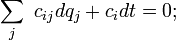
The discussion centers on understanding the notation related to Holonomic constraints, specifically the equations involving differential forms. The equations presented, Cij = ∂fi/∂qj and Ci = ∂fi/∂t, represent how constraints relate to coordinates and time. Participants seek clarification on the meaning of lower indices in the coordinate differentials and the expected correspondence in the indices of the constraints. The concept of a differential 1-form is introduced, emphasizing its role as a linear function on tangent vectors. Overall, the conversation highlights a need for further resources and explanations regarding this mathematical notation.
Mistake Not...
Messages
2
Reaction score
0
Hi there,

I was reading up on Holonomic constraints and came across this equation on the Wikipedia page:
fa14f9c440da57168334ebf30c88cf09.png


The page says it is a differential form. Can anyone explain the notation for me or provide a link or two to documents or pages which explain this notation?

Thank you very much,
Geoff
 
Physics news on Phys.org
Cij = ∂fi/∂qj
and
Ci = ∂fi/∂t where fi is the i th constraint. and qj is the j th coordinate.
 
  • Like
Likes Mistake Not...
Mistake Not... said:
Hi there,

I was reading up on Holonomic constraints and came across this equation on the Wikipedia page:

fa14f9c440da57168334ebf30c88cf09.png


The page says it is a differential form. Can anyone explain the notation for me or provide a link or two to documents or pages which explain this notation?

Thank you very much,
Geoff

You can interpret the dhqs and dt as small increments in the q's and in t.

Formally a differential 1 form is a linear function on tangent vectors that varies smoothly from one tangent space to the next. .
 
  • Like
Likes Mistake Not...
I'm quite confused.

fa14f9c440da57168334ebf30c88cf09.png


Why are there lower indices on the ##q^i##coordinate differentials?

I would also expect to see an equal number of indeces on ##c##.
 
Last edited:
Topic about reference frames, center of rotation, postion of origin etc Comoving ref. frame is frame that is attached to moving object, does that mean, in that frame translation and rotation of object is zero, because origin and axes(x,y,z) are fixed to object? Is it same if you place origin of frame at object center of mass or at object tail? What type of comoving frame exist? What is lab frame? If we talk about center of rotation do we always need to specified from what frame we observe?

Similar threads

  • · Replies 8 ·
Replies
8
Views
3K
  • · Replies 10 ·
Replies
10
Views
2K
  • · Replies 3 ·
Replies
3
Views
2K
  • · Replies 7 ·
Replies
7
Views
1K
  • · Replies 1 ·
Replies
1
Views
1K
  • · Replies 5 ·
Replies
5
Views
4K
  • · Replies 3 ·
Replies
3
Views
2K
  • · Replies 4 ·
Replies
4
Views
1K
  • · Replies 2 ·
Replies
2
Views
2K
  • · Replies 5 ·
Replies
5
Views
2K