Direction of current in Kirchoff's second law

Click For Summary
SUMMARY

This discussion focuses on the application of Kirchhoff's second law in circuit analysis, specifically addressing the direction of current flow in relation to voltage sources. The participants clarify that current direction is arbitrary and can be defined as positive or negative based on the chosen reference. They emphasize that a closed loop is necessary for Kirchhoff's second law to hold, and integrating Faraday's Law over a closed surface is essential for accurate calculations. The conversation highlights the importance of consistency in defining current directions within circuit loops.

PREREQUISITES
  • Understanding of Kirchhoff's laws, specifically Kirchhoff's second law.
  • Familiarity with basic circuit components, including batteries and current flow.
  • Knowledge of Faraday's Law of electromagnetic induction.
  • Proficiency in applying Stokes's theorem in physics.
NEXT STEPS
  • Study Kirchhoff's laws in detail, focusing on practical applications in circuit analysis.
  • Learn about Faraday's Law and its implications in electromagnetic theory.
  • Explore Stokes's theorem and its applications in physics and engineering.
  • Investigate the role of closed loops in circuit design and analysis.
USEFUL FOR

Electrical engineers, physics students, and anyone involved in circuit design or analysis will benefit from this discussion, particularly those looking to deepen their understanding of current flow and circuit laws.

Roroy
Messages
9
Reaction score
0
Hello,

I'm going through Kirchoff's second law, and stumbled across this example on this page:
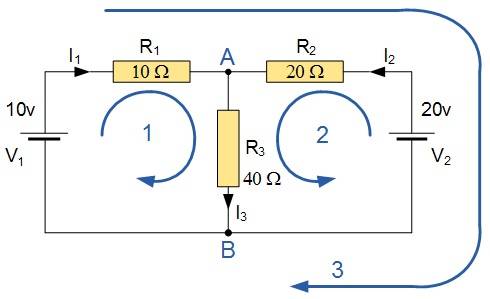
kirchhoff-2nd-law.jpg


In the image above, you can see that the blue arrows (both arrow 1 and arrow 2) indicate the direction that the current goes in. However, I am wondering why the current cannot go as per the red and green arrows depicted in the image below?
What stops the electrons from going from Negative end of 10V battery to positive end of 20V battery (as per red arrow)? What stops them going from negative end of 20V to positive end of 10V (as per green arrow)?
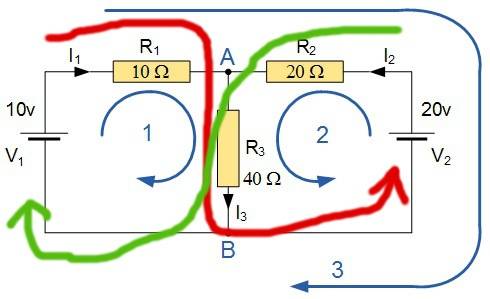
kirchhoff_2nd_law.jpg


Any help much appreciated.
 
Physics news on Phys.org
Roroy said:
What stops the electrons from going from Negative end of 10V battery to positive end of 20V battery (as per red arrow)? What stops them going from negative end of 20V to positive end of 10V (as per green arrow)?
Nothing. The current (not the electrons) goes wherever it needs too go. In your first example, the current arrows does not indicate where the current goes, they are just indicators that you are going to use when calculating the currents. If one of the current turns out to be negative - you just guessed wrong and the current goes against the arrow.
 
  • Like
Likes   Reactions: CWatters
But it's not wrong to get negative currents. How you choose the direction of currents in circuit analysis is arbitrary. Maybe it's intuitive to have only positive currents, but it's not necessary. For AC you have anyway time-dependent currents with positive and negative values like ##i(t)=i_0 \cos(\omega t)## :-).
 
  • Like
Likes   Reactions: CWatters and Dale
Hold on a min folks. I agree that it doesn't matter if 1) or 2) are clockwise or anticlockwise as long as you are consistent but...

In the first image the arrows 1) and 2) show the currents going right around their respective loops. For example 1) goes from the +ve of the 10V battery all the way around the left hand loop back to the +ve of the 10V battery. eg back to where it started.

In the second image the currents don't go around a loop at all. The red arrow starts at the +ve of the 10V battery and ends at the -ve of the 20V battery. It's not a closed loop. I don't think that works at all as far as Kirchoff's second law is concerned. However if someone wants to prove me wrong...

Edit: If you look at the 10V battery the current leaving the +ve terminal is the red current. The current entering the -ve terminal is the green current. That implies the red and green currents must be the same value which clearly doesn't have to be true.
 
  • Like
Likes   Reactions: Roroy
CWatters said:
Hold on a min folks. I agree that it doesn't matter if 1) or 2) are clockwise or anticlockwise as long as you are consistent but...

In the first image the arrows 1) and 2) show the currents going right around their respective loops. For example 1) goes from the +ve of the 10V battery all the way around the left hand loop back to the +ve of the 10V battery. eg back to where it started.

In the second image the currents don't go around a loop at all. The red arrow starts at the +ve of the 10V battery and ends at the -ve of the 20V battery. It's not a closed loop. I don't think that works at all as far as Kirchoff's second law is concerned. However if someone wants to prove me wrong...

Edit: If you look at the 10V battery the current leaving the +ve terminal is the red current. The current entering the -ve terminal is the green current. That implies the red and green currents must be the same value which clearly doesn't have to be true.

This cleared a lot of it up! Thanks!
 
Indeed the loop must be closed. What you do there is just to integrate Faraday's Law over a surface ##S## with boundary ##\partial S## (which is necessarily a closed loop), using Stokes's theorem
$$\frac{1}{c} \dot{\vec{B}}=-\vec{\nabla} \times \vec{E} \; \Rightarrow \; \frac{1}{c} \int_S \mathrm{d} \vec{S} \cdot \dot{\vec{B}}=-\int_{\partial S} \mathrm{d} \vec{x} \cdot \vec{E}.$$
You can integrate along the circuit, and as long as it is at rest you get
$$\mathcal{E}=\int_{\partial S} \mathrm{d} \vec{S} \cdot \vec{E}=-\frac{1}{c} \dot{\Phi}_S=-\frac{1}{c} \frac{\mathrm{d}}{\mathrm{d} t} \int_S \mathrm{d} \vec{S} \cdot \vec{B}.$$
 

Similar threads

  • · Replies 2 ·
Replies
2
Views
2K
  • · Replies 5 ·
Replies
5
Views
3K
  • · Replies 7 ·
Replies
7
Views
2K
  • · Replies 8 ·
Replies
8
Views
4K
  • · Replies 14 ·
Replies
14
Views
2K
  • · Replies 1 ·
Replies
1
Views
2K
  • · Replies 7 ·
Replies
7
Views
3K
  • · Replies 4 ·
Replies
4
Views
3K
  • · Replies 5 ·
Replies
5
Views
2K
  • · Replies 6 ·
Replies
6
Views
646