Discharging a P-Channel MOSFET quickly

  • Thread starter Thread starter Dextrine
  • Start date Start date
  • Tags Tags
    Mosfet
Click For Summary
SUMMARY

This discussion focuses on efficiently discharging a P-Channel MOSFET during turn-off using a totem pole configuration. The recommended approach involves replacing the resistor in the circuit with an additional NPN transistor to create a low-resistance path for discharging the gate capacitance. Participants also emphasize the importance of not exceeding the maximum gate-to-source voltage to prevent damage to the FET. Additional resources, including application notes and circuit collections, are provided for further exploration.

PREREQUISITES
  • Understanding of P-Channel MOSFET operation
  • Familiarity with NPN transistor biasing techniques
  • Knowledge of gate capacitance in MOSFETs
  • Basic circuit design principles
NEXT STEPS
  • Research "Totem Pole MOSFET Driver" configurations
  • Study "MOSFET Gate Drive Circuits" for optimal performance
  • Explore "Analog Circuit Design" resources for common circuit examples
  • Investigate "NPN Transistor Linear Region Operation" for theoretical insights
USEFUL FOR

Electronics engineers, circuit designers, and hobbyists working with MOSFETs and transistor circuits will benefit from this discussion.

Dextrine
Messages
102
Reaction score
7
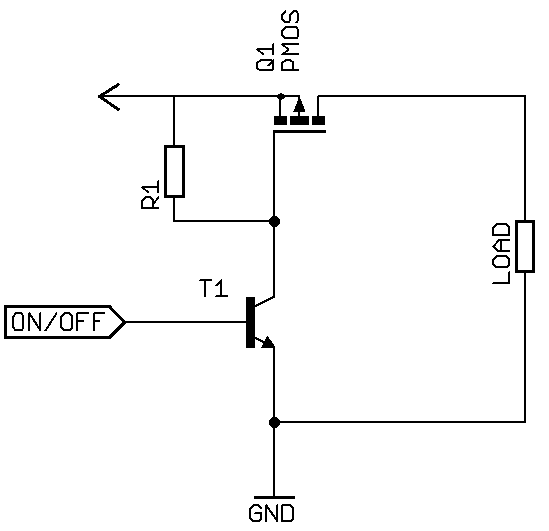
I am using trying to familiarize myself with P-Channel mosfets since I don't have too much experience with them. I am trying to use the FET as a switch, being driven in the typical highside FET manner using an NPN transistor.

Is there some standard way of quickly discharging the FET during turn off? I am trying to use maybe another BJT but can't seem to bias it correctly during turn off.

Pretty much just like this.
8PxZ6.png
thanks in advance for the help.
 
Engineering news on Phys.org
  • Like
Likes Dextrine
Thanks a lot Tom. I sometimes struggle finding information due to not knowing the terminology, I'll be sure to remember this though. Thanks again.
 
You are welcome. Have Fun!
Oh, and I almost forgot:
Be careful you don't exceed the maximum Gate-to-Source voltage in the ON condition. The circuit you show puts the full supply voltage on the Gate. Unless it is a really low supply voltage, that generally leads to a very short life of the FET.
 
  • Like
Likes Dextrine
I made it work with an extra NPN transistor. Apparently just adding the totem pole will invert the output. Thanks again though, is there some document that lists common circuits in analog and power along with their name?
 
About 7 780 000 hits: Just be aware that not all of the circuits actually work.
https://www.google.com/search?site=...rcuit+collection&oq=analog+circuit+collection

About 4 390 000 hits: Much more reliable results than the above search.
https://www.google.com/search?q=analog+circuit+design+design+note+collection

After you get tired of those, with the search field still showing the search string, click in the field again. You will receive more search suggestions.

(Should keep you busy for a little while, at least until your hair turns gray.)
 
Wow, thanks! This definitely will keep me busy for quite a while. I had been looking up "List of analog circuits" with much poorer results.
 
Tom.G said:
About 7 780 000 hits: Just be aware that not all of the circuits actually work.
https://www.google.com/search?site=...rcuit+collection&oq=analog+circuit+collection

About 4 390 000 hits: Much more reliable results than the above search.
https://www.google.com/search?q=analog+circuit+design+design+note+collection

After you get tired of those, with the search field still showing the search string, click in the field again. You will receive more search suggestions.

(Should keep you busy for a little while, at least until your hair turns gray.)
Quick question Tom, is there some circuit that can take a pulse that goes from, say 0 to +V and makes it go from. -V to V? to ? I'll be looking through the analog circuit indexes but thought you might know the name of such a circuit off hand.

Thanks in advance
 
PNP transistor
Emitter to +V
input to Base
Collector to resistor to -V

(Get the biasing right.)
(Note that it does invert the signal.)
 
  • #10
Tom.G said:
PNP transistor
Emitter to +V
input to Base
Collector to resistor to -V

(Get the biasing right.)
(Note that it does invert the signal.)
Thanks again for the input Tom. I had another question more from a theoretical vs. applied point of view:

Is it possible to have an NPN transistor be in the linear region, never saturated, if the emitter is connected to ground, the base to a resistor (which goes to your signal or something), and the collector to another resistor that goes to some high rail?

In other words, can the following circuit, in real life, ever NOT be saturated?

rokCu.gif
 
  • #11
Dextrine said:
...ever NOT be saturated?
Sure. Just restrict VB so the transistor is always operating in its linear range.
It's a simple enough circuit you can build it even without a breadboard. Use a potentiometer (pot) across VCC and take VB from the wiper. Measure the voltage on the Collector while you adjust the pot.
 
  • #12
IS this NPN Transistor question completely unrelated to the MOSFET gate driver situation? Is there a case when you would want to drive the MOSFET gate using the NPN transistor in linear?
 

Similar threads

  • · Replies 1 ·
Replies
1
Views
2K
Replies
39
Views
6K
  • · Replies 28 ·
Replies
28
Views
5K
  • · Replies 8 ·
Replies
8
Views
3K
  • · Replies 7 ·
Replies
7
Views
8K
  • · Replies 49 ·
2
Replies
49
Views
4K
  • · Replies 12 ·
Replies
12
Views
3K
Replies
8
Views
4K
  • · Replies 14 ·
Replies
14
Views
4K
Replies
7
Views
3K