Disk rolling down a hill with no sliping

Click For Summary

Homework Help Overview

The discussion revolves around a disk with mass m and radius R rolling down a hill without slipping. Participants are exploring the dynamics of the disk's motion, including the forces acting on it, the equations of motion, and the relationship between the center of mass and points on the disk.

Discussion Character

  • Exploratory, Conceptual clarification, Mathematical reasoning, Assumption checking

Approaches and Questions Raised

  • Participants discuss the forces acting on the disk, including gravitational components and friction. They explore equations of motion and energy conservation to relate the motion of the center of mass to angular motion. Questions arise about the role of mass in the motion and the connection between coordinates of points A and B.

Discussion Status

The discussion is active, with participants providing insights and guidance on the equations governing the motion. Some participants have proposed equations and relationships, while others are questioning assumptions and seeking clarification on specific points. There is no explicit consensus, but various interpretations and approaches are being explored.

Contextual Notes

Participants are working under the constraints of homework rules and are attempting to derive relationships without providing complete solutions. There are discussions about the implications of static friction and the conditions for pure rolling motion.

dislect
Messages
163
Reaction score
0
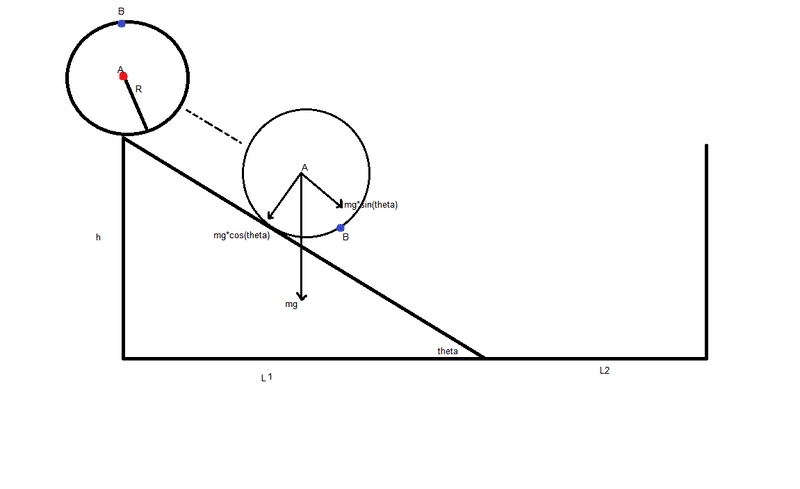
A disk with mass m and radius R is rolling down a hill with no slipping, until it reaches a wall and then stops:
zcmwywz2qy3n.png


I want to write a set of equations describing the position cordinates x and y of the disk's center of mass (point A) and the cordinates for point B.

mgsin(theta)=ma -> gsin(theta)=a -> gsin(theta)=dv/dt ; V_B=2wR ; V_A=wR

Can you help me figure this out and guide me towards the solution?

Thanks,
Sharon
 
Last edited:
Physics news on Phys.org
The CM moves as if the whole mass was centred there, under the effect of all forces acting on the disk.
You wrote the component of gravity along the slope as force, but there is an other one, which makes the disk rolling instead of slipping. What is it?

You can also use conservation of energy to find out the velocity of the CM and angular velocity of the rotation of the disk.

If you have figured out the motion of the CM, the point on the rim performs circular motion around the CM, with angular velocity vCM/R. You have to add the velocities ; those of translation and rotation.

ehild
 
You mean friction?
Is it correct to say that my coefficient of friction is mew=1, giving me:
mgsin(theta) - mgcos(theta) = ma ?

using energy:
mg(h+R)=0.5mv^2

I still wonder how i am using these equations to create the connection between cordinates x,y of points A and B to time,mass,radius,height,angle ?
 
Ignore my last message,

1. -f+mgsinθ=mx'' , 2. N=mgcosθ Forces equations
3. -fR=-0.5mR^2 * θ'' Momentum equation
4. Rα''=-x'' Pure rolling condition

After some algebra i get:

5.1 x''=2/3 gsinθ
5.2 α''=-2/3 * g/R * sinθ
5.3 f=1/3 mgsinθ
5.4 N=mgcosθ

And as long as μ>1/3 tanθ there is a pure roll with no slip

x'=2/3 gtsinθ+x'(0)=2/3 gtsinθ , x(t)=1/3 gt^2 sinθ+x(0)=1/3 gt^2 sinθ

Now, how do I find x(t) and y(t) for points A and B ?
 
Last edited:
dislect said:
You mean friction?
Is it correct to say that my coefficient of friction is mew=1, giving me:
mgsin(theta) - mgcos(theta) = ma ?

using energy:
mg(h+R)=0.5mv^2

It is static friction (Fs) between the disk and slope that does not let the disk slip. Static friction is not a force of defined magnitude: it has got the necessary magnitude. The static friction decelerates the translation of the CM, but accelerates rotation.

You have two equations, one between forces and acceleration of CM:

ma=mgsinθ-Fs

the other for torque (FsR), moment of inertia (I) and angular acceleration dω/dt

Idω/dt=R Fs,

You have the condition of rolling Rω=VCM, which holds also for the accelerations Rdω/dt=a.
Eliminate Fs and you get the acceleration a.

ehild
 
I posted another message, can you take a look at the equations I wrotre there?
 
dislect said:
And as long as μ>1/3 tanθ there is a pure roll with no slip

x'=2/3 gtsinθ+x'(0)=2/3 gtsinθ , x(t)=1/3 gt^2 sinθ+x(0)=1/3 gt^2 sinθ

Now, how do I find x(t) and y(t) for points A and B ?

You have found x(t): it is the position of point A along the slope, till the disk is on the slope. It is not the x coordinate so it would be better to use s(t) instead of x(t). x(t)=s(t)cos(theta)
You get the change of y as the y coordinate of the displacement, and add the initial height: yi=h+R

For x>L1, the disks moves on the horizontal track with constant velocity.

As for the point on the rim, write up its position in terms of the position of the CM and the position of B with respect to the CM.

ehild
 

Attachments

  • rolldisk.JPG
    rolldisk.JPG
    6.2 KB · Views: 512
I got another question, this dosent add up but it seems like the mass plays no role in the motion. is that correct?
 
dislect said:
I got another question, this dosent add up but it seems like the mass plays no role in the motion. is that correct?

It does not matter.

ehild
 
  • #10
thanks you, you had been a great up!
now I am left with writing the x(t) equation for the center of mass while moving on the plane (x>L1), how do i approach this one?
is it correct to say that now my x(t)=sqrt(2gH)*t + x(0)=sqrt(2g*(h+R)) + 0 ?
 
  • #11
The disk will roll further with the same speed and angular speed as it reached the bottom of the slope, and the change of height is h. The CM can not go deeper than the radius. The initial potential energy transforms to the sum of KE of the translation and KE of rotation.

ehild
 
  • #12
the equations i wrote don't work for me could you tell me where i went wrong?
what i did was
mgh=0.5mv^2
v=x'=sqrt(2gh)
x=sqrt(2gh)t+x(0)=sqrt(2gh)t+L1
 
  • #13
dislect said:
the equations i wrote don't work for me could you tell me where i went wrong?
what i did was
mgh=0.5mv^2
v=x'=sqrt(2gh)
x=sqrt(2gh)t+x(0)=sqrt(2gh)t+L1

That is not true.

mgh is equal to the total kinetic energy: 1/2 mv2+1/2 Iω2.


ehild
 
  • #14
Thanks,
now i know that I=0.5mR^2, i know R,m and h
though I am not sure how do i find the ω ? is it v/R ?
 
  • #15
dislect said:
Thanks,
now i know that I=0.5mR^2, i know R,m and h
though I am not sure how do i find the ω ? is it v/R ?

In case of pure rolling, it is.

ehild
 

Similar threads

  • · Replies 97 ·
4
Replies
97
Views
6K
Replies
39
Views
4K
  • · Replies 3 ·
Replies
3
Views
2K
  • · Replies 1 ·
Replies
1
Views
3K
  • · Replies 9 ·
Replies
9
Views
2K
  • · Replies 5 ·
Replies
5
Views
3K
  • · Replies 9 ·
Replies
9
Views
2K
  • · Replies 3 ·
Replies
3
Views
2K
Replies
7
Views
2K
  • · Replies 18 ·
Replies
18
Views
6K