clope023
- 990
- 130
[SOLVED] Distance a rocket travels on a launch ramp
A 1600kg rocket is to be launched with an initial upward speed of 51.0m/s . In order to assist its engines, the engineers will start it from rest on a ramp that rises 53 degrees above the horizontal. At the bottom, the ramp turns upward and launches the rocket vertically. The engines provide a constant forward thrust of 2000N , and friction with the ramp surface is a constant 500N .
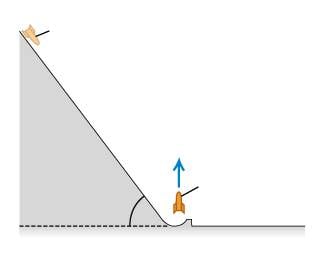
How far from the base of the ramp should the rocket start, as measured along the surface of the ramp?
K1 + U1 + Wother = K2 + U2
U1 = mgd(sin53)
K1 = 0
Wother = 2000N-500N = (1500N)d
K2 = 1/2m(51m/s)^2
U2 = 0
mgd(sin53) + 1500Nd = 1/2(1600kg)(51m/s)^2
d(mgsin53 + 1500N) = 1/2(1600kg)(51m/s)^2
d = 1/2(1600kg)(51m/s)^2/(mgsin53 + 1500N)
would this be correct?
Homework Statement
A 1600kg rocket is to be launched with an initial upward speed of 51.0m/s . In order to assist its engines, the engineers will start it from rest on a ramp that rises 53 degrees above the horizontal. At the bottom, the ramp turns upward and launches the rocket vertically. The engines provide a constant forward thrust of 2000N , and friction with the ramp surface is a constant 500N .
How far from the base of the ramp should the rocket start, as measured along the surface of the ramp?
Homework Equations
K1 + U1 + Wother = K2 + U2
U1 = mgd(sin53)
K1 = 0
Wother = 2000N-500N = (1500N)d
K2 = 1/2m(51m/s)^2
U2 = 0
The Attempt at a Solution
mgd(sin53) + 1500Nd = 1/2(1600kg)(51m/s)^2
d(mgsin53 + 1500N) = 1/2(1600kg)(51m/s)^2
d = 1/2(1600kg)(51m/s)^2/(mgsin53 + 1500N)
would this be correct?