DIY wireless power transfer device concept

Join the discussion
Ask a follow-up here, or get your own question answered by working scientists, mathematicians and engineers — people, not an autocomplete.
Real named experts · corrections over time · the nuance an AI answer skips
5 replies · 7K views
srinaath
Messages
51
Reaction score
2
i am planning to do a small diy wireless power transfer device.
The circuit of the transmitter is
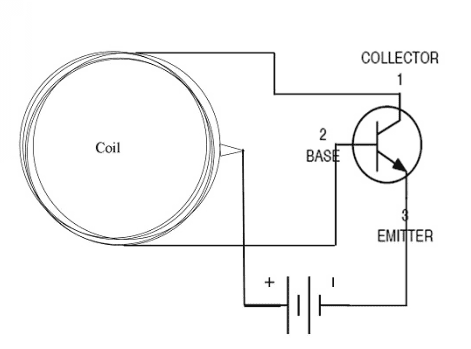
upload_2017-2-1_18-1-43.png

receiver has just the coil and load arrangement.
my query is, (please correct me if am wrong)
-->to induce a voltage in the secondary coil, there must be a varying magnetic field right?
-->but according to circuit, the transistor doesn't help in changing the polarity, what is the necessity of using the transistor then?

am just a hobbyist.
thanks much for your reply in advance.
 
on Phys.org
How much power over what distance are you planning?

A more common name for what you are designing is a transformer even though you think of it as wireless power transmission. There are numerous web sites that offer aid in transformer design.

Transformers work with AC power, not DC. If you have no DC source, then your circuit must be an oscillator that will generate an AC signal. Wikipedia is a good place to start your research. https://en.wikipedia.org/wiki/Electronic_oscillator
 
  • Like
Likes   Reactions: srinaath
anorlunda said:
How much power over what distance are you planning?

A more common name for what you are designing is a transformer even though you think of it as wireless power transmission. There are numerous web sites that offer aid in transformer design.

Transformers work with AC power, not DC. If you have no DC source, then your circuit must be an oscillator that will generate an AC signal. Wikipedia is a good place to start your research. https://en.wikipedia.org/wiki/Electronic_oscillator

hello anorlunda,
thanks much for your reply,
i am planning to transfer a power of 2W over a distance of 10cm
so, can you suggest me any technique to make it as a high power oscillator?
 
I'm very rusty but that circuit looks like some sort of "transformer oscillator". Oscillators need positive feedback and a gain > unity. The transistor provides the gain and the transformer provides positive feedback from the output/collector back to the input/base. The receiver will form a third winding on the transformer. To get any kind of efficiency I think the diameter of the coil needs to be larger than the separation.

Google found that IDT have a development kit..
http://www.idt.com/products/power-management/wireless-power/wireless-power-reference-kits
 
  • Like
Likes   Reactions: sophiecentaur
srinaath said:
can you suggest me any technique to make it as a high power oscillator?
The circuit in your post uses the transistor to produce an oscillation. It's very cheap and cheerful, though and the frequency of oscillation is anybody's guess. It was probably, originally posted (by someone) to show the principle. If you are experimenting, it would be very useful (essential?) to be able to vary the frequency of the system to optimise any power transfer you manage to get.
The IDT device is clearly quite complicated; it has an integrated circuit on board which is an indication for you that a reliable system needs more than what's in that diagram in the OP. The downside of this approach is that you don't end up learning much about electronics (not a problem is you just want to plug and play, of course.)
If you do go for one, let us know if you made it work easily and how much money you spent.
We're clearly not far from having all our mobile devices charged this way (internal circuitry) and the price will soon drop. It would be good for you to get in on the ground floor - rosy glow when you're the first of your mates to have one.
 
May I make a suggestion? The more difficult part of your project is not the oscillator, but rather the wireless transfer. I think it will be immensely more difficult to transmit across 10 cm than 0.5 cm. Testing that distance relationship is exactly what a DIY experimenter may determine for himself.

Therefore, why not experiment first using an AC source rather than DC? Be safe. Don't use 120V or 230V AC. Find a transformer that will step down the voltage to 10V or less, and use that for experiments.

If the wireless power transfer is successful, then you can discard the AC power and add a DC powered oscillator as the second step. Using an oscillator, you can control one more important parameter -- the frequency.