Do charges accelerate because their field lines are changed?

Click For Summary
SUMMARY

The discussion centers on the relationship between electric charges and their field lines, specifically whether changes in field lines cause charges to accelerate. It is established that when two charges are released, the repulsion between them alters their respective electric fields, leading to a change in their geometric configuration. The inquiry suggests that an accelerating charge adjusts its position to maintain a natural state of field line orientation, although this perspective is not formally recognized in physics. The formal definition of force on a charge is given by F=qE, where F is force, q is charge, and E is the electric field.

PREREQUISITES
  • Understanding of electric fields and field lines
  • Familiarity with Coulomb's Law and the concept of force (F=qE)
  • Basic knowledge of charge interactions (attraction and repulsion)
  • Concept of acceleration in the context of physics
NEXT STEPS
  • Explore the implications of field line geometry on charge interactions
  • Study the mathematical derivation of force from electric fields using F=qE
  • Investigate the behavior of accelerating charges in electromagnetic fields
  • Learn about the principles of field theory and its applications in particle physics
USEFUL FOR

Physicists, electrical engineers, and students studying electromagnetism who seek to deepen their understanding of charge interactions and electric field dynamics.

FallenApple
Messages
564
Reaction score
61
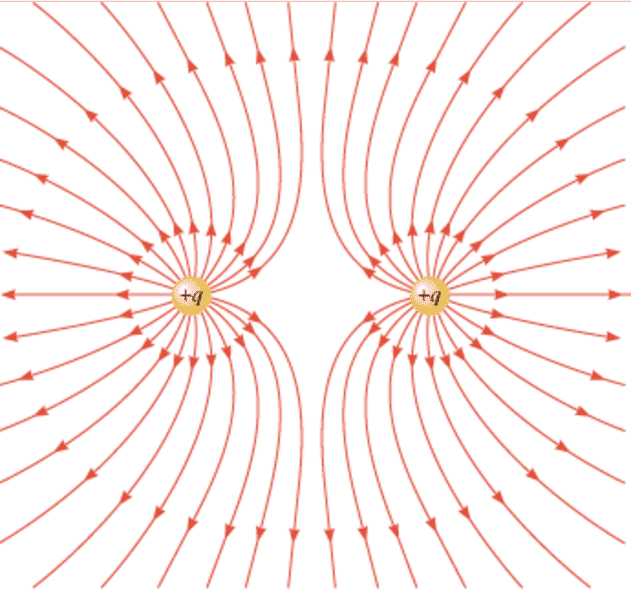
I ask this because of this diagram.
Screen Shot 2017-01-20 at 5.57.27 PM.png


Say that two charges are held a certain distance apart and are let go. Well, we see that the field lines of one charge repels the other.

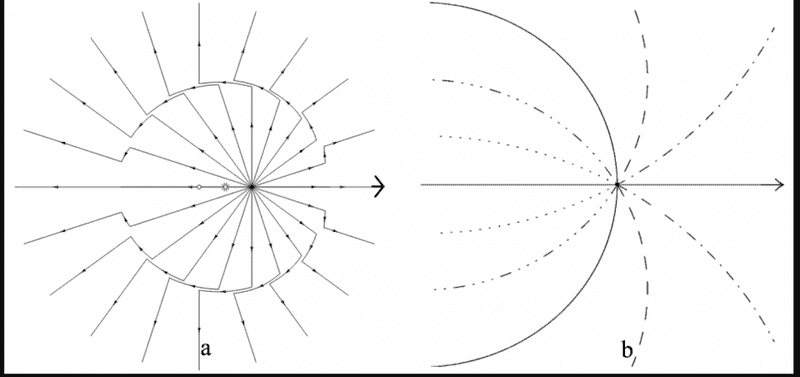
And I noticed that the field lines for an accelerating charge also bends.
Screen Shot 2017-01-20 at 6.01.26 PM.png


So can we say that because one field changes the geometric configuration of the other field, the other charge must accelerate to accompany that change?

I know the formal definition involves charges(F=qE), but I want to know if it can be viewed from another perspective.
 
Physics news on Phys.org
I guess you could think of it in a way that states that a particle wants to return to its natural configuration with all field lines point straight outward/innward. So it seeks that natural state by moving. That definitely isn't an official law or anything but it definitely gets the idea across. But that wouldn't describe opposite charges.
 
  • Like
Likes   Reactions: FallenApple

Similar threads

  • · Replies 73 ·
3
Replies
73
Views
6K
  • · Replies 8 ·
Replies
8
Views
2K
  • · Replies 4 ·
Replies
4
Views
3K
  • · Replies 22 ·
Replies
22
Views
2K
  • · Replies 25 ·
Replies
25
Views
3K
  • · Replies 3 ·
Replies
3
Views
2K
  • · Replies 16 ·
Replies
16
Views
2K
  • · Replies 7 ·
Replies
7
Views
2K
  • · Replies 14 ·
Replies
14
Views
3K
  • · Replies 5 ·
Replies
5
Views
2K