Does a heat sink work equally well in both hot and cold environments?

Click For Summary

Discussion Overview

The discussion centers on the effectiveness of heat sinks in transferring heat in both hot and cold environments. Participants explore the principles of heat transfer, particularly in relation to temperature differences and convection, and consider practical applications such as heat exchangers.

Discussion Character

  • Exploratory
  • Technical explanation
  • Debate/contested

Main Points Raised

  • One participant questions whether a heat sink operates equally effectively in hot versus cold environments, specifically regarding the direction of heat transfer.
  • Another participant suggests that heat transfer efficiency depends on the temperature difference across the boundary and notes that fins can enhance heat transfer, although efficiency may decrease as temperatures equalize.
  • A different participant asserts that the concept is applicable in practical systems like shell and tube heat exchangers, referencing common practices in the industry.
  • One participant highlights that the effectiveness may vary based on system specifics, particularly mentioning the change in convection direction when hot and cold environments are reversed.

Areas of Agreement / Disagreement

Participants express varying views on the effectiveness of heat sinks in different environments, indicating that the discussion remains unresolved with multiple competing perspectives on the factors influencing heat transfer.

Contextual Notes

Participants mention factors such as temperature differences, convection direction, and system specifics, but do not fully resolve how these factors interact in different scenarios.

Jan Kraner
Messages
1
Reaction score
0
Hey,

I have a question regarding heat transfer. I was wondering if a heat sink works in both ways equally effective. What I mean by that is if we submerge the fins of a heat sink into a hot environment, will it transfer the heat equally effective to cold environment which it's mounted on compared to the fins being submerged in a cold environment and we would be cooling the hot environment that the heat sink is mounted on (normal use of a heatsink). A diagram for a better understanding is below.

Thank you for your answers :)
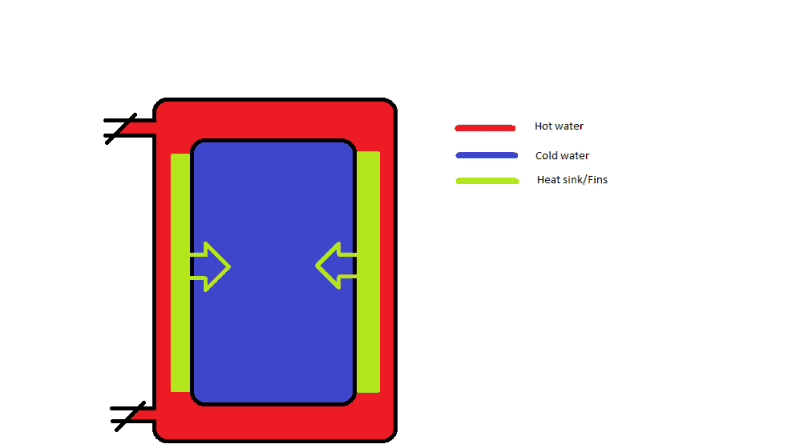
Kotel.png
 
Science news on Phys.org
Sure.

The heat transfer will depend on the temperature difference across the boundary. So in this situation, the fins will speed up heat transfer. The heat transfer will eventually slow as the temperature of the cold water warms up to the temperature of the hot water.

In other words, the fins will help increase heat transfer efficiency. But you still have various other things like energy conservation and heat conduction and so on.
 
Yes this will work. It's common on the pipes within shell and tube heat exchangers (Trane chillers).
Google image "tubes finned"
 
It does depend a bit on the particulars of the system. When you flip the hot and cold, you flip the convection direction.
 

Similar threads

Replies
8
Views
2K
  • · Replies 12 ·
Replies
12
Views
5K
  • · Replies 11 ·
Replies
11
Views
3K
  • · Replies 31 ·
2
Replies
31
Views
4K
  • · Replies 2 ·
Replies
2
Views
2K
  • · Replies 11 ·
Replies
11
Views
2K
  • · Replies 19 ·
Replies
19
Views
5K
  • · Replies 9 ·
Replies
9
Views
3K
  • · Replies 21 ·
Replies
21
Views
8K
  • · Replies 6 ·
Replies
6
Views
10K