Discussion Overview
The discussion revolves around the orientation of aerial antennas in relation to electromagnetic (EM) waves, particularly focusing on the implications of polarization and the interaction of EM waves with conductive materials. Participants explore concepts related to antenna design, wave propagation, and the behavior of electric and magnetic fields in various contexts.
Discussion Character
- Exploratory
- Technical explanation
- Conceptual clarification
- Debate/contested
- Mathematical reasoning
Main Points Raised
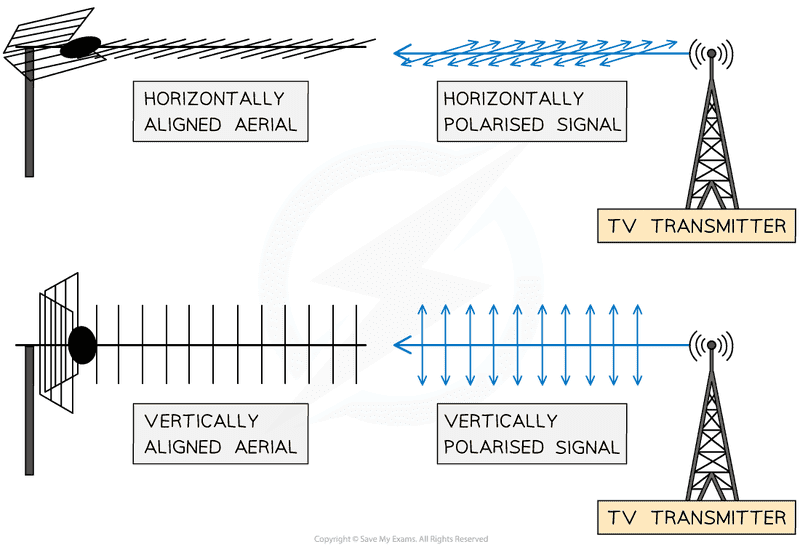
- Some participants suggest that aerial antennas should be positioned perpendicularly to all EM waves, including radio waves.
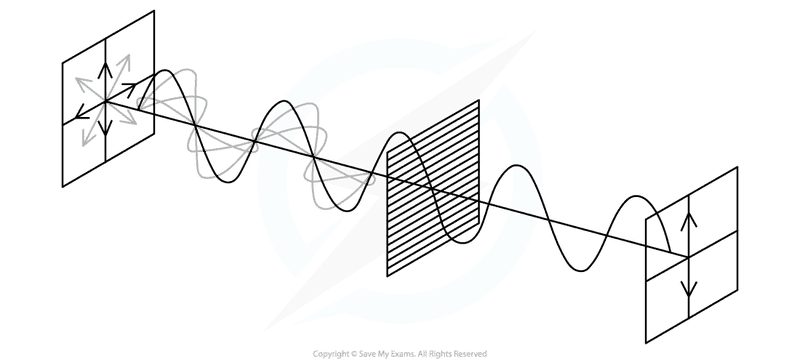
- Others explain that a metal grille reflects the electric polarization parallel to its wires, allowing only the orthogonal component to pass through.
- There is confusion among participants regarding the definitions of orthogonality and electric polarization, with some questioning how free electrons in a grille interact with the electric field of the wave.
- One participant describes how a horizontal wire antenna transmits horizontally polarized electric waves and vertically polarized magnetic waves, noting their orthogonal relationship.
- Another participant elaborates on how a perfectly conductive sheet induces a perpendicular current that cancels the forward wave, leading to reflection of the magnetic component.
- Some participants express uncertainty about the relationship between the forward wave and the induced current, questioning the role of energy returning to the transmitter.
- There is a discussion about the necessity for both transmit and receive antennas to be oriented similarly to ensure effective communication.
- One participant asserts that a magnetic field cannot cause electron movement, emphasizing the role of the electric field in this process.
- Another participant counters that in near-field analysis of conductive antennas, the electric field can be ignored, focusing instead on the current.
- Some participants share personal insights on learning and understanding complex topics, emphasizing the importance of critical thinking and diverse sources of information.
Areas of Agreement / Disagreement
Participants express a range of views on the orientation of antennas and the interaction of EM waves with conductive materials. There is no consensus on several technical aspects, including the roles of electric and magnetic fields in inducing currents and the implications of polarization.
Contextual Notes
Some participants acknowledge limitations in their understanding of the concepts discussed, particularly regarding the definitions and implications of polarization and the behavior of currents in conductive materials. The discussion includes unresolved questions about the mechanics of wave propagation and the interactions involved.