Dot product in spherical coordinates

Click For Summary
SUMMARY

The discussion centers on evaluating radiation patterns using the dot product in spherical coordinates, specifically through the expression r' cos ψ = r' ⋅ r̂. The formula provided breaks down the dot product into Cartesian components, highlighting the relationship between spherical and Cartesian coordinates. The confusion arises from the need to convert vectors r' and r̂ into Cartesian form before performing the dot product. Understanding the spherical coordinate system and its conversion to Cartesian coordinates is essential for correctly applying these concepts in antenna theory.

PREREQUISITES
  • Spherical coordinate system and its conventions
  • Cartesian coordinate system and vector representation
  • Dot product and its geometric interpretation
  • Electromagnetic theory fundamentals, particularly in antenna design
NEXT STEPS
  • Study the conversion formulas between spherical and Cartesian coordinates
  • Learn about the properties of the dot product in vector calculus
  • Explore antenna radiation patterns and their mathematical representations
  • Review Jin's Electromagnetic text for practical applications of these concepts
USEFUL FOR

Students and professionals in electrical engineering, particularly those focusing on antenna design and electromagnetic theory, will benefit from this discussion. It is also valuable for anyone seeking to understand the mathematical foundations of radiation patterns in spherical coordinates.

FrankJ777
Messages
140
Reaction score
6
TL;DR
I'm trying to understand how to take the dot product in spherical coordinates, if that is indeed what I'm supposed to be doing here?
I'm learing about antennas in a course, and we are using Jin's Electromagnetic text.
This isn't a homework problem, I'm just trying to understand what I'm supposed to do in this situation.

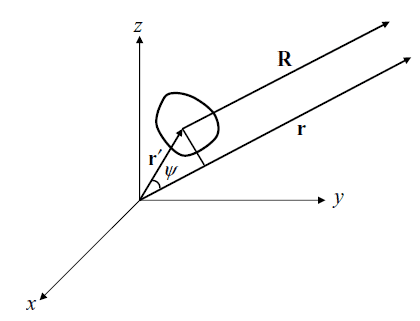
This part of the text discusses how to evaluate a radiation pattern.
One of the steps to evaluate the pattern is we have to find an expression for r'cosψ. (See diagram below.)
It says to find the expression, take the dot product between the vector r' and unit vector r.
Like so...r'⋅ \hat r
It gives the formula:
r' cos ψ = \textbf{r'} ⋅ \hat r = \textbf{r'} ⋅ \hat x cosθsinφ + \textbf{r'} ⋅ \hat y sinθsinφ + \textbf{r'} ⋅ \hat z cosθ

I'm confused about what I'm supposed to do, and what I'm supposed to get as an output.

I see that, that expression is the identity for the r component when converting from cartesian to spherical, I'm not sure what's going on.
Am I supposed to convert r' and r_hat to cartesian then take the dot product?

What are the components. \hat x cosθsinφ \hat y sinθsinφ \hat z cosθ
Do I find the θ and φ of r_hat?

I appreciate any help. I'm very confused.
1601953972291.png
 
Last edited:
Physics news on Phys.org
A unit vector ##\hat n## defined by the polar angle ##\theta## and azimuthal angle ##\varphi## is:
$$\hat n = \sin \theta\cos \varphi \ \hat x + \sin \theta\sin \varphi \ \hat y + \cos \theta \hat z$$
Note that this is the "physics" convention for ##\theta, \varphi##. The "maths" convention uses these angles the other way round. See, for example:
https://en.wikipedia.org/wiki/Spherical_coordinate_system
 
Let's work with a Cartesian basis system ##\vec{e}_j##. The spherical coordinate system is then usually introduced by choosing ##\vec{e}_3## as the polar axis. The position vector is parametrized by spherical coordinates ##(r,\vartheta,\varphi)## as
$$\vec{x}=\begin{pmatrix} r \sin \vartheta \cos \varphi \\ r \sin \vartheta \sin \varphi \\ r \cos \vartheta \end{pmatrix}.$$
Where here and in the following all column vectors are referring to the Cartesian coordinates.

The holonomic basis of the spherical coordinates are given by
$$\vec{b}_r = \partial_r \vec{x}=\begin{pmatrix} \sin \vartheta \cos \varphi \\ \sin \vartheta \sin \varphi \\ \cos \vartheta \end{pmatrix},$$
$$\vec{b}_{\vartheta} = \partial_{\vartheta} \vec{x} =r \begin{pmatrix} \cos \vartheta \cos \varphi \\ \cos \vartheta \sin \varphi \\ -\sin \vartheta \end{pmatrix},$$
$$\vec{b}_{\varphi}=\partial_{\varphi} \vec{x} = r \begin{pmatrix} -\sin \vartheta \sin \varphi \\ \sin \vartheta \cos \varphi \\ 0\end{pmatrix}.$$
It's easy to see by takting the scalar products that these vectors are pairwise orthogonal and thus one usually uses a normalized basis, i.e., in each point there's a Cartesian basis spanned by tangent vectors on the coordinate lines. These vectors are
$$\vec{e}_r=\vec{b}_r=\begin{pmatrix} \sin \vartheta \cos \varphi \\ \sin \vartheta \sin \varphi \\ \cos \vartheta \end{pmatrix},$$
$$\vec{e}_{\vartheta}=\vec{b}_{\vartheta}/r=\begin{pmatrix} \cos \vartheta \cos \varphi \\ \cos \vartheta \sin \varphi \\ -\sin \vartheta \end{pmatrix},$$
$$\vec{e}_{\varphi}=\vec{b}_{\varphi}/(r \sin \vartheta) = \begin{pmatrix} -\sin \varphi \\ \cos \varphi \\ 0\end{pmatrix}.$$
In this order they build a right-handed Cartesian basis, ##\vec{e}_r \times \vec{e}_{\vartheta}=\vec{e}_{\varphi}## (and cyclic).

Now you can express any vector field with components wrt. this basis
$$\vec{V}(\vec{r})=V_r(r,\vartheta,\varphi) \vec{e}_r + V_{\vartheta}(r,\vartheta,\varphi) \vec{e}_{\vartheta}+ V_{\varphi}(r,\vartheta,\varphi).$$

Position vectors are somewhat special. Here you often need the relation between the angle ##\psi## between two position vectors ##\vec{x}## and ##\vec{x}'##. To evaluate this, it's more convenient to use the Cartesian components in terms of the spherical coordinates, i.e.,
$$\vec{x}=r \begin{pmatrix} \sin \vartheta \cos \varphi \\ \sin \vartheta \sin \varphi \\ \cos \vartheta \end{pmatrix}, \quad \vec{x}'=r' \begin{pmatrix} \sin \vartheta' \cos \varphi' \\ \sin \vartheta' \sin \varphi' \\ \cos \vartheta' \end{pmatrix}.$$
Then by definition of the scalar product you have after using the cosine addition theorem
$$\vec{x} \cdot \vec{x}'=r r' \cos \psi = r r' [\sin \vartheta \sin \vartheta' \cos(\varphi-\varphi') + \cos \vartheta \cos \vartheta')].$$
 
  • Like
Likes   Reactions: BvU

Similar threads

  • · Replies 4 ·
Replies
4
Views
2K
  • · Replies 8 ·
Replies
8
Views
2K
  • · Replies 14 ·
Replies
14
Views
3K
  • · Replies 5 ·
Replies
5
Views
2K
  • · Replies 1 ·
Replies
1
Views
3K
  • · Replies 4 ·
Replies
4
Views
2K
  • · Replies 19 ·
Replies
19
Views
3K
  • · Replies 1 ·
Replies
1
Views
15K
  • · Replies 2 ·
Replies
2
Views
2K
  • · Replies 1 ·
Replies
1
Views
4K