Double Slit Diffraction Problem

Click For Summary

Discussion Overview

The discussion revolves around a double slit diffraction problem encountered in an exam setting. Participants are exploring the conditions for constructive interference and the calculations involved in determining the positions of maxima on a screen. The scope includes conceptual understanding and mathematical reasoning related to wave interference patterns.

Discussion Character

  • Homework-related
  • Conceptual clarification
  • Mathematical reasoning

Main Points Raised

  • One participant describes their approach to solving the problem using Pythagorean theorem and arctangent calculations, seeking feedback on potential errors.
  • Another participant suggests that the initial approach may have overcomplicated the problem and prompts a return to the fundamental physics of the situation.
  • There is a discussion about the condition for constructive interference, with one participant asserting that it involves complete constructive interference from two rays of light.
  • Another participant proposes that the condition for constructive interference relates to the path difference being a whole number of wavelengths.
  • A clarification is made regarding the central maximum being the zeroth maximum, with subsequent maxima defined in relation to it, and a formula involving path difference is introduced.

Areas of Agreement / Disagreement

Participants do not reach a consensus on the correct approach to the problem, as there are differing opinions on the complexity of the initial solution and the interpretation of the conditions for constructive interference.

Contextual Notes

Some assumptions regarding the geometry of the setup and the definitions of path lengths may be implicit in the discussion. The relationship between the distances and angles involved in the diffraction pattern is not fully resolved.

spitonem
Messages
4
Reaction score
0
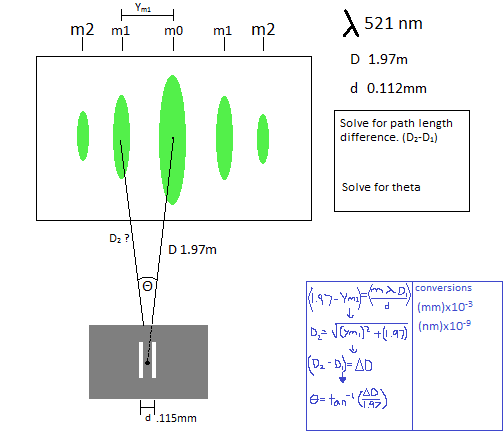
I had this problem on my exam and I was pretty sure i knew what to do but it couldn't come up with the right answers.
I diagrammed the problem and showed the way i tried to solve it in blue. Can someone tell me where i went wrong?
W6xA170.png


Basically i found the length the of the first maximum off the center. i used Pythagorean's theorem to find D2. Then subtracted the two distances to find the difference. I then took the arctan of that distance divided by D1.
 
Science news on Phys.org
You way over-thought the problem.
Start from the physics: what is the condition that makes a maximum?
 
the center of a maximum is complete constructive interference from two rays of light?
 
the center of a maximum is complete constructive interference from two rays of light?
... good - so what is the condition for constructive interference in terms of the path lengths?
 
wouldn't it be the wavelength plus by any integer being multiplied by the wavelength?
 
wouldn't it be the wavelength plus by any integer being multiplied by the wavelength?
Almost: the path difference has to be a whole number of wavelengths for constructive interference.
This makes the central maximum the zeroth maximum ... with the 1st and second etc on either side of it.

Lets say D is the perpendicular distance from the slits to the screen - as it is in your diagram.
If D>>d, the path difference between the zeroth maximum and the nth maximum is ##D_n-D=d\sin\theta_n##
You've seen a formula like that before.
 

Similar threads

  • · Replies 4 ·
Replies
4
Views
2K
  • · Replies 33 ·
2
Replies
33
Views
4K
  • · Replies 11 ·
Replies
11
Views
3K
  • · Replies 8 ·
Replies
8
Views
21K
  • · Replies 3 ·
Replies
3
Views
3K
  • · Replies 20 ·
Replies
20
Views
3K
  • · Replies 4 ·
Replies
4
Views
2K
  • · Replies 4 ·
Replies
4
Views
4K
  • · Replies 8 ·
Replies
8
Views
6K
  • · Replies 2 ·
Replies
2
Views
2K