Can I simplify this RLC circuit problem using a different method?

Click For Summary
SUMMARY

The forum discussion centers on simplifying an RLC circuit problem involving impedance calculations. The user struggles with deriving the maximum impedance frequency from a complex expression, specifically using the formula Z = R + i(ωL - 1/ωC). The conversation highlights the need for clearer algebraic steps and the use of LaTeX for mathematical expressions. Participants suggest that the user may need to consider alternative methods or approximations to simplify the problem.

PREREQUISITES
  • Understanding of RLC circuit theory
  • Familiarity with complex impedance calculations
  • Knowledge of LaTeX for mathematical notation
  • Ability to perform algebraic manipulations involving complex numbers
NEXT STEPS
  • Learn how to derive impedance in RLC circuits using the s-domain method
  • Study techniques for simplifying complex expressions in circuit analysis
  • Explore the use of approximations in electrical engineering problems
  • Practice using LaTeX for formatting mathematical equations in discussions
USEFUL FOR

Electrical engineering students, circuit designers, and anyone involved in analyzing RLC circuits and their impedance characteristics.

Cloruro de potasio
Messages
30
Reaction score
1
Homework Statement
Given the circuit of Fig. 13-6, with L = 4mH, C=2$\muF$, R1 = 25 ohms, R2 = 40 Ohms. Find the following set of frequencies.

a) where $\omega = 1/\sqrt{LC}$
b) where the impedance is maximum.
c) where the current through R1 is in phase with the generatori voltage.
Relevant Equations
Z = R + i(\omegaL - 1/\omegaC)

Series asociation of Z: $Z_eq = Z_1 + Z_2 + ...$
Association of Z in parallel: $Z_eq^-1 = Z_1^-1 + Z_2^-1 + ...$
Hello,

I have been thinking about this problem for a few hours, and I do not understand how I should proceed to solve it correctly. Section a is very simple, just substitute in the expression that gives us the values of L and C that the statement gives us.

However, when I get to section b, I have encountered the problem that what I have done is calculate the modulus of the equivalent impedance, and from there, try to derive with respect to $ \ omega $, in order to try to find the frequency value for which the impedance is maximum.

However, the expression of Z that remains is very long and complicated, both to calculate its module, and to derive, so I interpret that there must be another way to solve the exercise more easily, which has not occurred to me.

I leave you the figure on which the exercise deals, and the value of impedance that is obtained

Thank you very much in advance and regards
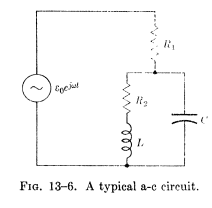
1588207879515.png

1588207928689.png
 
Physics news on Phys.org
Cloruro de potasio said:
Relevant Equations:: Z = R + i(\omegaL - 1/\omegaC)

Series asociation of Z: $Z_eq = Z_1 + Z_2 + ...$
Association of Z in parallel: $Z_eq^-1 = Z_1^-1 + Z_2^-1 + ...$

I leave you the figure on which the exercise deals, and the value of impedance that is obtained
No, please show your work where you did the algebra to calculate the Z for that simple circuit. Are you having trouble doing the algebra or dealing with the mix of complex impedances or keeping the parallel and series combinations straight? If you show your detailed work, we can try to help you figure it out.

Please use LaTeX when you post your math -- there is a tutorial at the top of the page under INFO/Help. Thank you. :smile:
 
Thanks again, the associations of impedances if I understand them correctly, and I know how to get to the expression that I have left above, the problem is that when calculating the module of the impedance, and deriving, the expressions that remain on very very long and ugly, and it is practically impossible, to clear the value of the requested frequency. Therefore, I have assumed that this is not the correct way to solve the exercise, I suppose that it will be necessary to make some approximation or some consideration that I cannot see, so that the problem is greatly simplified.

I have not uploaded your photos at work because I have a broken mobile phone, but I can try to ask someone to scan my pages
 
Cloruro de potasio said:
the problem is that when calculating the module of the impedance, and deriving, the expressions that remain on very very long and ugly, and it is practically impossible, to clear the value of the requested frequency.
The initial expression in the s-domain is not too bad, then substituting s=jω is not much worse, and then finding the real and imaginary parts is still not too bad, IMO. Finding the magnitude of the real part after that is a little messy, but necessary...
Cloruro de potasio said:
I have not uploaded your photos at work because I have a broken mobile phone, but I can try to ask someone to scan my pages
No pictures needed if you just read the LaTeX tutorial and start typing... :smile:
 
@Cloruro de potasio ,
I see that you did try to use ##LaTeX## to a small degree, particularly in the Homework Statement and Relevant Equations section of the Opening Post. A few tips for ##LaTeX## here at PF.

Rather than using a single $ for a delimiter, PF uses a double $ for stand alone expressions and a double # for inline expressions.

For your Homework Statement, you wrote
Given the circuit of Fig. 13-6, with L = 4mH, C=2$\muF$, R1 = 25 ohms, R2 = 40 Ohms. Find the following set of frequencies.

a) where $\omega = 1/\sqrt{LC}$
b) where the impedance is maximum.
c) where the current through R1 is in phase with the generator voltage.
Replacing each dollar sign ( $ ) with a double pound sign ( ## ) gives the following for the Homework Statement.

Given the circuit of Fig. 13-6, with L = 4mH, C=2##\mu F##, R1 = 25 Ohms, R2 = 40 Ohms. Find the following set of frequencies.

a) where ##\omega = 1/\sqrt{LC}##
b) where the impedance is maximum.
c) where the current through R1 is in phase with the generator voltage.

Similar modification to your Relevant Equations gives the following.

##Z = R + i(\omega L - 1/\omega C) ##

Series association of Z: ##Z_{eq} = Z_1 + Z_2 + ...##

Association of Z in parallel: ##Z_{eq}^{-1} = Z_1^{-1} + Z_2^{-1} + ...##

Added in Edit:
Note: That last line was entered as follows.
Association of Z in parallel: ##Z_{eq}^{-1} = Z_1^{-1} + Z_2^{-1} + ...## .
 
Last edited:
  • Like
Likes   Reactions: berkeman

Similar threads

  • · Replies 3 ·
Replies
3
Views
1K
  • · Replies 8 ·
Replies
8
Views
2K
  • · Replies 21 ·
Replies
21
Views
1K
  • · Replies 13 ·
Replies
13
Views
1K
  • · Replies 32 ·
2
Replies
32
Views
3K
  • · Replies 5 ·
Replies
5
Views
3K
  • · Replies 6 ·
Replies
6
Views
2K
  • · Replies 14 ·
Replies
14
Views
3K
  • · Replies 3 ·
Replies
3
Views
3K
  • · Replies 5 ·
Replies
5
Views
5K
