Doubt about solution -- Two masses connected by a rod moving on a surface

Click For Summary
SUMMARY

The discussion centers on the mechanics of two masses connected by a rod moving on a surface, specifically addressing the nature of forces acting on the system. Participants clarify that all forces involved are pulling forces, with mass m1 exerting a force F1,rod on the rod, which in turn pulls the rod to the left. The confusion arises from the notation and the assumption of how the masses interact, with emphasis on the role of static friction and the connection between the masses. The conclusion is that the connection implies a secure relationship, allowing for coordinated movement.

PREREQUISITES
  • Understanding of Newton's laws of motion
  • Familiarity with force diagrams and free-body diagrams
  • Knowledge of static friction and its role in mechanics
  • Basic principles of connected systems in physics
NEXT STEPS
  • Study Newton's second law and its application in connected systems
  • Learn about free-body diagrams and how to represent forces accurately
  • Research the effects of static friction in mechanical systems
  • Explore examples of connected masses and their motion in physics problems
USEFUL FOR

Physics students, educators, and anyone interested in understanding the dynamics of connected systems and force interactions in mechanics.

String theory guy
Messages
26
Reaction score
4
Homework Statement
The statement is below.
Relevant Equations
Newton's Second Law
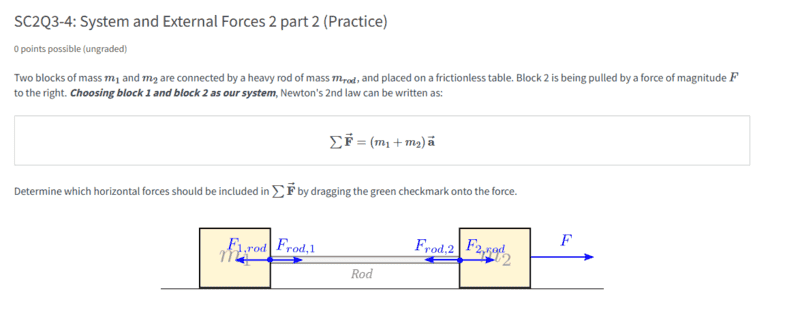
The doubt is about this question.
1671078556063.png

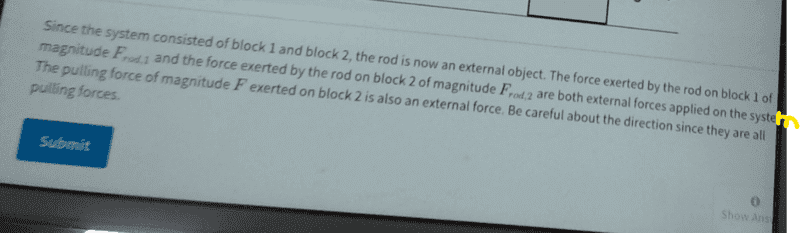
Which the answer is
1671078745584.png

They say that all the forces are pulling forces? How is this the case?

How would this setup even work? I don't think block 2 could pull the rod.
 
Physics news on Phys.org
String theory guy said:
They say that all the forces are pulling forces? How is this the case?
Can you find one that isn't?
 
  • Love
Likes   Reactions: String theory guy
String theory guy said:
Yes I can @haruspex :
F1, rod
F2, rod
F1,rod is the force m1 exerts on the rod. That force pulls the rod to the left.
 
  • Love
Likes   Reactions: String theory guy
haruspex said:
F1,rod is the force m1 exerts on the rod. That force pulls the rod to the left.
I thought it was the opposite way round. How did you derive that @haruspex ?
 
String theory guy said:
I thought it was the opposite way round. How did you derive that @haruspex ?
Do you mean, how do I know that F1,rod is the force m1 exerts on the rod, not the force the rod exerts on m1? Because clearly everything does move to the right, and the only way m1 is going to move to the right is if the force the rod exerts on m1 is to the right. So that must be Frod,1.
But the question ought to have made the notation clear.
 
  • Love
Likes   Reactions: String theory guy
haruspex said:
Do you mean, how do I know that F1,rod is the force m1 exerts on the rod, not the force the rod exerts on m1? Because clearly everything does move to the right, and the only way m1 is going to move to the right is if the force the rod exerts on m1 is to the right. So that must be Frod,1.
But the question ought to have made the notation clear.
Yea that is my doubt I think @haruspex - how dose everything in the system move to the right? Is there some glue or something between the block and masses? That is the only way I can see mass 1 moving to the right being in contact with the rod that is moving to the right.

I don't know, but the force of static friction should not be that great allowing the rod to pull mass 1.
 
String theory guy said:
Is there some glue or something between the block and masses?
It says they're connected, so I would take that as meaning they are somehow secured together.
 
  • Love
Likes   Reactions: String theory guy

Similar threads

Replies
10
Views
2K
  • · Replies 71 ·
3
Replies
71
Views
3K
Replies
3
Views
2K
Replies
13
Views
2K
  • · Replies 6 ·
Replies
6
Views
1K
  • · Replies 9 ·
Replies
9
Views
2K
Replies
7
Views
2K
  • · Replies 2 ·
Replies
2
Views
2K
Replies
4
Views
2K
  • · Replies 13 ·
Replies
13
Views
3K