Is Dragos rule evidence of hybridization theory's failure?

Click For Summary
SUMMARY

The discussion centers on Drago's rule, which states that when a central atom has a lone pair, belongs to groups 13-16, has an electronegativity of 2.5 or less, and has a total of four sigma bonds and lone pairs, hybridization can be disregarded. This rule highlights discrepancies between predicted bond angles from hybridization theory and actual bond angles observed in molecules like PH3, which are closer to 90 degrees rather than the expected 109.28 degrees. The conversation critiques the limitations of hybridization theory and suggests that theoretical frameworks like molecular orbital theory (Q) provide a more accurate representation of molecular geometry.

PREREQUISITES
  • Understanding of Drago's rule and its implications in molecular geometry.
  • Familiarity with hybridization theory and its limitations.
  • Knowledge of molecular orbital theory and the Schrödinger equation.
  • Basic concepts of VSEPR theory for predicting molecular shapes.
NEXT STEPS
  • Research the mathematical foundations of the Schrödinger equation and its applications in quantum chemistry.
  • Explore molecular orbital theory in-depth to understand its advantages over hybridization theory.
  • Study VSEPR theory to learn how it can be used as a practical tool for predicting molecular shapes.
  • Investigate experimental data supporting Drago's rule and its implications for chemical bonding.
USEFUL FOR

Chemistry students, theoretical chemists, educators seeking to improve teaching methods, and anyone interested in the nuances of molecular geometry and bonding theories.

Hamiltonian
Messages
296
Reaction score
193
TL;DR
-
Drago rule states that if –
  1. the central atom has at least one lone pair of electron on it
  2. the central atom belongs to group 13,14,15 or 16 and is from the 3rd to 7th period.
  3. if electronegativity of the central element is 2.5 or less
  4. no. of sigma bonds+ lone pair=4
then, there is no need to consider the Hybridization of that element.

Drago's rule was introduced to explain why the bond angles of molecules such as ##PH_3##, ##AsH_3##, ##SbH_3## differ so much from ##109^o28'## which is supposed to be the ideal bond angle of molecules with ##sp^3## hybridization(as the steric number ##Z = 4##). Is the fact that Dragos rule exists prove somewhat the failure of hybridization theory as the theory itself predicts the bond angles to be ##109^o28'## but in actuality, the bond angles are closer to ##90^o## hence implying hybridization does not take place?

The theory of hybridization does not account for the bond angles of these elements to be (##\approx 90^o##) and Dragos rule was born out of only experimental data.
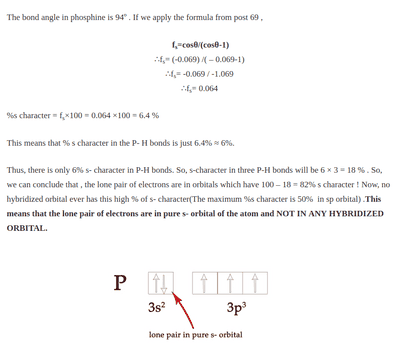
The only theoretical proof that I have found that predicts Dragos rule is
Phosphine _dragos rule.png.png

(https://madoverchemistry.com/2018/1...l-bonding-24-covalent-bonding23-drago-rule-2/)
I am unclear as to how they get those equations(I can't find post 69 but I suspect its an equation from orbital analysis but I am not too sure) here it is proving by contradiction that no hybridization is going to take place in phosphine(##PH_3##) instead of solely relying on experimental data.

so in short I don't understand:
1. the theoretical prediction of Dragos rule(which is given in the link above) using orbital analysis.
2. If the fact that Dragos rule exists proves the failure of hybridization theory.
 
Last edited:
Chemistry news on Phys.org
If I understand correctly what is happening here is this:

1. There exists a general theory (call it Q) allowing us to describe electrons in any molecule.
2. This theory is way too inconvenient for everyday use, so we devised a simplified theory O, based on Q.
3. O is simplified, so it doesn't account for some phenomena we observe in reality, thus we add another theory, H, that helps us describe them.
4. Because of these simplifications O with H still fail, so we add an experimental rule D, to predict when H stops working.

Now you are trying to find a rationale behind O, H and D, that will allow you to treat them the same way we treat Q. Well - it won't work, because O and H are just simplified attempts at explaining the more complicated reality. In a way there is no need to prove they are wrong, as they are wrong by design. They do share many characteristics of the full theory Q, but they also ignore some details, so by definition now and then they have to fail.
 
  • Like
Likes   Reactions: DrClaude, DrStupid, jim mcnamara and 1 other person
Borek said:
If I understand correctly what is happening here is this:

1. There exists a general theory (call it Q) allowing us to describe electrons in any molecule.
2. This theory is way too inconvenient for everyday use, so we devised a simplified theory O, based on Q.
3. O is simplified, so it doesn't account for some phenomena we observe in reality, thus we add another theory, H, that helps us describe them.
4. Because of these simplifications O with H still fail, so we add an experimental rule D, to predict when H stops working.

Now you are trying to find a rationale behind O, H and D, that will allow you to treat them the same way we treat Q. Well - it won't work, because O and H are just simplified attempts at explaining the more complicated reality. In a way there is no need to prove they are wrong, as they are wrong by design. They do share many characteristics of the full theory Q, but they also ignore some details, so by definition now and then they have to fail.
just out of curiosity what would theory Q be (molecular orbital theory?)
also, I still don't understand the equations in the post above that predict the %s character.
 
Broadly speaking Q is the quantum theory based on the Schrödinger equation H\Psi=E\Psi.

Note that the notion of orbitals (O) is a simplification. Schrödinger equation describes the system (atom, molecules) as a whole, and its solution doesn't treat every electron individually. Assigning electrons to orbitals and finding solutions in terms of these orbitals makes math easier and results much more palatable, but in general it is only an approximation. In many cases a very good one, but not always - that's why we need tricks like hybridization. MO is another variant of a simplified theory - similar to O, just applied to larger systems.
 
  • Like
  • Informative
Likes   Reactions: jim mcnamara, BillTre and TeethWhitener
Borek said:
Broadly speaking Q is the quantum theory based on the Schrödinger equation H\Psi=E\Psi.

Note that the notion of orbitals (O) is a simplification. Schrödinger equation describes the system (atom, molecules) as a whole, and its solution doesn't treat every electron individually.
what does its solution yield? ( the shape of the atom in 3d space?)

Borek said:
assigning electrons to orbitals and finding solutions in terms of these orbitals makes math easier and results much more palatable, but in general it is only an approximation. In many cases a very good one, but not always - that's why we need tricks like hybridization. MO is another variant of a simplified theory - similar to O, just applied to larger systems.
I think I don't know enough math to truly understand this:(
 
Hamiltonian299792458 said:
what does its solution yield? ( the shape of the atom in 3d space?)

Wave function Ψ and energy E. Squared wave function is an electron density, so it is related to the shape.

I think I don't know enough math to truly understand this:(

Don't worry, just remember, that this is a wast subject and things you are taught now are just simplified approaches. On many levels they are good enough, but they will be never fully consistent.
 
  • Like
Likes   Reactions: Hamiltonian
Strangely enough, for at least 50 years now, no theoretical chemist believes any more in the geometry being dictated by hybridization. Yet teachers don't stop parroting this old lore.
 
DrDu said:
Strangely enough, for at least 50 years now, no theoretical chemist believes any more in the geometry being dictated by hybridization.
probably because they know of a much more elegant theory(the Schrödinger equation as mentioned above) that doesn't need a whole lot of exceptions like hybridization and molecular orbital theory.
 
DrDu said:
Strangely enough, for at least 50 years now, no theoretical chemist believes any more in the geometry being dictated by hybridization. Yet teachers don't stop parroting this old lore.
Are there general rules that have replaced hybridization? What would be the better way to teach this?

(In case my questions may sound negative, they are not. I am genuinely interesting in figuring out how to best teach this.)
 
  • #10
On a simple level, VSEPR theory comes to my mind.
 

Similar threads

Replies
7
Views
1K
  • · Replies 4 ·
Replies
4
Views
3K
  • · Replies 1 ·
Replies
1
Views
4K
  • · Replies 3 ·
Replies
3
Views
44K
  • · Replies 1 ·
Replies
1
Views
2K
  • · Replies 8 ·
Replies
8
Views
7K
Replies
4
Views
29K
  • · Replies 1 ·
Replies
1
Views
3K
  • · Replies 8 ·
Replies
8
Views
4K
  • · Replies 3 ·
Replies
3
Views
5K