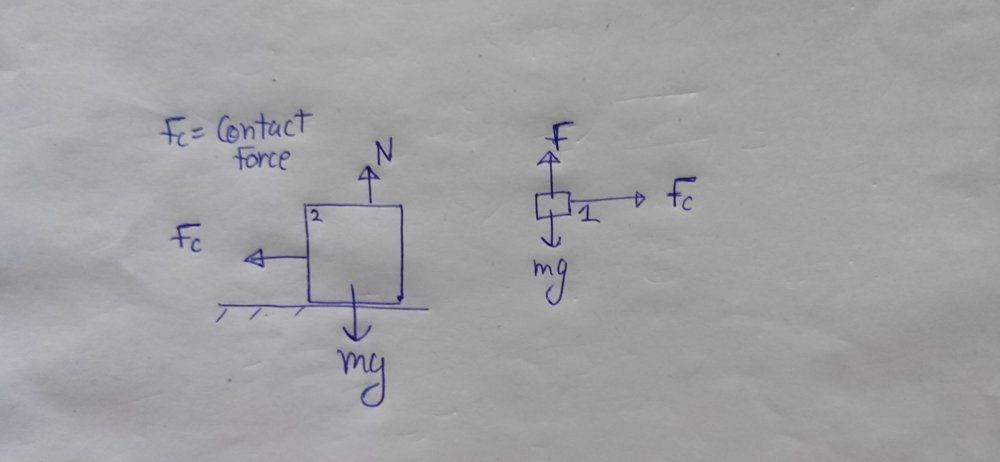
Draw the F.B.D. (Free Body diagram) of two blocks

Click For Summary
SUMMARY

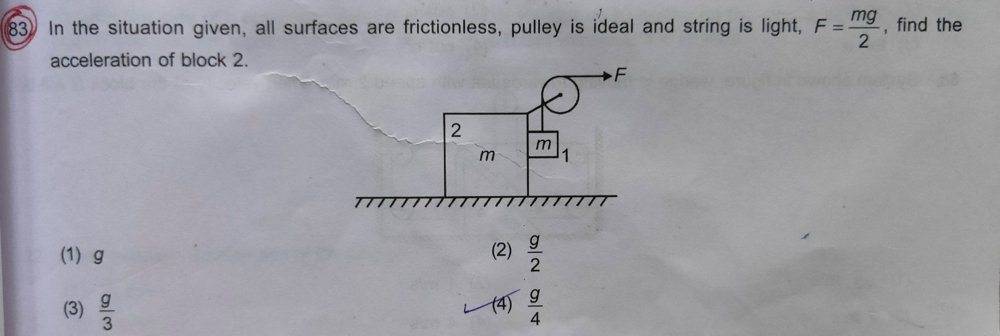
The discussion focuses on drawing the Free Body Diagram (FBD) for two blocks connected by a pulley system, where all surfaces are frictionless, and the pulley is ideal. The key equation derived is F = mg/2, which is essential for calculating the acceleration of block 2. Participants emphasize the importance of considering the system as a whole rather than analyzing individual bodies separately, noting that the tension in the string and the forces acting on the pulley must be accurately represented in the FBD.

PREREQUISITES
  • Understanding of Free Body Diagrams (FBD)
  • Knowledge of Newton's laws of motion
  • Familiarity with pulley systems and tension forces
  • Basic principles of frictionless surfaces in physics
NEXT STEPS
  • Study the principles of tension in pulley systems
  • Learn how to construct Free Body Diagrams for multiple objects
  • Explore Newton's second law and its applications in dynamic systems
  • Investigate the effects of friction in pulley systems for comparative analysis
USEFUL FOR

Physics students, mechanical engineers, and anyone studying dynamics and forces in systems involving pulleys and multiple bodies.

Shivam
Messages
32
Reaction score
2
Summary: In the situation given, all the surfaces are friction less, pulley is ideal and string is light, F=mg/2, Find the acceleration of block 2 ?

Here's the diagram--
245501
My attempt- (i) I tried to solve the question by making FBD of the two blocks, but i am not able to draw all the forces, the forces that i drew are not able to explain the motion of the blocks.
245502
[Moderator's note: Moved from a technical forum and thus no template.]
 
Last edited by a moderator:
Physics news on Phys.org
What forces act on the pulley?
 
scottdave said:
What forces act on the pulley?
Net √2F will be acting on pulley due to tension making an angle of -45° with +x-axis, and this Force has to be balanced by the opposite Force but I don't know how to associate this opposite Force and to whom should I associate .
 
You don't need to analyse the bodies separately to answer the question. Just consider the system and the horizontal external forces. The body 2 had no vertical acceleration.
 
Shivam said:
Net √2F will be acting on pulley due to tension making an angle of -45° with +x-axis, and this Force has to be balanced by the opposite Force but I don't know how to associate this opposite Force and to whom should I associate .
The pulley is rigidly attached to the box (not with a rope). @nasu is also correct but there is nothing wrong with your method. You do need to include the pulley applying F to the right on the box through the attachment. It will also push down on the box with force F .
 
nasu said:
You don't need to analyse the bodies separately to answer the question. Just consider the system and the horizontal external forces. The body 2 had no vertical acceleration.
I saw one method where these boxes are considered under a system. I understood that method , but I wanted to know FBD of the boxes separately and actually which force is opposing the contact force .. if can draw the FBD then please do post here.
 
Your FBD is almost correct. Just that F is horizontal and not vertical. The force acting vertically on the the small body is the tension in the string. As the pulley is rigidly connected to body 2, F acts horizontally on body 2. This is where is supposed to be in the FBD, if you split the system into two objects. If you consider the force in the pulley connection then you should have a 3 body diagram: body 1, body 2 and pulley. But you don't need this for the problem. Even 2-body is not necessary.
 

Similar threads

  • · Replies 5 ·
Replies
5
Views
2K
Replies
4
Views
868
  • · Replies 5 ·
Replies
5
Views
1K
  • · Replies 2 ·
Replies
2
Views
1K
Replies
4
Views
1K
  • · Replies 25 ·
Replies
25
Views
2K
  • · Replies 7 ·
Replies
7
Views
4K
  • · Replies 11 ·
Replies
11
Views
3K
Replies
4
Views
1K