Drawing a Wheel Under Acceleration - RWD Car

Click For Summary

Discussion Overview

The discussion revolves around the forces acting on a driving wheel of a rear-wheel drive (RWD) car during acceleration. Participants explore the correct representation of forces and torques in a free body diagram, addressing both theoretical and practical aspects of the scenario.

Discussion Character

  • Technical explanation, Conceptual clarification, Debate/contested

Main Points Raised

  • One participant presents a drawing of a wheel under acceleration and questions whether any forces are missing or incorrectly directed.
  • Another participant describes the external forces acting on the wheel, including friction and reaction forces, and discusses the relationship between torque and angular acceleration.
  • A later reply suggests that the forces of gravity and normal force should be equal, and questions the inclusion of a forward force in the diagram.
  • Some participants express confusion regarding the treatment of torque and angular acceleration, emphasizing that torque must be present if there is angular acceleration.
  • There is a discussion about the implications of assuming zero angular inertia for the wheel and how that affects the net torque and acceleration of the car.
  • Participants consider the need to simplify the model by removing certain forces while acknowledging real-world factors like rolling resistance and aerodynamic drag.

Areas of Agreement / Disagreement

Participants exhibit some agreement on the need to refine the diagram and the role of torque in the context of angular acceleration. However, there is disagreement regarding the inclusion of certain forces and the implications of different assumptions about angular inertia.

Contextual Notes

Limitations include the assumptions made about angular inertia and the exclusion of real-world factors such as rolling resistance and energy losses, which may not be fully addressed in the current model.

PhysicsN_b
Messages
6
Reaction score
0
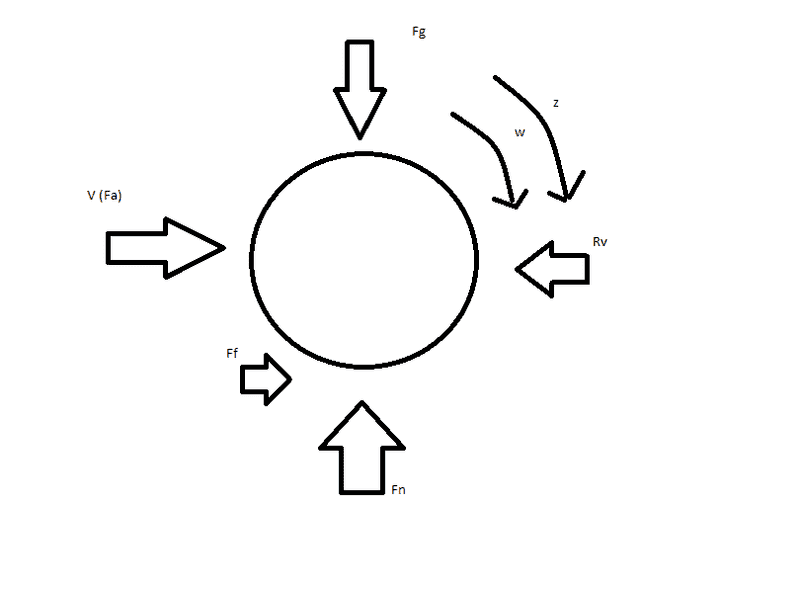
I drew up a quick picture in paint of a wheel under acceleration. This is the driving wheel of a RWD car. Am I missing any forces/drawn in the wrong direction?
FBDWheel.png


Thanks.
 
Physics news on Phys.org
Assuming all the forces are supposed to be external forces applied to the wheel, then friction force from the road to the tire would be to the right, and the reaction force of the car to acceleration, F = m a, would be to the left and same magnitude as friction force. You also have a clockwise torque force on the wheel from the rear axle (negative sign if using conventional angular math), almost all opposed by the counter clockwise torque related road force and car reaction force. The net torque on the wheel would correspond to the rate of angular acceleration of the wheel divided by it's angular inertia. If you assume that angular inertia of the wheel is zero, then net torque is zero.
 
Last edited:
Updated.

FBDWheel-2.png


Assume Rv to be the reaction force of the car on the wheel, and I labeled the angular acceleration z since I cannot due Greek letters in paint. This is correct now right?
 
There is no force V(Fa) acting on the wheel. Fg and Fn should have equal magnitude. Ff and Rv should have equal magnitude. Apparently you're not concerned about torques on the wheel.
 
I don't understand how I am not concerned with the torque applied on the wheel. If there is angular acceleration on the wheel, there has to be a torque applied. Also, the wheel has to be applying a forward force V(Fa) for the car to accelerate in speed correct, so at the axle there would be a forward force applied? I don't understand what I am missing.
 
PhysicsN_b said:
I don't understand how I am not concerned with the torque applied on the wheel. If there is angular acceleration on the wheel, there has to be a torque applied.
If your model uses a non-zero value for angular inertia of the wheel then there's a small net torque on the wheel, most of the torque ends up accelerating the car. If your model uses a zero value for angular inertia of the wheel, then there is no torque due to angular acceleration of a massless wheel, and all of the torque ends up accelerating the car.

PhysicsN_b said:
Also, the wheel has to be applying a forward force V(Fa) for the car to accelerate in speed correct, so at the axle there would be a forward force applied?
A free body diagram is supposed to show only the forces acting on the wheel, and not the forces generated by the wheel.
 
Okay. So the only thing I need to get rid of is V(Fa) and 'say' that z is non zero and it should be perfect to be an example of a driving/accelerating wheel?
 
PhysicsN_b said:
Okay. So the only thing I need to get rid of is V(Fa) and 'say' that z is non zero and it should be perfect to be an example of a driving/accelerating wheel?
Close enough. In the real world, there would be rolling resistance, aerodynamic drag, energy losses in the drive train, but for a typical physics problem, it's good enough.
 

Similar threads

  • · Replies 15 ·
Replies
15
Views
5K
  • · Replies 12 ·
Replies
12
Views
2K
  • · Replies 10 ·
Replies
10
Views
3K
  • · Replies 6 ·
Replies
6
Views
3K
  • · Replies 21 ·
Replies
21
Views
3K
  • · Replies 95 ·
4
Replies
95
Views
7K
  • · Replies 15 ·
Replies
15
Views
3K
  • · Replies 20 ·
Replies
20
Views
2K
  • · Replies 29 ·
Replies
29
Views
8K
  • · Replies 1 ·
Replies
1
Views
2K