Jairo Rodriguez
- 1
- 0
Hello, today our teacher told us that on tomorrow's test there is going to be a problem where you drop a mass on a slope which connects into a loop. The point of the problem is to calculate exactly how tall the slope must be for the mass to complete exactly one course through the loop.
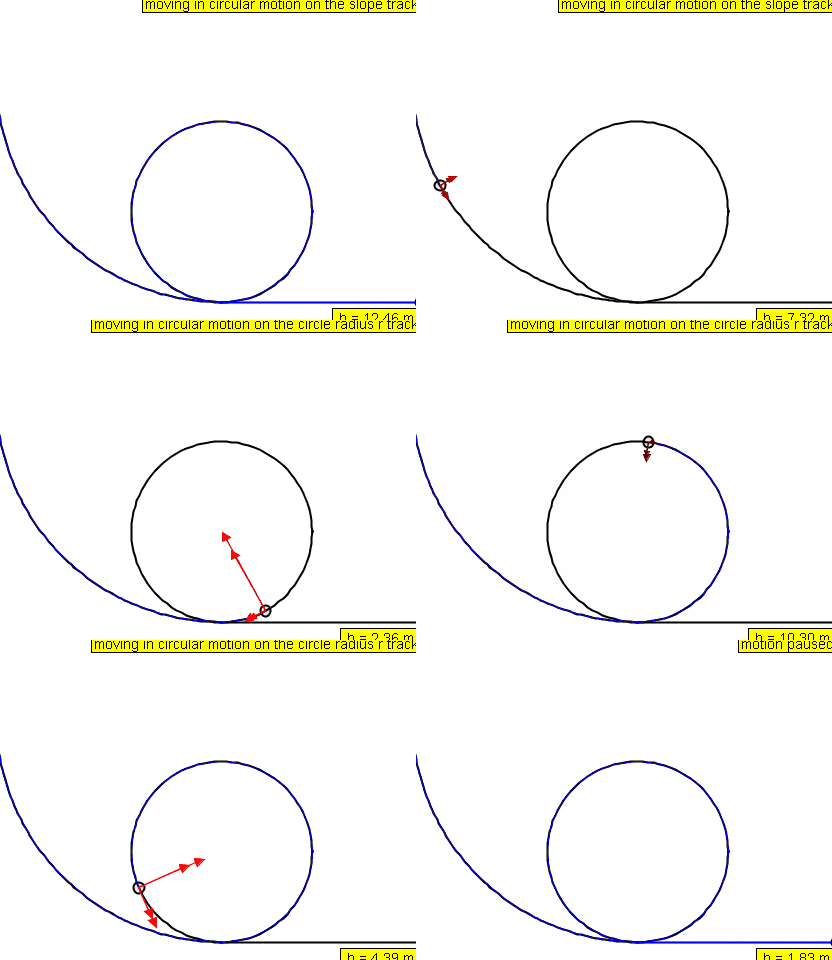
(https://upload.wikimedia.org/wikipedia/commons/1/10/CoasterH%3D2.5r.gif, I think it looks better from there.)
I hope this helps to visualize. The idea is that I drop the object on h height, and then it travels down the slope which is frictionless, then enters the loop which has friction, μk=0,2. I have to express algebraically the height required for the mass to stop after it has completed exactly 1 turn. The turn starts when the mass "starts going up" the loop.
I have tried doing this, I even asked another teacher (an assistant) how to do it, and he was unable to. I initially started with the usual stuff, U1 = K2, U1 at the start of the slope, K2 when the loop starts. Then I started calculating the K3 + U3 on the topmost part of the loop, but then I realized I have to take into account centripetal forces, also the normal force which it's different for every point on the loop, so I think I have to dive into calculus. I haven't done any calculus in my life, but if that's the only way to the answer, I am willing to do the necessary reading to at least understand the explanation.
That's all the info we get. If the post is badly redacted, I am sorry, spanish is my first language. If I wasn't clear on some point, let me know, I will try to fix it or explain myself as soon as possible. First time on this forum. Sorry again.
Thanks.
(https://upload.wikimedia.org/wikipedia/commons/1/10/CoasterH%3D2.5r.gif, I think it looks better from there.)
I hope this helps to visualize. The idea is that I drop the object on h height, and then it travels down the slope which is frictionless, then enters the loop which has friction, μk=0,2. I have to express algebraically the height required for the mass to stop after it has completed exactly 1 turn. The turn starts when the mass "starts going up" the loop.
I have tried doing this, I even asked another teacher (an assistant) how to do it, and he was unable to. I initially started with the usual stuff, U1 = K2, U1 at the start of the slope, K2 when the loop starts. Then I started calculating the K3 + U3 on the topmost part of the loop, but then I realized I have to take into account centripetal forces, also the normal force which it's different for every point on the loop, so I think I have to dive into calculus. I haven't done any calculus in my life, but if that's the only way to the answer, I am willing to do the necessary reading to at least understand the explanation.
That's all the info we get. If the post is badly redacted, I am sorry, spanish is my first language. If I wasn't clear on some point, let me know, I will try to fix it or explain myself as soon as possible. First time on this forum. Sorry again.
Thanks.
Last edited by a moderator: