Dynamic Fluid (airplane landing/decrease altitude)

  • Context: High School 
  • Thread starter Thread starter Arif Setiawan
  • Start date Start date
  • Tags Tags
    Altitude Dynamic Fluid
Click For Summary
SUMMARY

The discussion centers on the conditions affecting an airplane's wings during landing and descent, specifically analyzing pressure (P1 and P2) and velocity (v1 and v2) using Bernoulli's equation. The consensus is that during landing, the condition P1>P2 and v1 PREREQUISITES

  • Understanding of Bernoulli's equation
  • Basic principles of aerodynamics
  • Knowledge of lift and weight dynamics in flight
  • Familiarity with steady-state flight conditions
NEXT STEPS
  • Research the application of Bernoulli's equation in aviation
  • Study the relationship between lift, weight, and drag during flight
  • Explore the physics of steady ascent and descent in aircraft
  • Learn about the effects of pressure differences on wing performance
USEFUL FOR

Aerodynamics educators, aviation students, flight instructors, and anyone interested in the principles of aircraft performance during landing and descent.

Arif Setiawan
Messages
6
Reaction score
1
Hi guys.. I've some discussion with my friend. We are teacher. So we must carefully to answer question for student.. there the question is

From figure below, p2 and p1 applied on plane's wings. When airplane landing/decrease altitude, which condition must occupied
A. P1=P2 and v1=v2
B. P1<P2 and v1>v2
C. P1<P2 and v1<v2
D. P1>P2 and v1>v2
E. P1>P2 and v1<v2
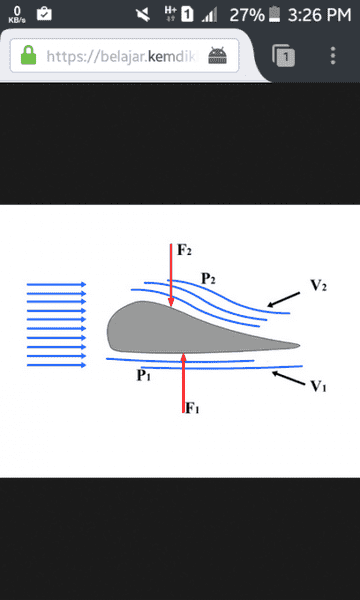
Screenshot_2017-02-21-15-26-58.png


On my opinion, at any rate we total force by bernoully equation must upright vertical oposite weight. Because, without Force of wings plane will fall. So, when take off/increase altitude F>w .. stay at certain height F=w.. and when landing F<w.. But F must remain positive. So P1>P2 and v1<v2 (E)

At opposite, my friend though that when take off P1>P2 and when landing P1<P2.

OK guys.. may you all give us your though.. thanks.. regrads
 
Physics news on Phys.org
Arif Setiawan said:
On my opinion, at any rate we total force by bernoully equation must upright vertical oposite weight. Because, without Force of wings plane will fall. So, when take off/increase altitude F>w .. stay at certain height F=w.. and when landing F<w.. But F must remain positive. So P1>P2 and v1<v2 (E)

At opposite, my friend though that when take off P1>P2 and when landing P1<P2.

OK guys.. may you all give us your though.. thanks.. regrads
You are correct: when decreasing in altitude, the wing is still producing positive lift...just less of it.
 
russ_watters said:
You are correct: when decreasing in altitude, the wing is still producing positive lift...just less of it.
In a steady descent, the total net force is zero (otherwise the aircraft would accelerate). A component of drag in addition to most of the lift opposes gravity. In a steady climb, lift is also less than the weight, and a component of thrust (in excess of drag) opposes gravity.
 
Last edited:
rcgldr said:
In a stead descent, the total net force is zero (otherwise the aircraft would accelerate). A component of drag in addition to most of the lift opposes gravity. In a steady climb, lift is also less than the weight, and a component of thrust (in excess of drag) opposes gravity.
Thanks for the clarification. I did fall into a little trap there, though it doesn't impact the problem answer.
 
Arif Setiawan said:
So, when take off/increase altitude F>w .. stay at certain height F=w.. and when landing F<w ..
If the aircraft is not accelerating, then total net force = zero. In level flight, lift = weight (ignoring direction). In a steady climb or steady descent, lift < weight (ignoring direction). In a steady climb, a component of thrust (minus drag) opposes gravity. In a steady descent, a component of drag (minus thrust) opposes gravity.
 
That's the aspect that I haven't see before..
Thanks for these clear information
 

Similar threads

Replies
0
Views
2K
  • · Replies 7 ·
Replies
7
Views
2K
  • · Replies 3 ·
Replies
3
Views
2K
Replies
2
Views
4K
  • · Replies 10 ·
Replies
10
Views
6K
  • · Replies 3 ·
Replies
3
Views
16K
  • · Replies 16 ·
Replies
16
Views
4K
  • · Replies 9 ·
Replies
9
Views
4K
  • · Replies 3 ·
Replies
3
Views
3K
  • · Replies 4 ·
Replies
4
Views
4K