Dynamics: disc released horizontally, with pin fixed to edge (rotation)

Click For Summary

Homework Help Overview

The discussion revolves around a dynamics problem involving a disc released horizontally with a fixed pin at its edge. Participants explore concepts related to torque, moment of inertia, and angular acceleration as they analyze the motion of the disc.

Discussion Character

  • Exploratory, Conceptual clarification, Mathematical reasoning

Approaches and Questions Raised

  • The original poster attempts to calculate the angular acceleration and the acceleration of the disc's center of mass using torque and moment of inertia. They question how to determine the vertical reaction force at the pin and explore different interpretations of the forces acting on the disc.

Discussion Status

Participants have engaged in a productive dialogue, clarifying concepts related to net forces and the application of forces at different points on the disc. Some guidance has been offered regarding the relationship between angular acceleration and linear acceleration, as well as the nature of the reaction force at the pin.

Contextual Notes

Participants are navigating the complexities of dynamics, including the implications of fixed pivot points and the effects of gravitational forces on the system. There is an ongoing exploration of assumptions regarding force application points and net force calculations.

Aralox
Messages
5
Reaction score
0
Hi guys, I am really stumped by this 1st yr Dynamics question, and would appreciate any help on how to approach the question.
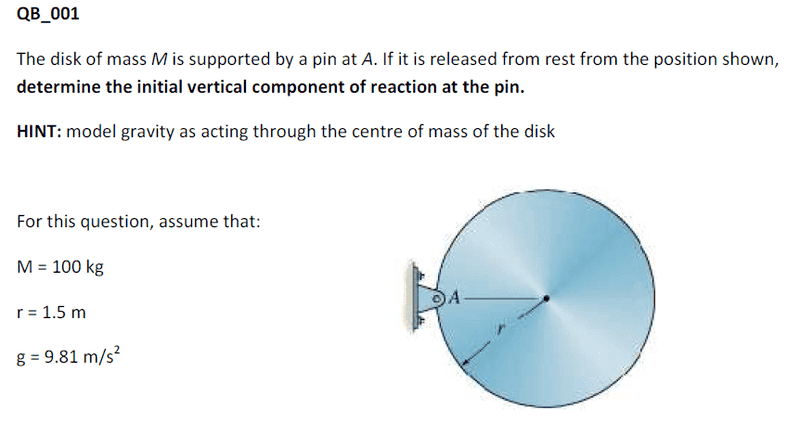
Homework Statement


q4KaJ.png


Homework Equations


Torque equations and Force equations
Moment of inertia for disc rotating around centre: (mr^2)/2
After using parallel axis theorem, the I about the edge is I = (3/2)mr^2

Thank you,
Aralox
 
Physics news on Phys.org
Welcome to PF.
Aralox said:

Homework Equations


Torque equations and Force equations
Moment of inertia for disc rotating around centre: (mr^2)/2
After using parallel axis theorem, the I about the edge is I = (3/2)mr^2

Thank you,
Aralox
Using the parallel axis theorem is a good start. Can you do the following:

1. Given I, and the torque about the pivot point, can you calculate the angular acceleration of the disk?

2. From the angular acceleration about the pivot, you should be able to figure out the acceleration of the disk's center of mass.
 
Thanks for the reply!

1. Given I, and the torque about the pivot point, can you calculate the angular acceleration of the disk?
I used Net Torque = mgr, as initially the weight is perp. to radius to pivot.
Since net torque = Iα (α is angular acc.),
mgr = Iα.
Since I = (3/2) mr^2, I simplified the previous equation to

α = 2g/3r, which happens to be a constant, so it looks like i have the initial angular acceleration of the disc about the pivot at the edge.


2. From the angular acceleration about the pivot, you should be able to figure out the acceleration of the disk's center of mass.
To find this, i used the equation a = αr,
so acceleration of disc's center: a = (2g/3r) * r = (2/3)g

How would i find the vertical reaction of the pin from this though?
Just brainstorming, could i do something where i took the disc to be not moving and the world rotating around it, meaning i would have the edge moving at a = (2/3)g, which i could get some kind of reaction force from?
This interpretation/application step is what I am having the most trouble with.


Thanks,
Aralox

PS: Just a test to figure out this 'latex reference' thing
[itex]\sum Torque[/itex]
 
Looks good so far :approve:
Aralox said:
.
.
.
...so acceleration of disc's center: a = (2g/3r) * r = (2/3)g

How would i find the vertical reaction of the pin from this though?
Just brainstorming, could i do something where i took the disc to be not moving and the world rotating around it, meaning i would have the edge moving at a = (2/3)g, which i could get some kind of reaction force from?
This interpretation/application step is what I am having the most trouble with.
Well, now that you know the acceleration of the disk's center of mass, you pretty much know what the net force (vector sum of all forces) acting on the disk must be...
 
Alrighty, so if i had:

[itex]\sum F[/itex] = N - mg = ma,
which leads to N = (5/3)mg

would N be the 'vertical component of reaction at the pin'? Isnt N the force (reaction force of some sort) vector originating at the centre of the disc, since I am taking net force at the centre?
 
Just a little bump :)
 
Sorry, somehow I missed your earlier post.
Aralox said:
Alrighty, so if i had:

[itex]\sum F[/itex] = N - mg = ma,
which leads to N = (5/3)mg
Well, a is downward, right? And you're taking the downward direction to be negative.

would N be the 'vertical component of reaction at the pin'?
Yes.
Isnt N the force (reaction force of some sort) vector originating at the centre of the disc, since I am taking net force at the centre?
No, N is acting at the pin. You're taking the net force acting on the disk, meaning the vector sum of all forces acting on the disk, whether they act at the center or not.
 
Ohhhhh now i understand! I've always had this idea in my head that when taking the net force they must all act at the same point, but now i think about it, that can't be the case.

Thank you for all the help Redbelly98! :)
 

Similar threads

  • · Replies 3 ·
Replies
3
Views
2K
Replies
7
Views
2K
  • · Replies 9 ·
Replies
9
Views
3K
Replies
8
Views
2K
Replies
11
Views
3K
  • · Replies 11 ·
Replies
11
Views
2K
Replies
335
Views
17K
  • · Replies 5 ·
Replies
5
Views
3K
  • · Replies 1 ·
Replies
1
Views
3K
  • · Replies 7 ·
Replies
7
Views
3K