Dynamics of a double atwood machine

Click For Summary
SUMMARY

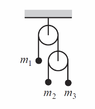
The discussion focuses on the dynamics of a double Atwood machine, specifically analyzing the forces and accelerations involved with mass configurations m1, m2, and m3. Key equations derived include T - m2g = m2a1 and m3g - T = m3a1, with T1 being defined as 2T under the assumption that the pulleys are massless and frictionless. The participants clarify that the accelerations of m2 and m3 are not equal in magnitude or direction, emphasizing the importance of considering the non-inertial frame of the accelerating pulley system.

PREREQUISITES
  • Understanding of Newton's Second Law of Motion
  • Familiarity with pulley systems and their dynamics
  • Knowledge of kinematic equations related to acceleration
  • Concept of massless and frictionless pulleys in mechanics
NEXT STEPS
  • Study the derivation of forces in a double Atwood machine
  • Learn about non-inertial reference frames in classical mechanics
  • Explore the implications of massless and frictionless assumptions in pulley systems
  • Investigate the kinematics of multiple connected masses in dynamic systems
USEFUL FOR

Students of physics, mechanical engineers, and anyone studying dynamics and kinematics of pulley systems will benefit from this discussion.

Aurelius120
Messages
269
Reaction score
24
Homework Statement
In a double Atwood machine(pulley suspended from another pulley), a mass, m1 is suspended from one side of the upper pulley(on the other side is the lower pulley) and masses m2 and m3 are suspended from either side of the lower pulley. π‘š3>π‘š2>π‘š1
𝑇 is the tension in the lower strings
𝑇1 is the tension in the upper strings
π‘Ž2 is the acceleration of π‘š1 and of the lower pulley system (as a whole)
π‘Ž1 is the acceleration of π‘š2 and π‘š3 in the lower pulley (taking only the lower system into consideration)
𝑔 is the acceleration due to gravity
I want to find the net acceleration of each mass and the time for m1 to strike the upper pulley given the length of the string from m1 to the upper pulley is 20cm
Relevant Equations
N/A
I think the equations should be

π‘‡βˆ’π‘š2𝑔=π‘š2π‘Ž1
π‘š3π‘”βˆ’π‘‡=π‘š3π‘Ž1
𝑇1βˆ’π‘š1𝑔=π‘š1π‘Ž2
2π‘‡βˆ’π‘‡1=(π‘š2+π‘š3)π‘Ž2

P.S.- My textbook assumes T1 = 2T.
I don't understand why that is so.
 

Attachments

  • LE615.png
    LE615.png
    3.3 KB · Views: 186
  • Like
Likes   Reactions: Delta2
Physics news on Phys.org
Are the pulleys assumed massless?
 
The accelerations of m2 and m3 are not equal, either in magnitude or direction. They would be equal in magnitude only if the lower pulley were not accelerating.
 
Last edited:
Aurelius120 said:
π‘Ž1 is the acceleration of π‘š2 and π‘š3 in the lower pulley (taking only the lower system into consideration)
It is not clear what you mean by that. Since you are taking the two accelerations to have the same magnitude, I presume you mean these as accelerations relative to the pulley. But the pulley is accelerating, so this is a non-inertial frame. Consequently the equations below need another term:
Aurelius120 said:
π‘‡βˆ’π‘š2𝑔=π‘š2π‘Ž1
π‘š3π‘”βˆ’π‘‡=π‘š3π‘Ž1
Aurelius120 said:
P.S.- My textbook assumes T1 = 2T.
Consider the balance of forces on the lower pulley and write out the F=ma equation for it.
 
  • Like
Likes   Reactions: Delta2 and Chestermiller
Aurelius120 said:
Homework Statement:: In a double Atwood machine(pulley suspended from another pulley), a mass, m1 is suspended from one side of the upper pulley(on the other side is the lower pulley) and masses m2 and m3 are suspended from either side of the lower pulley. π‘š3>π‘š2>π‘š1
𝑇 is the tension in the lower strings
𝑇1 is the tension in the upper strings
π‘Ž2 is the acceleration of π‘š1 and of the lower pulley system (as a whole)
π‘Ž1 is the acceleration of π‘š2 and π‘š3 in the lower pulley (taking only the lower system into consideration)
𝑔 is the acceleration due to gravity
I want to find the net acceleration of each mass and the time for m1 to strike the upper pulley given the length of the string from m1 to the upper pulley is 20cm
Relevant Equations:: N/A

P.S.- My textbook assumes T1 = 2T
This holds only if the lower pulley is massless. To prove it proceed as @haruspex suggest and don't forget that the pulley is massless when applying Newton's 2nd law for this pulley.

Also a pulley has to be massless in order for the tensions on each side of the pulley to be equal. Just saying cause you might have taken this for granted, that it holds for all pulleys.
 
Doc Al said:
Are the pulleys assumed massless?
yes they are massless and frictionless
 
So will T1 be equal to 2T or will there be some other equations for T1?
[Because I think the string will slack if T1=2T
As m1 moves up with some a2 but the lower pulley will be stationary for T1=2T]
 
Aurelius120 said:
yes they are massless and frictionless
Good. From that you can deduce (not merely assume):
Aurelius120 said:
P.S.- My textbook assumes T1 = 2T.
 
Aurelius120 said:
So will T1 be equal to 2T or will there be some other equations for T1?
There may well be other equations in which T1 appears, but T1 = 2T follows from the fact that the pulley is massless.
Aurelius120 said:
[Because I think the string will slack if T1=2T
As m1 moves up with some a2 but the lower pulley will be stationary for T1=2T]
Not so.
 
  • #10
(Apply Newton's 2nd law to the pulley itself. Since it's massless, the net force on it must be zero.)
 

Similar threads

  • Β· Replies 22 Β·
Replies
22
Views
2K
  • Β· Replies 2 Β·
Replies
2
Views
2K
  • Β· Replies 7 Β·
Replies
7
Views
4K
Replies
1
Views
4K
  • Β· Replies 29 Β·
Replies
29
Views
5K
  • Β· Replies 3 Β·
Replies
3
Views
3K
  • Β· Replies 4 Β·
Replies
4
Views
1K
  • Β· Replies 5 Β·
Replies
5
Views
4K
  • Β· Replies 3 Β·
Replies
3
Views
6K
  • Β· Replies 1 Β·
Replies
1
Views
3K