EECS: Find i_0 in a circuit with 4 resistors and 1 indep. current source

Click For Summary

Discussion Overview

The discussion focuses on determining the current i_0 in a circuit with four resistors and one independent current source using nodal analysis and linearity. Participants explore the application of Kirchhoff's Current Law (KCL) and the implications of sign conventions in their calculations.

Discussion Character

  • Technical explanation
  • Debate/contested
  • Mathematical reasoning

Main Points Raised

  • One participant presents an initial calculation for i_0 using nodal analysis, expressing it in terms of node voltages v_1 and v_2.
  • Another participant identifies a mistake in the application of KCL at node v_2, suggesting that the sign of the 9A current source should be negative since it is entering the node.
  • A subsequent participant requests clarification on the identified mistake, indicating a lack of understanding.
  • Following the correction, the original poster revises their KCL equation for v_2, incorporating the negative sign for the current source, which alters the signs in their equations for v_1 and v_2.
  • The revised calculation leads to a new value for i_0, which is presented as positive, indicating a change from the initial assessment.
  • Another participant acknowledges the improvement in the calculations and advises caution in future KCL formulations.

Areas of Agreement / Disagreement

Participants do not reach a consensus on the initial calculations, as there is a correction made regarding the sign of the current source. The discussion reflects a process of refinement rather than a settled conclusion.

Contextual Notes

There are unresolved aspects regarding the assumptions made in the initial KCL formulations and the implications of sign conventions in circuit analysis.

VinnyCee
Messages
486
Reaction score
0
(a) Using nodal analysis, determine [itex]i_0[/itex] in the circuit.

(b) Now use linearity to find [itex]i_0[/itex].
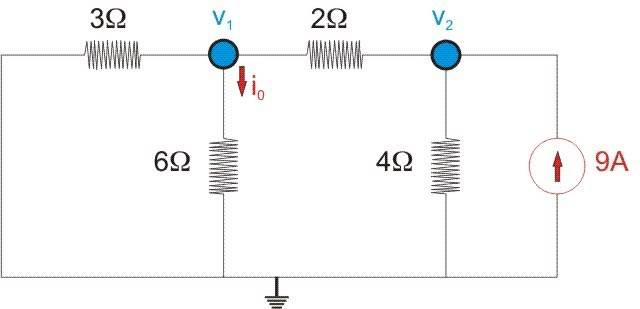

ch4prob4.jpg


Work so far:

[tex]i_0\,=\,\frac{v_1\,-\,0}{6\,\ohm}\,=\,\frac{v_1}{6\,\ohm}[/tex]

KCL@[itex]v_1[/itex]: [tex]\frac{v_1\,-\,0}{3\,\ohm}\,+\,\frac{v_1\,-\,0}{6\,\ohm}\,+\,\frac{v_1\,-\,v_2}{2\,\ohm}\,=\,0[/tex]

KCL@[itex]v_2[/itex]: [tex]\frac{v_2\,-\,v_1}{2\,\ohm}\,+\,\frac{v_2\,-\,0}{4\,\ohm}\,+\,9A\,=\,0[/tex]

[tex]v_1\,-\,\frac{1}{2}\,v_2\,=\,0[/tex]

[tex]-\,\frac{1}{2}\,v_1\,+\,\frac{3}{4}\,v_2\,=\,-9[/tex]

Whe I put these two equaitons into a 3 X 2 coefficient matrix, I get

[tex]v_1\,=\,-\,9V[/tex]
[tex]v_2\,=\,-\,18V[/tex]

Then I plug into the first equation:

[tex]i_0\,=\,\frac{v_1}{6\,\ohm}\,=\,\frac{(-\,9V)}{6\,\ohm}\,=\,-\,\frac{3}{2}A[/tex]

Is this the correct value for [itex]i_0[/itex] or have I got the sign wrong?
 
Physics news on Phys.org
VinnyCee said:
KCL@[itex]v_2[/itex]: [tex]\frac{v_2\,-\,v_1}{2\,\ohm}\,+\,\frac{v_2\,-\,0}{4\,\ohm}\,+\,9A\,=\,0[/tex]
You are repeating the same mistake here as you did in the previous exercise.
 
What is that, can you explain?
 
VinnyCee said:
What is that, can you explain?
The sign on the 9A is wrong. The other two terms in that KCL are for currents *out* of the node. So since the 9A is into the node, it has to be -9A in that equation. Makes sense?
 
OIC! There has to be a minus in there somewhere if all of the terms are on one side and it's equal to zero. Whoops!

Using your correction:

KCL @ [itex]v_2[/itex]: [tex]\frac{v_2\,-\,v_1}{2\,\ohm}\,+\,\frac{v_2\,-\,0}{4\,\ohm}\,-\,9A\,=\,0[/tex]

[tex]-\,\frac{1}{2}\,v_1\,+\,\frac{3}{4}\,v_2\,=\,9[/tex]

Which switches the signs on the [itex]v_1[/itex] and [itex]v_2[/itex]!

[tex]i_0\,=\,\frac{v_1}{6\,\ohm}\,=\,\frac{(9V)}{6\,\ohm}\,=\,\frac{3}{2}A[/tex]
 
Yes, that's much better. And be careful when you formulate the KCLs next time.
 

Similar threads

  • · Replies 6 ·
Replies
6
Views
3K
  • · Replies 15 ·
Replies
15
Views
2K
  • · Replies 37 ·
2
Replies
37
Views
6K
  • · Replies 1 ·
Replies
1
Views
2K
  • · Replies 8 ·
Replies
8
Views
2K
  • · Replies 15 ·
Replies
15
Views
2K
  • · Replies 2 ·
Replies
2
Views
2K
  • · Replies 9 ·
Replies
9
Views
6K
Replies
15
Views
3K
  • · Replies 16 ·
Replies
16
Views
4K