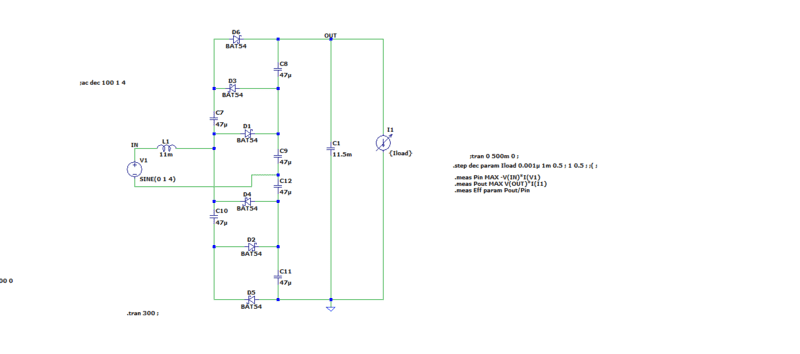
Discussion Overview
The discussion revolves around the efficiency analysis of a voltage multiplier circuit, specifically a sextupler voltage multiplier. Participants explore issues related to output power calculations, power losses, and the implications of using low voltage inputs in the circuit design. The conversation includes technical details about circuit components and their effects on performance.
Discussion Character
- Technical explanation
- Debate/contested
- Mathematical reasoning
Main Points Raised
- One participant reports negative output power in their simulation and questions how to calculate efficiency and power losses.
- Another participant suggests that low voltage inputs are inefficient due to voltage drops across diodes and proposes using saturated transistors for better efficiency.
- Concerns are raised about the adequacy of a 1 volt input at 4 Hz for the circuit's operation, with calculations provided for diode losses and capacitor reactance.
- Participants discuss the implications of using a current sink that pulls the output voltage negative, affecting the overall power output.
- There are inquiries about the source of power and its limitations, with calculations suggesting that the available power may be insufficient for effective energy harvesting.
- Some participants propose using more turns on the pickup coil or transformers to increase voltage, while others caution about the losses associated with transformers.
- Commercial solutions for energy harvesting are mentioned as potential resources for further exploration.
Areas of Agreement / Disagreement
Participants express differing views on the efficiency and feasibility of the voltage multiplier circuit, with no consensus reached on the best approach to improve performance or calculate output power accurately.
Contextual Notes
Participants highlight various assumptions, such as the impact of diode voltage drops, the frequency of the input signal, and the limitations of the circuit components used. The discussion remains open-ended regarding the optimal design and calculations for the voltage multiplier circuit.
Who May Find This Useful
This discussion may be of interest to individuals working on circuit design, energy harvesting technologies, or those studying the efficiency of voltage multipliers in practical applications.