Electric field, flux, and conductor questions

Click For Summary
SUMMARY

The discussion centers on the behavior of electric fields and charges in conductors, particularly addressing Gaussian surfaces and induced charges. Key points include that the electric field is zero at the bottom of a Gaussian surface due to symmetry and the absence of enclosed charge. It is established that a positive charge outside a conductor induces movement of free electrons, creating a negative side without actual movement of positive charges. When a positive rod is touched to a conductor, some positive charge transfers, resulting in the rod retaining a smaller positive charge.

PREREQUISITES
  • Understanding of Gauss' Law and its application to electric fields
  • Knowledge of electric field behavior in conductors and insulators
  • Familiarity with charge distribution and symmetry in electrostatics
  • Concept of electric potential and its relation to charge movement
NEXT STEPS
  • Study Gauss' Law in detail, focusing on applications to spherical and cylindrical symmetries
  • Explore the concept of electric potential and its implications in electrostatics
  • Investigate charge induction in conductors and the behavior of free electrons
  • Learn about the effects of touching conductors with different charge states
USEFUL FOR

Students and professionals in physics, electrical engineering, and anyone interested in understanding electrostatics, electric fields, and charge behavior in conductors.

annamal
Messages
393
Reaction score
33
1) Why is the electric field 0 at the bottom of Gaussian surface? Isn't the electric field on both sides of the surface, pointing down and outwards like a plane of charge? see image.
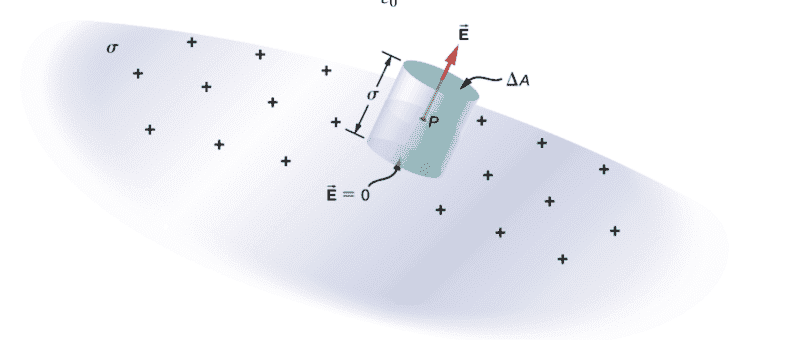
Screen Shot 2022-04-24 at 12.03.26 AM.png

2) Why does a charge distribution with cylindrical symmetry have to be infinitely long?
3) My book says a positive charge outside the conductor induces only the free electrons to move, so there are no positive charges that are actually moving? The excess electrons creates a negative side and the devoid of electrons creates a positive side so no positive charges are actually being repulsed away?
4) If I put a positive rod inside the cavity of a conductor and touch it inside, then take it away, does the rod retain being positive or did the electrons induced in the inside cavity move to the rod?
5) Is the net electric field of a charge 0 because the radial field lines cancel each other due to symmetry?
6) Why is there no induced charge outside of the conductor with positive and negative charges in a conductor's cavity? See image
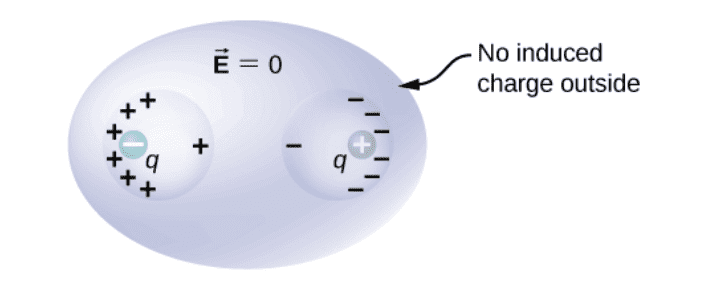
Screen Shot 2022-04-24 at 12.16.38 AM.png
 
  • Like
Likes   Reactions: Delta2
Physics news on Phys.org
As for 1), by the attached figure I observe that the bottom side is within the closed surface of charge and the top side is outward. If it is so, considering another closed surface where the bottom side is on that contains no charge inside, E=0 at the bottom side.
 
anuttarasammyak said:
As for 1), by the attached figure I observe that the bottom side is within the closed surface of charge and the top side is outward. If it is so, considering another closed surface where the bottom side is on that contains no charge inside, E=0 at the bottom side.
Yes, I see that but the surface charges have electric fields radiating outwards...so don't know why it doesn't have an electric field pointing down
 
annamal said:
Yes, I see that but the surface charges have electric fields radiating outwards...so don't know why it doesn't have an electric field pointing down
What does Gauss' theorem tell you about the field inside a hollow spherical shell of uniform charge density?
 
Ibix said:
What does Gauss' theorem tell you about the field inside a hollow spherical shell of uniform charge density?
I think I get it, but my explanation is the electric field lines radiating into the sphere all cancel out leaving no electric field inside the sphere
 
annamal said:
I think I get it, but my explanation is the electric field lines radiating into the sphere all cancel out leaving no electric field inside the sphere
You are correct that there is no field, but if there is no field then there are no field lines. That's why none are shown.
 
Ibix said:
You are correct that there is no field, but if there is no field then there are no field lines. That's why none are shown.
Do you know the answers to my other question or should I create different threads for them?
 
annamal said:
1) Why is the electric field 0 at the bottom of Gaussian surface? Isn't the electric field on both sides of the surface, pointing down and outwards like a plane of charge? see image.
View attachment 300479
2) Why does a charge distribution with cylindrical symmetry have to be infinitely long?
3) My book says a positive charge outside the conductor induces only the free electrons to move, so there are no positive charges that are actually moving? The excess electrons creates a negative side and the devoid of electrons creates a positive side so no positive charges are actually being repulsed away?
4) If I put a positive rod inside the cavity of a conductor and touch it inside, then take it away, does the rod retain being positive or did the electrons induced in the inside cavity move to the rod?
5) Is the net electric field of a charge 0 because the radial field lines cancel each other due to symmetry?
6) Why is there no induced charge outside of the conductor with positive and negative charges in a conductor's cavity? See image
View attachment 300480
UPDATE: 1, 2, 3, and 5 are answered.
I just need answers to 4 and 6.
 
for 4) yes if the rod is conductor too then the two conductors, because we touch them, have to be at the same potential , so some of the positive charge from rod has to move to the conductor, or equivalently some free electrons from the conductor to the positive rod. So the positive rod will have smaller positive charge after we touch them.
 
  • #10
Delta2 said:
for 4) yes if the rod is conductor too then the two conductors, because we touch them, have to be at the same potential , so some of the positive charge from rod has to move to the conductor, or equivalently some free electrons from the conductor to the positive rod. So the positive rod will have smaller positive charge after we touch them.
I didn't know the positive charges could move. I thought only the free electrons were moving.

I wonder why the positive rod is not completely neutralized.
 
  • #11
annamal said:
I didn't know the positive charges could move. I thought only the free electrons were moving.

I wonder why the positive rod is not completely neutralized.
You are right positive charges can't move, so free electrons move in order to equalize the potential. If the positive rod was completely neutralized that would mean that its potential would be zero, and so the conductor potential would be zero, so both conductor and rod at zero potential, which also would mean they have zero total charge, which violates conservation of charge, because the total charge at the start wasn't zero.
 
  • #12
Delta2 said:
You are right positive charges can't move, so free electrons move in order to equalize the potential. If the positive rod was completely neutralized that would mean that its potential would be zero, and so the conductor potential would be zero, so both conductor and rod at zero potential, which also would mean they have zero total charge, which violates conservation of charge, because the total charge at the start wasn't zero.
No, the conductor we touched would have net positive charge on the outside and the rod would have neutral charge.
 
  • #13
annamal said:
No, the conductor we touched would have net positive charge on the outside and the rod would have neutral charge.
if this was the case then the conductor and rod wouldn't be at same potential.

Basically when we touch them their potential becomes the same and we can conclude everything else from this fact. It is not that their charge becomes the same or that one charge becomes zero.
 
Last edited:
  • #14
Delta2 said:
if this was the case then the conductor and rod wouldn't be at same potential.

Basically when we touch them their potential becomes the same and we can conclude everything else from this fact. It is not that their charge becomes the same or that one charge becomes zero.
And the rod being less positive would create the same potential?
 
  • #15
annamal said:
And the rod being less positive would create the same potential?
It will not have the same potential as before we touch but it will have the same potential with the conductor.

The potential of something does not depend only on the charge it carries but on its shape/geometry too.
 

Similar threads

  • · Replies 3 ·
Replies
3
Views
2K
  • · Replies 1 ·
Replies
1
Views
1K
  • · Replies 10 ·
Replies
10
Views
2K
  • · Replies 6 ·
Replies
6
Views
2K
  • · Replies 3 ·
Replies
3
Views
502
  • · Replies 11 ·
Replies
11
Views
2K
  • · Replies 9 ·
Replies
9
Views
2K
Replies
48
Views
5K
  • · Replies 7 ·
Replies
7
Views
3K
  • · Replies 3 ·
Replies
3
Views
2K