Electric Field inside the material of a hollow conducting sphere

Click For Summary
SUMMARY

The discussion centers on the behavior of electric fields within a hollow conducting sphere when a positive point charge is placed inside. It is established that the electric field inside the conductor remains zero due to the rearrangement of charges, specifically a negative charge on the inner surface and a positive charge on the outer surface. The application of Gauss's Law confirms that the net charge enclosed by a Gaussian surface within the conductor is zero, maintaining the electric field at zero despite the presence of additional charges on the outer surface. The conversation also touches on the implications of symmetry in applying Gauss's Law to insulators.

PREREQUISITES
  • Understanding of Gauss's Law
  • Knowledge of electric fields and charge distribution
  • Familiarity with conductors and insulators in electrostatics
  • Basic concepts of electric flux
NEXT STEPS
  • Study the implications of Gauss's Law in various geometries
  • Explore electric field calculations in non-uniform charge distributions
  • Learn about the behavior of electric fields in insulators versus conductors
  • Investigate the mathematical techniques for solving electric field problems in asymmetric configurations
USEFUL FOR

Students and professionals in physics, electrical engineering, and anyone interested in understanding electrostatics, particularly the behavior of electric fields in conductors and insulators.

preachingpirate24
Messages
15
Reaction score
2
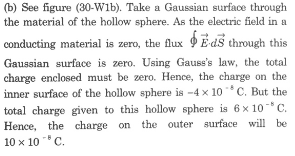
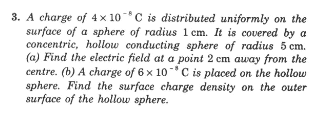
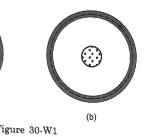
Let's say I place a positive point charge inside a hollow conducting sphere. If we take a Gaussian surface through the material of the conductor, we know the field inside the material of the conductor is 0, which implies that there is a -ve charge on the inner wall to make the net enclosed charge 0 and a +ve charge on its outer wall. If I remove some electrons from the sphere, my textbook tells me that the +ve charge on the outer surface increases. Does this mean that the Electric Field inside the conductor is not equal to 0?

If it still is equal to 0, can someone please help me understand why? When I remove some negative charge from the conducting sphere's material, the positive charge on its outer surface becomes greater in magnitude, which to me implies that there is an Electric Field inside the conductor.
Capture.PNG
Capture.PNG
Capture.PNG


I think I could also be misinterpreting the answer, and the author could be trying to say that the field inside the conductor was 0 before the extra charge was added to it, but then again, the author has stated that there can be no electric field inside a conductor in electrostatics. I understood why that statement is true, but when I add extra charges, I'm really not sure.

Thanks a lot for taking time to help :)
 
Physics news on Phys.org
If you put the charge inside, the charges of the conductor in the static state rearrange such there's no electric field inside the conductor, and there must be a surface charge distribution at the inner and the outer surface. From Gauss's Law you get that the inner surface must have a total charge of ##-4 \cdot 10^{-8} \text{C}##. Nothing changes on the inner surface of the conductor when putting the additional charge of ##6 \cdot 10^{-8} \text{C}## on the outer conductor but the additional charge distributes over the outer surface. Which thus must have a total charge of ##+10 \cdot 10^{-8} \text{C}##.
 
  • Like
Likes   Reactions: preachingpirate24 and etotheipi
vanhees71 said:
Nothing changes on the inner surface of the conductor when putting the additional charge of on the outer conductor but the additional charge distributes over the outer surface. Which thus must have a total charge of .

But wouldn't the extra positive charge create a net electric field pointing inwards in the conducting material? Or am I thinking along the wrong lines?
 
niranjanreji said:
But wouldn't the extra positive charge create a net electric field pointing inwards in the conducting material? Or am I thinking along the wrong lines?
Gauss's theorem says what is inside of enclosure matters, not outside. For example electric field is zero inside a sphere that has charged surface.
 
Last edited:
  • Like
Likes   Reactions: preachingpirate24
niranjanreji said:
When I remove some negative charge from the conducting sphere's material, the positive charge on its outer surface becomes greater in magnitude
This is correct. So now apply Gauss’ law. What does Gauss’ law say will happen?
 
  • Like
Likes   Reactions: preachingpirate24
Dale said:
This is correct. So now apply Gauss’ law. What does Gauss’ law say will happen?
If I take a Gaussian surface through the material of the conductor and the extra positive charge is outside the radius of this surface, the Electric Field is 0 since the net charge enclosed by it is 0. If I take a Gaussian surface with a radius larger than that of the larger sphere, I find that the flux is not 0, and hence the Electric Field is also not equal to zero. I'm pretty sure I'm right but I could be wrong here too.

I think I can see it better in my head now and justify it. Thanks a lot :smile:
 
niranjanreji said:
If I take a Gaussian surface through the material of the conductor and the extra positive charge is outside the radius of this surface, the Electric Field is 0 since the net charge enclosed by it is 0. If I take a Gaussian surface with a radius larger than that of the larger sphere, I find that the flux is not 0, and hence the Electric Field is also not equal to zero. I'm pretty sure I'm right but I could be wrong here too.
You are exactly right!
 
  • Like
Likes   Reactions: preachingpirate24
Dale said:
You are exactly right!
I have a follow up question. What if I have a uniformly charged plastic shell with a positive point charge inside it at the center? The field is easy to find in this case using a Gaussian surface inside the plastic shell. But when I bring another positive charge close to the border of the shell, if I use the same Gaussian surface, the field inside doesn't change at all.

And this is even when the electrons in the plastic shell cannot rearrange themselves to cancel out the external field. Can I not apply Gauss's law when I'm working with an insulator?
 
preachingpirate24 said:
But when I bring another positive charge close to the border of the shell, if I use the same Gaussian surface, the field inside doesn't change at all.
You need to be careful here. Because the symmetry is disrupted only the net flux doesn’t change. The field will increase in some parts of the surface and decrease in others. The loss of symmetry prevents you from easily using Gauss’ law.

preachingpirate24 said:
Can I not apply Gauss's law when I'm working with an insulator?
It isn’t an issue about conductor vs insulator. The issue is the symmetry. With the symmetry Gauss’ law is easy, but without the symmetry you need to use numerical techniques.
 
  • #10
Dale said:
You need to be careful here. Because the symmetry is disrupted only the net flux doesn’t change. The field will increase in some parts of the surface and decrease in others. The loss of symmetry prevents you from easily using Gauss’ law.
What about the center of the plastic sphere then?
 
  • #11
preachingpirate24 said:
What about the center of the plastic sphere then?
Is the situation completely spherically symmetric?
 
  • #12
Dale said:
Is the situation completely spherically symmetric?
Yeah.. no it isn't. I suppose I'll learn how to solve this once I study some higher mathematics at college. Thanks!
 
  • Like
Likes   Reactions: vanhees71 and Dale

Similar threads

  • · Replies 6 ·
Replies
6
Views
437
  • · Replies 1 ·
Replies
1
Views
1K
  • · Replies 5 ·
Replies
5
Views
1K
  • · Replies 4 ·
Replies
4
Views
2K
  • · Replies 3 ·
Replies
3
Views
561
  • · Replies 9 ·
Replies
9
Views
2K
  • · Replies 4 ·
Replies
4
Views
4K
  • · Replies 14 ·
Replies
14
Views
2K
  • · Replies 11 ·
Replies
11
Views
2K
  • · Replies 6 ·
Replies
6
Views
2K