Electric flux textbook discrepancy ?

Click For Summary
SUMMARY

The discussion centers on the concept of electric flux as defined by Gauss's Law, specifically addressing the confusion surrounding the inclusion of charges in relation to a Gaussian surface. It is established that only the charge enclosed by the surface contributes to the net electric flux, while external charges influence the electric field but do not affect the flux calculation. The net flux through a surface with zero enclosed charge is zero, as all field lines entering the surface also exit it. The distinction between enclosed and external charges is critical for understanding electric flux in electrostatics.

PREREQUISITES
  • Understanding of Gauss's Law in electrostatics
  • Familiarity with electric field lines and their representation
  • Basic knowledge of charge interactions (positive and negative)
  • Concept of Gaussian surfaces in physics
NEXT STEPS
  • Study the mathematical formulation of Gauss's Law
  • Explore the concept of electric field lines and their properties
  • Investigate examples of Gaussian surfaces with different charge configurations
  • Learn about applications of Gauss's Law in solving electrostatic problems
USEFUL FOR

Students studying AP Physics, particularly those focusing on electromagnetism, as well as educators seeking to clarify concepts related to electric flux and Gauss's Law.

jaredvert
Messages
61
Reaction score
0
Electric flux textbook discrepancy ??
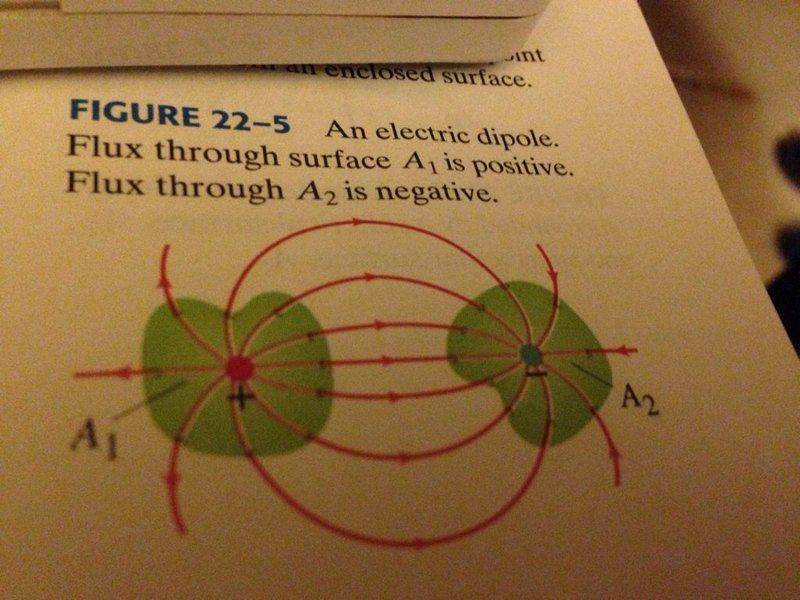
ImageUploadedByPhysics Forums1393031750.624667.jpg
my textbook says "q enclosed for the Guastian surface in a1 would be the positive charge enclosed by a1: the negative charge does contribute to the electric field at a1 but it is not enclosed by surface a1 and so is not included in q enclosed". ...…..;…. So I would be quicker to deduce that I made the error than my textbook but the I thought the net electric flux is defined by the flux entering or leaving that doesn't begin or end in the enclosed surface. Since the electric field stops in the surface doesn't that mean it now has that net flux ? Or does this just not contribute to gauss's law? If so please elucidate! I'm only in ap physics so don't go beyond mechanics and basic e and m since I just started! ThanksSent from my iPhone using Physics Forums
 
Physics news on Phys.org
woah - big photo!
It shows an electric dipole with well separated charges.
The flux through surface A1 is positive while the flux through A2 is negative.
Both sets of charge contribute to the electric field everywhere, but the net flux through a surface is determined by the charge enclosed by the surface. The sign of the charge determines the direction.

You can actually see this in your diagrams - the flux is just the number of field lines through a surface.
The number of field lines starting or ending on a charge is a fixed number - determined by the amount of charge.

So if you have two equal and opposite charges, then they both have the same number of field lines attached to them - bring them close and all the field lines starting on the positive charge can end up on the negative charge and the total number of lines on each charge stays the same.

If you draw a surface around a volume with zero charge in it, but there are charges outside it, you'll see that all the field lines that enter the surface also leave it - so the net flux through the surface is zero.
 

Similar threads

  • · Replies 4 ·
Replies
4
Views
1K
  • · Replies 9 ·
Replies
9
Views
2K
  • · Replies 14 ·
Replies
14
Views
1K
  • · Replies 83 ·
3
Replies
83
Views
5K
  • · Replies 11 ·
Replies
11
Views
2K
  • · Replies 2 ·
Replies
2
Views
2K
  • · Replies 22 ·
Replies
22
Views
3K
  • · Replies 2 ·
Replies
2
Views
3K
  • · Replies 7 ·
Replies
7
Views
1K
  • · Replies 30 ·
2
Replies
30
Views
3K