Electric flux through an inclined cylinder

Click For Summary
SUMMARY

The discussion focuses on calculating the electric flux through an inclined cylinder, emphasizing the importance of avoiding double counting in flux calculations. The total flux is derived from three areas: the projection of the cylinder, the top circle, and the bottom circle. The correct approach involves recognizing that the projection covers half of the top and bottom circles, necessitating the inclusion of only the other halves to avoid redundancy. The final formula for the total entering flux is established as the sum of the contributions from each relevant area.

PREREQUISITES
  • Understanding of electric flux and its mathematical representation.
  • Familiarity with the concept of area vectors and field vectors.
  • Knowledge of geometric projections, particularly in three dimensions.
  • Basic principles of electromagnetism, including Gauss's Law.
NEXT STEPS
  • Study the derivation of electric flux in inclined geometries.
  • Learn about the application of Gauss's Law in complex shapes.
  • Explore the concept of field lines and their relation to flux calculations.
  • Investigate the implications of projection areas in electromagnetic theory.
USEFUL FOR

Students and professionals in physics, particularly those specializing in electromagnetism, as well as engineers working with electric fields and flux calculations in inclined geometries.

Zayan
Messages
63
Reaction score
7
Homework Statement
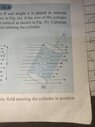
Finding the electric flux entering a cylinder(height H radius R) in uniform Electric Field. Axis of cylinder inclined at an angle theta from vertical.
Relevant Equations
Flux = E.A
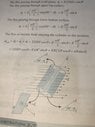
Flux equals dot product of Area Vector and the Field vector. So the areas are 3. The projection of cylinder (shadow of cylinder). It's flux is E2HRcostheta. Then remaining two circles have flux Eπr²sintheta each. But I checked my solution book and they have considered only half areas of the top and bottom circle. Why is that?
 

Attachments

  • 17206376126646809482154356886707.jpg
    17206376126646809482154356886707.jpg
    30.6 KB · Views: 79
  • 17206376443728580427513246289188.jpg
    17206376443728580427513246289188.jpg
    33.5 KB · Views: 75
Physics news on Phys.org
Please give the problem statement exactly as provided. The most straightforward interpretation of what you wrote here is trivially zero.
 
Orodruin said:
Please give the problem statement exactly as provided. The most straightforward interpretation of what you wrote here is trivially zero.
It would be zero if it was the net flux. I stated that it is asking about the entering flux.
 
Zayan said:
Flux equals dot product of Area Vector and the Field vector. So the areas are 3. The projection of cylinder (shadow of cylinder). It's flux is E2HRcostheta. Then remaining two circles have flux Eπr²sintheta each. But I checked my solution book and they have considered only half areas of the top and bottom circle. Why is that?
Carefully inspect the field lines. For example, look at the 4th field line from the bottom. It pierces the bottom circle and also pierces the light- colored flat region of area 2RH (axial plane) in your second figure.
 
TSny said:
Carefully inspect the field lines. For example, look at the 4th field line from the bottom. It pierces the bottom circle and also pierces the light- colored flat region of area 2RH (axial plane) in your second figure.
Do you mean like, some of the area is already included in the flat region that's why we don't take it?
 
Zayan said:
Do you mean like, some of the area is already included in the flat region that's why we don't take it?
Yes. You need to avoid double counting some of the flux.

Also, note that all of the field lines that pierce the top circle are coming out of the cylinder, not into the cylinder.
 
TSny said:
Yes. You need to avoid double counting some of the flux.

Also, note that all of the field lines that pierce the top circle are coming out of the cylinder, not into the cylinder.
Yeah I got it. Since I took the flux of the projection of the axis of cylinder, it already has common area with half the top circle and half the bottom circle. That's why we only need other halves.
 
Zayan said:
It would be zero if it was the net flux. I stated that it is asking about the entering flux.
That’s ambiguous. Many authors will count exiting flux as negative entering flux.
 
As for the problem as you wish it - just compute the projection of the cylinder on a plane perpendicular to the field and multiply by the field strength.
 
  • #10
In other words, find the area of the shadow that the cylinder casts on a plane perpendicular to the field and multiply it by the value of the field.
 
  • #11
kuruman said:
In other words, find the area of the shadow that the cylinder casts on a plane perpendicular to the field and multiply it by the value of the field.
I already did that. This is an inclined cylinder so there are 3 areas, projection, top circle and bottom circle. Since the projection covers half the top and half the bottom circle we only include one complete circular area of flux hence the discrepancy.
 
  • #12
Zayan said:
I already did that. This is an inclined cylinder so there are 3 areas, projection, top circle and bottom circle.
Cylinder Flux.png
What circle?

See the figure on the right. You have two halves of an ellipse of semi-major axis ##a=R## and semi-minor axis ##b=R\sin\!\theta## and a ##(2R\times H\cos\!\theta)## rectangle.
 
  • #13
kuruman said:
What circle?
While the end caps’ projection on a plane are ellipses, they are circles in three dimensions, which is most likely what the OP refers to.
 
  • #14
It looks like the solution provided $$
Orodruin said:
While the end caps’ projection on a plane are ellipses, they are circles in three dimensions, which is most likely what the OP refers to.
I suppose it is a language problem. OP does mention
Zayan said:
remaining two circles have flux Eπr²sintheta each
which, taken at face value, implies that each "circle" has radius ##r\sqrt{\sin\!\theta.}## I don't think that OP has correctly thought through how the flat circular faces project onto the plane.
 
  • #15
kuruman said:
which, taken at face value, implies that each "circle" has radius rsinθ. I don't think that OP has correctly thought through how the flat circular faces project onto the plane.
… or that the circle has radius r and the field has a normal component ##E\sin\theta##, which is the actual case.
 
  • #16
Orodruin said:
… or that the circle has radius r and the field has a normal component ##E\sin\theta##, which is the actual case.
Yes.
 
  • #17
For fun, another way to the answer:
1720813305936.png


Region ##A## is the “axial plane” shown in the second figure of the OP. Regions ##B, C##, and ##D## are semicircles. Region ##F## is the left half of the lateral side of the cylinder.

The total flux into the cylinder is $$|\Phi_{tot}^{in}| = |\Phi_F|+|\Phi_B|+|\Phi_C|$$
Consider the closed surface consisting of ##A + D + F + B##. This surface encloses no charge, so the flux into the surface equals the flux out: $$|\Phi_F| + |\Phi_B| = |\Phi_A| + |\Phi_D|.$$ Using this in the first equation: $$|\Phi_{tot}^{in}| = |\Phi_A|+|\Phi_D|+|\Phi_C| = 2ERH \cos \theta + E\frac{\pi R^2}{2} \sin \theta + E\frac{\pi R^2}{2} \sin \theta.$$
 

Similar threads

Replies
26
Views
1K
  • · Replies 9 ·
Replies
9
Views
1K
Replies
7
Views
2K
  • · Replies 7 ·
Replies
7
Views
2K
  • · Replies 2 ·
Replies
2
Views
1K
  • · Replies 2 ·
Replies
2
Views
3K
  • · Replies 2 ·
Replies
2
Views
2K
Replies
4
Views
5K
  • · Replies 9 ·
Replies
9
Views
8K
  • · Replies 10 ·
Replies
10
Views
10K