Discussion Overview
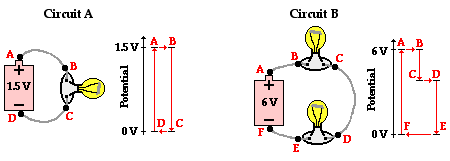
The discussion revolves around the concept of electric potential in circuits, particularly focusing on how charges behave as they move through different components of a circuit. Participants explore the relationship between electric potential energy and kinetic energy, the role of resistance in wires versus components like lamps, and the implications of measuring electric potential at various points in a circuit.
Discussion Character
- Exploratory
- Technical explanation
- Conceptual clarification
- Debate/contested
Main Points Raised
- Some participants assert that as a charge moves from a high potential to a low potential, it loses electric potential energy, which could convert to kinetic energy, but question how this applies in circuits with constant potential across certain segments.
- Others clarify that in ideal circuit analysis, the resistance of wires is often considered negligible, leading to the assumption that electric potential remains constant along a wire unless a component with resistance is encountered.
- A participant emphasizes the importance of specifying relative potential when discussing electric potential, noting that potential is often referenced relative to ground, which is defined as having zero potential.
- Some participants discuss the implications of Kirchhoff's Voltage Law, suggesting that potential differences are conserved in a circuit and that voltage drops occur across components like lamps.
- There is a mention of the confusion surrounding the flow of electrons versus conventional current, with some noting that while current is often described as flowing from positive to negative, electrons actually flow in the opposite direction.
- A participant raises a question about the behavior of charges in a circuit without a load, suggesting that without a lamp, charges would not experience a potential difference.
- Another participant points out that electric potential is location-dependent, leading to confusion about how electrons can maintain the same potential while moving through a wire.
Areas of Agreement / Disagreement
Participants express various viewpoints regarding the behavior of electric potential in circuits, with no clear consensus reached. Disagreements exist about the implications of constant potential in certain circuit segments and the interpretation of electric potential relative to ground.
Contextual Notes
Limitations include assumptions about ideal circuit conditions, the neglect of wire resistance, and the need for clarity in discussing relative potentials. The discussion also reflects varying interpretations of electric potential and its implications in circuit behavior.