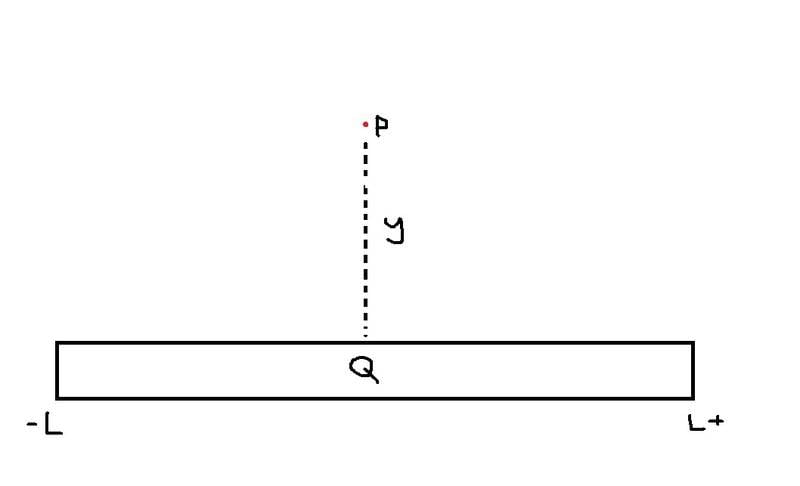
Electric potential of a uniformly charged thin rod.

Click For Summary
SUMMARY

The discussion focuses on calculating the electric potential and electric field of a uniformly charged thin rod of length 2L with total charge Q. Participants derive the electric potential V using the equation V = k ∫ dq / r, where λ = Q / 2L represents the linear charge density. The integration bounds are from -L to L, and the distance r is defined as r = √((L-x)² + y²). The final expression for the electric potential simplifies to V = kQ/y, confirming that the charge distribution does not affect the potential at point P, provided the distance y is maintained.

PREREQUISITES
  • Understanding of electric potential and electric fields
  • Familiarity with calculus, specifically integration techniques
  • Knowledge of charge density concepts, particularly linear charge density (λ)
  • Proficiency in using mathematical notation and symbols, including integrals and square roots
NEXT STEPS
  • Study the derivation of electric fields from electric potentials using the equation e = -∇v
  • Explore the implications of charge distribution on electric potential in different geometries
  • Learn about the symmetry in electric fields and potentials for various charge configurations
  • Investigate the application of LaTeX for formatting mathematical expressions in academic writing
USEFUL FOR

Students and professionals in physics, electrical engineering, and applied mathematics who are involved in electrostatics and the analysis of electric fields and potentials.

freshcoast
Messages
185
Reaction score
1
1. Problem statement
jg5aj8.jpg


A thin rod of length 2L has charge Q uniformly distributed along its length.

1. Draw a graph of the charge density as a function of x from -L to L
2. Find the electric potential at point P a distance y away
3. Use the result in part 2 of the electric field at point P (you are finding the electric field as a function of a y equation)
4. Assess ; Draw the V versus y graph and draw the E versus y graph.

2. Known equations

v = k ∫ dq / r
e = -∇v
λ = Q / L


3. Attempt

1.
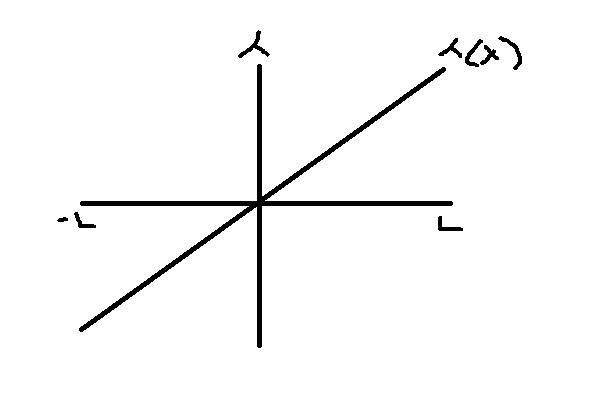
10gd9gm.jpg

graph charge density as a function of x from -L to L would just look like this because using the values and plugging it into the lambda equation it would produce these values.

2.

To find the electric potential I first need to find the correct form of dq.

Using the lambda equation
λ = Q / 2L ,

since L = 2L ,

Q = λ2L , then for dq = λ2dl

then

V = k ∫ λ2dl / √(L/2)^2 + y^2 (bounds for integral is from 0 to 2L)

because r = √(L/2)^2 + y^2

then it integrates to


V = 2kλ [ln(y^2 + √(L/2)^2 + y^2] |2L to 0

V = 2kλ [ln(y^2 + √((2L/2)^2 + y^2 - ln(y^2 + √(0/2)^2 + y^2))]

V = 2kλ [ln(y^2 + √L^2 + y^2 - ln(y^2 + √y^2]

then using log rules,

V = 2kλ [ln (y^2 + √L^2 + y^2 ) / (y^2 + y)

is this so far correct? I need to make sure this is correct before I can continue
 
Physics news on Phys.org
freshcoast said:
1. Problem statement

A thin rod of length 2L has charge Q uniformly distributed along its length.

1. Draw a graph of the charge density as a function of x from -L to L
2. Find the electric potential at point P a distance y away
3. Use the result in part 2 of the electric field at point P (you are finding the electric field as a function of a y equation)
4. Assess ; Draw the V versus y graph and draw the E versus y graph.
[...]
1.
[see above]
graph charge density as a function of x from -L to L would just look like this because using the values and plugging it into the lambda equation it would produce these values.
Curious - your graph has varying negative charge to the left and varying positive charge to the right ... didn't the question say that the charge "uniformly distributed"?
 
Oh, Would it just be a straight line then?
 
You already drew a straight line though. What's important is the slope and y intercept.

If the total charge on the rod is Q, then the linear charge density of ##\lambda=Q/2L## everywhere along the rod right?
 
I was thinking the slope would be zero? so the line would be horizontal from -L to L?
 
That's how I read it.
Now for the next step.
 
What do you think about my solution above?
 
It reads confused, i.e.
λ = Q / 2L , since L = 2L ,
... L=2L means that 1=2 ?!
You mean that the length of the rod is 2L?
But the charge distribution works.

V = k ∫ λ2dl / √(L/2)^2 + y^2 (bounds for integral is from 0 to 2L)
... let's see, that is:

$$V=k\int_0^{2L}\frac{\lambda 2 dl}{\sqrt{(L/2)^2+y^2}}$$
... you need to look again at this step.

You are integrating over "l": where is the "l" axis on your diagram?

You are integrating from 0 to 2L: does the rod go from 0 to 2L on your diagram?

In the integrand:
The denominator is a constant - doesn't the potential vary with distance?
The numerator has a factor of 2 in it - check the derivation of dq.

Better yet - go through the setup step by step and show me your reasoning at each stage.
Starting with: how much charge dq is on the rod between x and x+dx
 
Last edited:
jahzk8.jpg
I set my zero point to the very left, I am confused about the length part, I know the only thing that varies would be the length, so I am thinking if I set my lambda equation as

total length of rod is 2L,

λ = Q / 2L

I isolate Q to find dq,

λ2L = Q
λ2dl = dq

I guess the 2 goes away when I derive it, so my dq equation is

λdl = dq

Which I think would work if I integrate it from 0 to 2L and having λ = Q / 2L , I would get Q back.

Now for my R, I was thinking my new equation would be

r = √(2L-x)^2 + y^2)

I am confused at the part where I know the 2L is constant, the x is the one that varies, but in my dq I have it as λdl, does it matter if the dl should be a dx or not?

But I am thinking my 2L-x is correct when I integrate it from 0 to 2L, at 2L electric potential would be 0 and when it is at 0 the electric potential would be at it's highest.
 
  • #10
If you put the x-axis along the length of the rod with +x pointing to the right, and put x=0 in the center of the rod, then you get to exploit symmetry much more easily.

Anyway - your way puts x=0 on the far left, so point P is at position (L,y).
You drew your dq in an inconvenient place for visualizing what happens... put it at an arbitrary position (x,0)

So dq is the amount of charge between x and x+dx on the rod.
That's a length of (x+dx)-x=dx.

The charge per unit length is λ=Q/2L, therefore the charge in some arbitrary length Δx is Δq=λΔx... so the amount of charge dq in length dx is...

On your diagram, the distance r is the distance from dq to point P, that is the distance between point (x,0) and point (L,y) ... you have a formula for working out the distance between two points right?
 
  • #11
I see... Well disregard my original attempt I will now use your suggestion to try this problem. Setting x=0 at the center where +x is to the right, I believe my dq will be

dq = (lamda)dx

Now that I have that I can complete the integral

V = k § (lamda)dx / y

Since r = y

Now I remove the constants lamda and 1/y out which leaves dx in the integral and the bounds are from -L to L

Which solves to

V = 2Lk(lamda) / y
 
  • #12
V = k § (lamda)dx / y

Since r = y
That way you'll end up with V=kQ/y ... which is the same as for a point charge.
Is that correct? The charge distribution does not matter?!

Remember what dq actually is?
It is the amount of charge between x and x+dx on the rod.
Doesn't r depend on the x position of dq as well?

Note: the integral sign is "∫" in the quick-symbols chart and \int in LaTeX.
lambda is "λ" in quick-symbols and \lambda in LaTeX

LaTeX is very useful - eg. I can write your integral as:
Code:
V=k\int_{-L}^L \frac{\lambda dx}{r(x)}
... so it comes out like: $$V=k\int_{-L}^L \frac{\lambda dx}{r(x)}$$
 
Last edited:
  • #13
Hmm I see, since the charge is also a dependent of the x axis, and if I set x to be the amount of distance I'm subtracting off the whole rod...

my r would be

sqrt(L-x)^2 + y^2
 
  • #14
freshcoast said:
Hmm I see, since the charge is also a dependent of the x axis, and if

my r would be

sqrt(L-x)^2 + y^2
... you said that ##r=\sqrt{(L-x)^2}+y^2## typo? I'm guessing you meant that:

##r=\sqrt{(L-x)^2+y^2}##

... That would be if you put the origin of the coordinate system at one end of the rod.
Please make up your mind - it affects the limits of integration.

When you are setting up an integral, you need to be consistent and careful with your notation.

What you are doing is finding the contribution dV to the overall potential at P due to the charge element dq between x and x+dx on the rod. You end up with an equation dV=kλdx/r(x) - adding up all the dV's means integrating both sides... gets you V=kλ∫(dx/r(x))
 
  • #15
Ok I think I can see it now,

R would be just sqrt(x^2 + y^2), now that makes sense since my bounds are from L to -L
 
  • #16
freshcoast said:
Ok I think I can see it now,
R would be just sqrt(x^2 + y^2), now that makes sense since my bounds are from L to -L
If the origin is half-way along the rod. Be careful of the order of your limits.

You seem to have changed notation from "r" to "R" for the distance to the charge: try to use a consistent notation or you risk confusing your reader. When the reader is marking your work, that will cost you grades.

The last trick is to use the symmetry to shortcut the integration. (If you want...)
i.e. for your example: for a number a: 0<a<L, compare the contributions to the potential of the element at x=-a to that at x=+a.
 

Similar threads

  • · Replies 13 ·
Replies
13
Views
771
Replies
64
Views
5K
Replies
1
Views
2K
  • · Replies 11 ·
Replies
11
Views
1K
Replies
1
Views
3K
Replies
6
Views
4K
  • · Replies 5 ·
Replies
5
Views
2K
  • · Replies 6 ·
Replies
6
Views
2K
  • · Replies 2 ·
Replies
2
Views
1K
  • · Replies 2 ·
Replies
2
Views
1K