Electrical Potential and an Integration path

Click For Summary

Discussion Overview

The discussion revolves around the integration path for calculating electrical potential between two points in the context of electrostatics, particularly involving conducting plates and dielectric materials. Participants explore the implications of integrating the electric field and the associated signs in the potential calculation.

Discussion Character

  • Exploratory
  • Technical explanation
  • Debate/contested
  • Homework-related

Main Points Raised

  • One participant seeks clarification on how to determine the integration path for calculating potential between two conducting plates, noting confusion about the signs in the potential expression.
  • Another participant explains that for an EMF, the voltage is given by a positive integral of the induced electric field, while for electrostatic potential, it is a negative integral of the electric field.
  • Some participants express uncertainty about the relevance of EMF and its equations to the problem at hand, particularly in relation to displacement field equations.
  • There is a suggestion that the problem may be more appropriately categorized as a homework question, with a request for more detail to facilitate understanding.
  • A later reply emphasizes that the problem is fundamentally about electrostatics and suggests that the dielectrics can be treated as homogeneous materials, allowing for simplifications in the equations used.

Areas of Agreement / Disagreement

Participants generally do not reach consensus on the integration path and the relevance of EMF to the problem. There are competing views on the necessity of understanding EMF in the context of the assignment, and some participants express confusion about the underlying concepts.

Contextual Notes

Participants mention the use of Griffith's textbook and the complexity of the integral form of the equations. There is also a note about the assumption of large plate extensions compared to their distance, which may affect the treatment of the electric fields.

NicolaiTheDane
Messages
100
Reaction score
10
I have been looking everywhere for a clear explanation for the following: How do I know which way to integrate the electrical field, when I'm looking for the potential between to points?

Example:
upload_2018-10-6_16-28-32.png


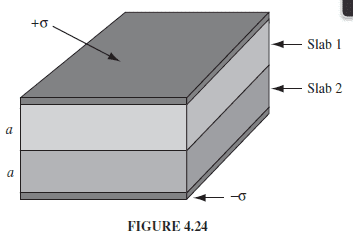
I have to find the potential between the top conducting plate and the bottom conducting plate. Assume that i got an expression for the field in both i linear dielectric slabs. My book says:

$$V = \int_\mathcal{O}^r \vec{E} \cdot d\vec{l}$$

However how do I translate that. Let's forget anything about the actually expression for ##\vec E##. Obviously we are going from ##0## til ##2*a## or the other way around. What dictates the path? I know what the answer to the assignment I'm doing is, but I do not see why my result (which is the same but negative) is wrong. It has something to do with the minus in front and the reference points. Can someone please clarify, because this has been driving me nuts for weeks now.

(The right answer comes from integrating from ##0## to ##2*a##)
 

Attachments

  • upload_2018-10-6_16-28-32.png
    upload_2018-10-6_16-28-32.png
    3 KB · Views: 920
Physics news on Phys.org
NicolaiTheDane said:
I have been looking everywhere for a clear explanation for the following: How do I know which way to integrate the electrical field, when I'm looking for the potential between to points?

Example:
View attachment 231793

I have to find the potential between the top conducting plate and the bottom conducting plate. Assume that i got an expression for the field in both i linear dielectric slabs. My book says:

$$V = \int_\mathcal{O}^r \vec{E} \cdot d\vec{l}$$

However how do I translate that. Let's forget anything about the actually expression for ##\vec E##. Obviously we are going from ##0## til ##2*a## or the other way around. What dictates the path? I know what the answer to the assignment I'm doing is, but I do not see why my result (which is the same but negative) is wrong. It has something to do with the minus in front and the reference points. Can someone please clarify, because this has been driving me nuts for weeks now.

(The right answer comes from integrating from ##0## to ##2*a##)
For an EMF with an electric field ## \vec{E} ##, the voltage ## V=+\int \vec{E}_{induced} \cdot dl ##. For an electrostatic potential ## V=-\int \vec{E} \cdot dl ##. ## \\ ## The reason for this is arguably that in the case of an electric field from an EMF in a conductor, there is necessarily an electrostatic field that gets generated that is equal and opposite the Faraday electric field, in order to keep the current from becoming infinite. Instead, the total electric field must nearly vanish in the conductor.
 
Charles Link said:
For an EMF with an electric field ## \vec{E} ##, the voltage ## V=+\int \vec{E}_{induced} \cdot dl ##. For an electrostatic potential ## V=-\int \vec{E} \cdot dl ##. ## \\ ## The reason for this is arguably that in the case of an electric field from an EMF in a conductor, there is necessarily an electrostatic field that gets generated that is equal and opposite the Faraday electric field, in order to keep the current from becoming infinite. Instead, the total electric field must nearly vanish in the conductor.

I hate to so publicly display my plebian nature, but I have absolutely no idea what you mean.

EDIT: I have read what you wrote a couple of times know. I'm embarrassed to admit I don't even know what questions to ask either.
 
NicolaiTheDane said:
I hate to so publicly display my plebian nature, but I have absolutely no idea what you mean.
EMF ## \mathcal{E}=-\frac{d \Phi}{dt} ## is known as an induced/Faraday EMF, where voltage ## V= \mathcal{E}=+\int \vec{E}_{induced} \cdot dl ##.## \\ ## (If you compute the voltage coming from an inductor, getting the correct sign can be important to have the calculations be completely consistent). ## \\## For the electrostatic potential ## V=-\int \vec{E} \cdot dl ##, which is also a voltage, the electric field integral gets a minus sign.
 
Charles Link said:
EMF ## \mathcal{E}=-\frac{d \Phi}{dt} ## is known as an induced/Faraday EMF, where ## \mathcal{E}=+\int \vec{E}_{induced} \cdot dl ##. ## \\## For the electrostatic potential ## V=-\int \vec{E} \cdot dl ##, the voltage gets a minus sign.

I have never heard of EMF nor seen the equations you just wrote before. The expressions of the fields I use in the actual assignment, is found from the displacement field equation. Is that related?
 
NicolaiTheDane said:
I have never heard of EMF nor seen the equations you just wrote before. The expressions of the fields I use in the actual assignment, is found from the displacement field equation. Is that related?
You need to show more detail, but then, it really belongs as a homework problem in the homework section. ## \\ ## I'm surprised you are already seeing a capacitor with dielectric layers, but they have yet to teach you about the Faraday EMF, which is caused by changing magnetic fields, in the physics class that you have.
 
Charles Link said:
You need to show more detail, but then, it really belongs as a homework problem in the homework section. ## \\ ## I'm surprised you are already seeing a capacitor with dielectric layers, but they have yet to teach you about the Faraday EMF, which is caused by changing magnetic fields, in the physics class that you have.

We are using Griffith 4. Edition. Dielectrics is the last part of electrostatics, before magnetism is introduced. And yea I'd didn't really want help with the assignment itself as much as figure out what I'm missing about the potential.
 
It's about electrostatics. So don't worry about induction and electromotive forces yet. The integral form is a bit more complicated than suggested by @Charles Link anyway.

As for the question asked in the OP you don't need anything of this. It's a macroscopic electrostatic problem. I guess the dielectrics in the capacitor are simple homogeneous material, and you can use the linear approximation, i.e., the equations read
$$\vec{\nabla} \cdot \vec{D}=\rho, \quad \vec{\nabla} \times \vec{E}=0, \quad \vec{D}=\epsilon \vec{E},$$
where ##\epsilon=\epsilon_{\text{rel}} \epsilon_0## is constant along each of the slabs.

Then the usual approximate treatment is to assume that the extension of the plates is very large compared to their distance. Then you can treat the fields as homogeneous in each slab. Then you get the fields by making this ansatz and using the continuity of the tangential components of ##\vec{E}## and that the jump of the normal components of ##\vec{D}## are the free charge-area densities along the surfaces of the slabs.
 

Similar threads

  • · Replies 3 ·
Replies
3
Views
1K
  • · Replies 21 ·
Replies
21
Views
4K
  • · Replies 6 ·
Replies
6
Views
1K
  • · Replies 1 ·
Replies
1
Views
2K
  • · Replies 12 ·
Replies
12
Views
2K
  • · Replies 2 ·
Replies
2
Views
2K
  • · Replies 8 ·
Replies
8
Views
2K
  • · Replies 7 ·
Replies
7
Views
2K
  • · Replies 11 ·
Replies
11
Views
5K
  • · Replies 11 ·
Replies
11
Views
2K