Electromagnetism static charge and forces

Click For Summary
SUMMARY

The discussion centers on the comparison of forces in electromagnetism, specifically the relationship |F(a)| > |F(b)| > |F(c)|. The user identifies that |F(b)| is greater than |F(c)| due to Lorentz contraction effects observed from the charge's perspective. However, the user struggles to justify why |F(a)| exceeds |F(b)|, despite recognizing that |F(a)| and |F(c)| maintain the same electric force regardless of motion. The weaker force of |F(c)| is attributed to magnetic attraction.

PREREQUISITES
  • Understanding of Lorentz contraction in special relativity
  • Basic principles of electric and magnetic forces in electromagnetism
  • Familiarity with the concept of invariant charge
  • Knowledge of force comparisons in electromagnetic contexts
NEXT STEPS
  • Study the principles of Lorentz contraction in detail
  • Explore the relationship between electric and magnetic forces in electromagnetism
  • Learn about invariant properties of electric charges
  • Research force comparison techniques in electromagnetism
USEFUL FOR

This discussion is beneficial for students and enthusiasts of electromagnetism, particularly those seeking to deepen their understanding of force relationships and the effects of special relativity on electric and magnetic interactions.

The black vegetable
Messages
22
Reaction score
0
Hi
Everyone, I'm trying to justify to myself why

|F(a)| > |F(b)| > |F(c)|
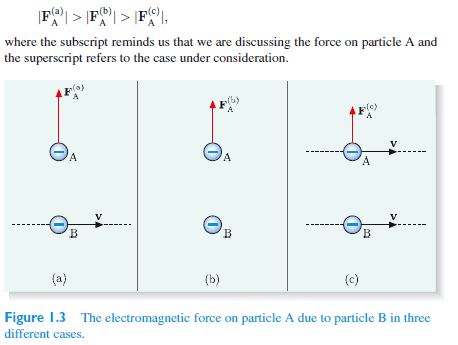
Capture.PNG


I think I can see why

|F(b)| > |F(c)|

due to special relativity case c observed from
the charges point of view would observe
the charges closer due to lorentz
contraction. As the charge is invariant would
result in a greater force?

However I can't justify to myself why
|F(a)| > |F(b)|

many thanks
 
Physics news on Phys.org
The black vegetable said:
would observe the charges closer due to lorentz contraction.
In which direction is the contraction?
 
Please ignore my justification, I see now it's wrongIm Just trying to find out why

|F(a)| > |F(b)| > |F(c)|

I know that |F(a)| and |F(c)| have the same
electric force independent of motion and that the weaker force
experienced by |F(c)| is a result magnetic attraction

but can't see why
|F(a)| > |F(b)|

I'm new to electromagnetism

many thanks
 

Similar threads

  • · Replies 10 ·
Replies
10
Views
2K
  • · Replies 1 ·
Replies
1
Views
1K
  • · Replies 5 ·
Replies
5
Views
509
  • · Replies 5 ·
Replies
5
Views
2K
  • · Replies 19 ·
Replies
19
Views
2K
  • · Replies 21 ·
Replies
21
Views
3K
  • · Replies 11 ·
Replies
11
Views
3K
  • · Replies 4 ·
Replies
4
Views
3K
  • · Replies 6 ·
Replies
6
Views
1K
  • · Replies 20 ·
Replies
20
Views
5K