Electron Gun diffraction and undeflected spot diameter

Join the discussion
Ask a follow-up here, or get your own question answered by working scientists, mathematicians and engineers — people, not an autocomplete.
Real named experts · corrections over time · the nuance an AI answer skips
4 replies · 4K views
rashida564
Messages
220
Reaction score
7
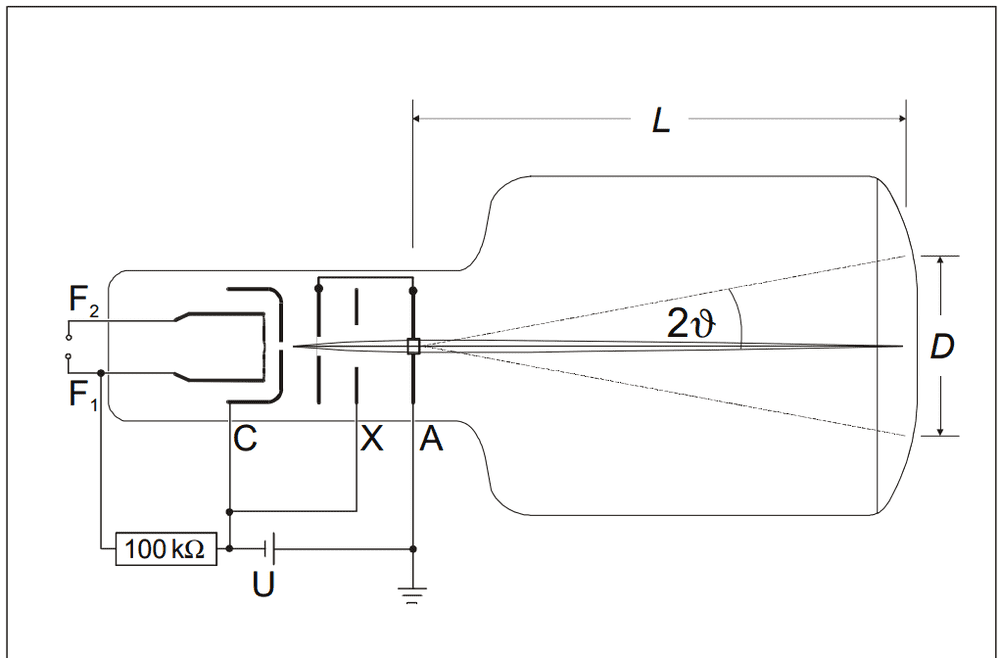
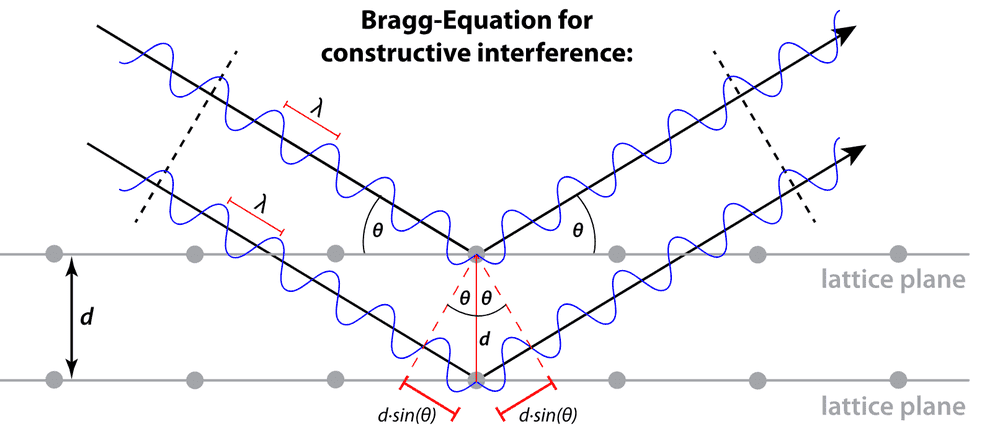
Hi I am doing an electron gun diffraction right now and I wonder why the angle below is 2 phi.
pXasrzc.png

What I think about it that it's actually the results of two waves one is shown below and the other is a wave
with the same accident angle but negative "those two rays will be symmetric around the lattice plane" and all other rays will cancel each other. Thus will image in the screen is the result of the two rays and the angle between them will be 2phi.
Even-though this makes sense to me, but I want to know is it true. and is there a proof that all the other rays"other than the twos" will cancel each other
SqNKbop.png
 

Attachments

  • pXasrzc.png
    pXasrzc.png
    17.5 KB · Views: 856
  • SqNKbop.png
    SqNKbop.png
    29.5 KB · Views: 658
Last edited by a moderator:
Physics news on Phys.org
If the ϑ in the top diagram is the θ in the bottom then the change of direction in the bottom is θ+θ. This is general and is true for rotation of an optical mirror. The image moves twice as much as the mirror rotation.
For Bragg scattering, the only directions where you get constructive interference is determined by the spacing d. So for other values of θ you are not at a max.
 
  • Like
Likes   Reactions: rashida564
sophiecentaur said:
If the ϑ in the top diagram is the θ in the bottom then the change of direction in the bottom is θ+θ. This is general and is true for rotation of an optical mirror. The image moves twice as much as the mirror rotation.
For Bragg scattering, the only directions where you get constructive interference is determined by the spacing d. So for other values of θ you are not at a max.
Is there a mathmatecal proof behind this
 
Like why is it possible to think about it as a rotates mirror
 
rashida564 said:
Is there a mathmatecal proof behind this
rashida564 said:
Like why is it possible to think about it as a rotates mirror
There are two mechanism involved, if you like. Firstly, in the direction of a maximum, you need the path lengths through successive layers to be a whole number of wavelengths (as with Youngs Slits etc. etc.). In other directions there is no constructive interference. You need to remember that there are many (hundreds) of crystal cells involved so that the analogy is more with a diffraction grating than with just two slits. That makes the reflections very 'directive' and with narrow beams.
Why is it like a mirror? Because the angles each side of the normal are equal (for constructive interference on the way in and on the way out). So the total deviation is twice the incoming angle. Google Mirrors and Laws of reflection for pictures and ideas but, if you accept that Incident and Reflected angles are equal (about the normal) then moving the mirror by an extra angle φ from the original θ, the change new direction will be 2(φ+θ), i.e. reflected beam will move by 2φ. A simple bit of Maths there.