Electrostatics: Calculate the Electric Field near a Charged Ring

Click For Summary

Homework Help Overview

The discussion revolves around calculating the electric field near a charged ring, a topic within electrostatics. Participants are examining the original poster's (OP) approach to the problem and seeking clarification on their calculations.

Discussion Character

  • Exploratory, Assumption checking, Problem interpretation

Approaches and Questions Raised

  • Some participants inquire about the OP's calculations and suggest that sharing the work would facilitate checking for correctness. Others discuss the method of calculating potential and the integration process involved in the problem.

Discussion Status

The discussion is ongoing, with participants expressing the need for the OP to clarify their calculations. There is a suggestion of using LaTeX for better readability of equations, indicating a focus on improving communication of the mathematical aspects. Multiple interpretations of the problem-solving approach are being explored.

Contextual Notes

Participants note potential issues with the OP's ability to upload images of their work, which may hinder the review process. There is also mention of the complexity of integrating around the ring, suggesting that assumptions about the method may need to be revisited.

polibuda
Messages
51
Reaction score
9
Homework Statement
Find the potential at p-point (0,0, z) from a circular ring (x ^ 2 + y ^ 2 = R ^ 2) uniformly charged with linear density q1.
Relevant Equations
q1
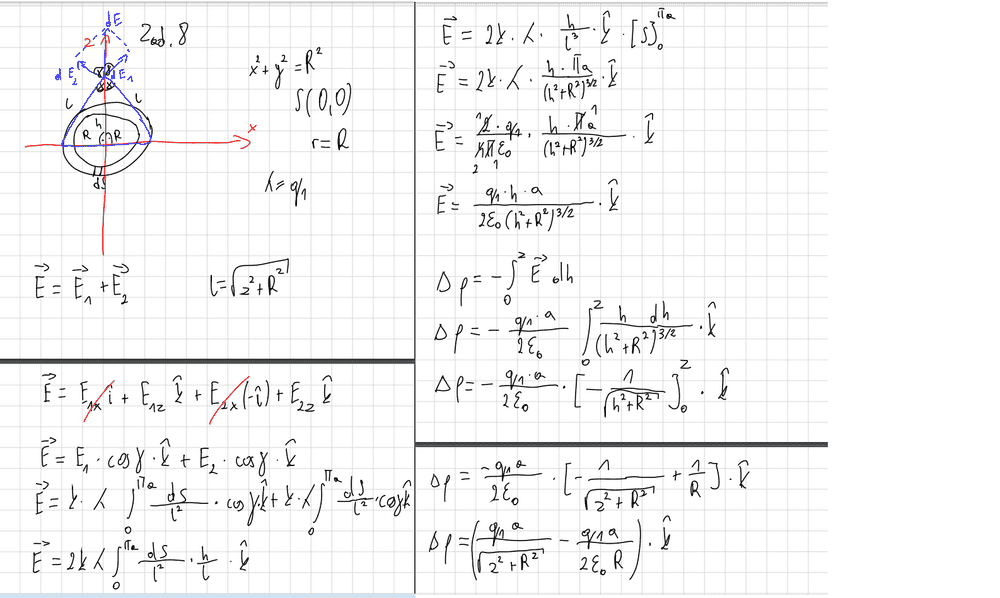
I have the problem with my solution. I don't know it is correct. Could somebody check it?
12345.png
 
Last edited:
  • Like
Likes   Reactions: vanhees71 and Delta2
Physics news on Phys.org
How can we check without seeing your calculation? Do you have an idea, how to calculate the potential on a given point? Also please use the great LaTeX feature of the forum to make your formulae legible. Just click on "LaTeX Guide" to see how it works:

https://www.physicsforums.com/help/latexhelp/
 
  • Like
Likes   Reactions: Hamiltonian
I guess he/she run into problems uploading the images with his attempt.

...unless what he writes in relevant equations of the OP is his final answer, but we still have to check his work.
 
Delta2 said:
I guess he/she run into problems uploading the images with his attempt.

...unless what he writes in relevant equations of the OP is his final answer, but we still have to check his work.
Yes, that is true. I am sorry for my mistakes.

 
Last edited:
If you use the approach that ## V=-\int \vec{E} \cdot dl ##, you would need to integrate from ## z'=+\infty ## to ## z ##. In any case, that method is a lot of extra and unnecessary work. For this problem, you need to simply integrate around the ring of the result of the potential from an infinitesimal segment ## ds ## at location ## (r,\theta,0) ##, (cylindrical coordinates). The total potential from separate charges is additive.
 
  • Like
Likes   Reactions: polibuda, vanhees71 and etotheipi

Similar threads

  • · Replies 5 ·
Replies
5
Views
1K
Replies
11
Views
1K
Replies
4
Views
4K
Replies
11
Views
4K
Replies
12
Views
2K
  • · Replies 2 ·
Replies
2
Views
1K
  • · Replies 3 ·
Replies
3
Views
1K
  • · Replies 68 ·
3
Replies
68
Views
8K
Replies
2
Views
3K
  • · Replies 10 ·
Replies
10
Views
2K