EM wave interacting with refelcting surface

Click For Summary

Discussion Overview

The discussion revolves around the interaction of electromagnetic (EM) waves with a reflecting surface, particularly focusing on the behavior of electric and magnetic fields during reflection. Participants explore concepts related to the penetration of fields into the reflecting medium, the nature of the waves involved, and the implications for wave behavior at the interface.

Discussion Character

  • Exploratory
  • Technical explanation
  • Debate/contested

Main Points Raised

  • One participant questions how the electric and magnetic fields of incoming light waves penetrate the reflecting medium and whether this penetration affects the integrity of the light wave.
  • Another participant clarifies that the reduction in amplitude of the reflected and transmitted waves is due to energy conservation and that as long as the fields satisfy the wave equation, a wave will still exist.
  • Some participants express confusion over the terminology used in diagrams, suggesting that the incoming energy may be a mix of ordinary and extraordinary waves rather than transverse electric (TE) and transverse magnetic (TM) waves.
  • One participant argues that the propagating electric field should penetrate beyond the reflecting surface, potentially causing polarization that could alter the reflection characteristics of the wave.
  • A later reply introduces the concept of evanescent fields in the context of frustrated total internal reflection, suggesting that the incident field does penetrate the second medium.

Areas of Agreement / Disagreement

Participants express differing views on the nature of the waves involved in reflection and the implications of field penetration. There is no consensus on how to analyze reflection as an electromagnetic phenomenon, and multiple competing perspectives remain present in the discussion.

Contextual Notes

Some participants note the confusion surrounding the diagrams and terminology, highlighting the complexity of distinguishing between different types of waves and their behavior at the interface. The discussion also touches on the limitations of the diagrams in accurately representing the phenomena being described.

modulus
Messages
127
Reaction score
3
When trying to explain reflection through the EM treatment of light waves, how do we account for the fact that the electric/magnetic field of the incoming light would penetrate into the medium from which it is reflecting off of?

Diagrams like these:
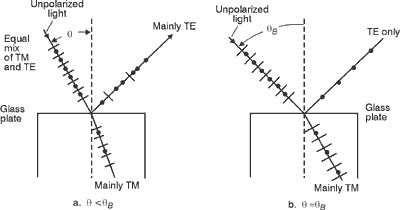
Fig13.gif


show the 'reflection point' on the axis of propagation. But, the fields which propagate about that axis would penetrate into the other medium.

From what I understand, EM waves are essentially coupled electric and magnetic fields that 'go on creating each other'...if one of the two gets distorted (the one in the plane of the normal and incoming light wave), wouldn't it destroy the light wave?
 
Physics news on Phys.org
What do you mean by "get distorted"? Do you mean the decrease of the number of lines or dots in the reflected and transmitted wave in that picture? That's just for telling us that the amplitudes of the TE and TM components are reduced by virtue of the energy conservation. And as long as the fields in both region satisfy the wave equation, we will still have a wave.
 
blue_leaf77 said:
What do you mean by "get distorted"? Do you mean the decrease of the number of lines or dots in the reflected and transmitted wave in that picture? That's just for telling us that the amplitudes of the TE and TM components are reduced by virtue of the energy conservation. And as long as the fields in both region satisfy the wave equation, we will still have a wave.
I find the diagram confusing. The incoming energy is a mix of ordinary and extraordinary waves, not TM and TE waves. The ratio of Magnetic to Electric is always constant for the material in which it is travelling, so that will alter in the glass.
modulus said:
When trying to explain reflection through the EM treatment of light waves, how do we account for the fact that the electric/magnetic field of the incoming light would penetrate into the medium from which it is reflecting off of?

Diagrams like these:

Fig13.gif


show the 'reflection point' on the axis of propagation. But, the fields which propagate about that axis would penetrate into the other medium.

From what I understand, EM waves are essentially coupled electric and magnetic fields that 'go on creating each other'...if one of the two gets distorted (the one in the plane of the normal and incoming light wave), wouldn't it destroy the light wave?
I find the diagram slightly confusing. The incoming ray can be regarded as a mixture of two light waves - in the plane of the paper and at right angles to it. The two behave differently at the surface, so we can study them separately. Each wave has magnetic and electric fields in a fixed ratio. For the wave in glass, the ratio is different to that in air.
 
tech99 said:
I find the diagram confusing. The incoming energy is a mix of ordinary and extraordinary waves, not TM and TE waves.
Why do you think that it's a mix of ordinary and extraordinary waves? That terms only arise in the propagation inside an anisotropic material.
 
I am not talking about the specific diagram. I am speaking in general about how to analyse reflection as an electromagnetic phenomenon. The thing is that the propagating electric field should penetrate beyond the reflecting surface (for the TM wave), and this should cause a polarisation to occur. With this added polarisation, won't the time varying electric field 'as seen by the light wave' be different from when it normally propagates? Wouldn't this cause the wave to reflect unevenly back?
 
modulus said:
When trying to explain reflection through the EM treatment of light waves, how do we account for the fact that the electric/magnetic field of the incoming light would penetrate into the medium from which it is reflecting off of?

<snip>

Google 'frustrated total internal reflection" or "TIRF microscopy". The incident field does indeed penetrate the second medium (it's an evanescent field).
 

Similar threads

  • · Replies 65 ·
3
Replies
65
Views
6K
  • · Replies 8 ·
Replies
8
Views
3K
  • · Replies 8 ·
Replies
8
Views
2K
  • · Replies 21 ·
Replies
21
Views
3K
  • · Replies 3 ·
Replies
3
Views
2K
  • · Replies 6 ·
Replies
6
Views
2K
  • · Replies 4 ·
Replies
4
Views
2K
  • · Replies 5 ·
Replies
5
Views
4K
  • · Replies 12 ·
Replies
12
Views
3K
  • · Replies 1 ·
Replies
1
Views
2K