Discussion Overview
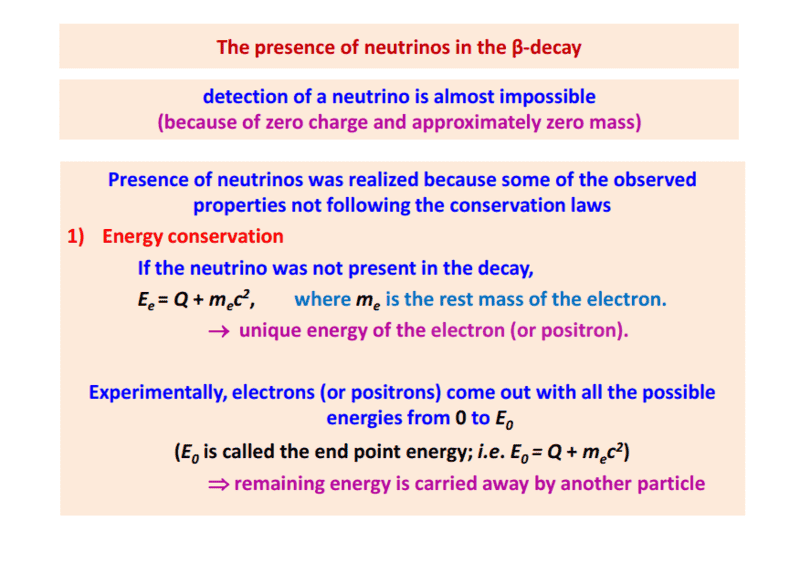
The discussion revolves around the concepts of endpoint energy and Q value in the context of beta decay. Participants explore the definitions and relationships between these quantities, focusing on their implications for the kinetic energy of electrons produced in the decay process.
Discussion Character
- Conceptual clarification
- Debate/contested
- Mathematical reasoning
Main Points Raised
- One participant asserts that the Q value of a reaction represents the difference between total initial mass-energy and total final mass-energy, suggesting that it should equal the maximum kinetic energy of the electron in beta decay.
- Another participant questions the interpretation of endpoint energy, asking whether it refers to the maximum kinetic energy of the electron or the total relativistic energy of the beta particle.
- A mathematical expression for the kinetic energy of a decay product is provided, indicating that for certain conditions, the kinetic energy can approximate the Q value.
- There is a reference to an article that defines endpoint energy as the sum of the maximum kinetic energy and the rest mass energy of the electron, prompting further clarification on the distinction between these energy types.
- Participants express a need for proper references to support claims made in the discussion.
Areas of Agreement / Disagreement
Participants express uncertainty regarding the definitions of endpoint energy and its relationship to kinetic energy and Q value. There is no consensus on the interpretation of these concepts, and multiple views remain present.
Contextual Notes
There are unresolved questions about the definitions of endpoint energy and Q value, as well as the assumptions underlying the mathematical expressions discussed. The discussion also highlights the need for clear references to support the claims made.