kostoglotov
- 231
- 6
edit: turned out to be a calculator typo...mods feel free to delete this thread if you wish, I won't complain.
[/B]
Having issues with part a)
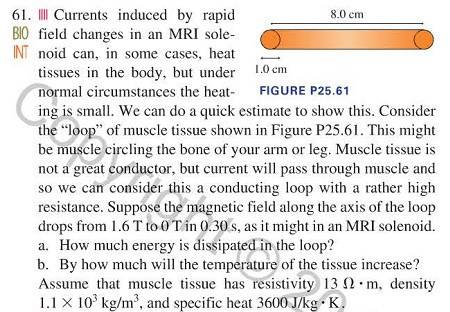
imgur link: http://i.imgur.com/4hzLyhb.jpg
Resistivity of muscle (from table in text): [tex]\rho \approx 13[/tex]
Large Diameter, Small Diameter: [tex]D = 0.080m \ \ \ d = 0.010m[/tex]
Energy dissipated: [tex]Q = P \Delta t[/tex]
Power: [tex]P = \frac{V^2}{R}[/tex]
EMF: [tex]V = \varepsilon = \left|\frac{\Delta \Phi}{\Delta t}\right|[/tex]
Change in Flux: [tex]\left|\frac{\Delta \Phi}{\Delta t}\right| = \left|\frac{\Delta B}{\Delta t}\right| A_{eff}[/tex]
Effective Area (assume [itex]\theta = 0[/itex]): [tex]A_{eff} = A \cos{\theta} = A = \pi \left(\frac{D}{2}\right)^2[/tex]
Resistance: [tex]R = \frac{\rho L}{A} = \frac{\rho \pi D}{\pi \left(\frac{d}{2}\right)^2} = \frac{\rho D}{ \left(\frac{d}{2}\right)^2}[/tex]
So, energy expression: [tex]Q = P \Delta t = \frac{\varepsilon^2 \Delta t}{R} = \left[\frac{\Delta B}{\Delta t}\pi \left(\frac{D}{2}\right)^2\right]^2 \Delta t \frac{d^2}{4 \rho D}[/tex]
Simplifying: [tex]Q = \frac{(\Delta B)^2 \pi^2 D^3 d^2}{64 \Delta t \rho}[/tex]
Plugging all the values from the problem in gives me: [itex]6.5 \times 10^{-8} J[/itex] with 2 sig figs.
The answer in the back is stated as: [itex]5.2 \times 10^{-9} J[/itex]
Where have I gone wrong?
Homework Statement
[/B]
Having issues with part a)
imgur link: http://i.imgur.com/4hzLyhb.jpg
Homework Equations
Resistivity of muscle (from table in text): [tex]\rho \approx 13[/tex]
Large Diameter, Small Diameter: [tex]D = 0.080m \ \ \ d = 0.010m[/tex]
Energy dissipated: [tex]Q = P \Delta t[/tex]
Power: [tex]P = \frac{V^2}{R}[/tex]
EMF: [tex]V = \varepsilon = \left|\frac{\Delta \Phi}{\Delta t}\right|[/tex]
Change in Flux: [tex]\left|\frac{\Delta \Phi}{\Delta t}\right| = \left|\frac{\Delta B}{\Delta t}\right| A_{eff}[/tex]
Effective Area (assume [itex]\theta = 0[/itex]): [tex]A_{eff} = A \cos{\theta} = A = \pi \left(\frac{D}{2}\right)^2[/tex]
Resistance: [tex]R = \frac{\rho L}{A} = \frac{\rho \pi D}{\pi \left(\frac{d}{2}\right)^2} = \frac{\rho D}{ \left(\frac{d}{2}\right)^2}[/tex]
The Attempt at a Solution
So, energy expression: [tex]Q = P \Delta t = \frac{\varepsilon^2 \Delta t}{R} = \left[\frac{\Delta B}{\Delta t}\pi \left(\frac{D}{2}\right)^2\right]^2 \Delta t \frac{d^2}{4 \rho D}[/tex]
Simplifying: [tex]Q = \frac{(\Delta B)^2 \pi^2 D^3 d^2}{64 \Delta t \rho}[/tex]
Plugging all the values from the problem in gives me: [itex]6.5 \times 10^{-8} J[/itex] with 2 sig figs.
The answer in the back is stated as: [itex]5.2 \times 10^{-9} J[/itex]
Where have I gone wrong?
Last edited: