Pushoam
- 961
- 53
<Moderator's note: Thread moved from a technical forum, so homework template missing>
To do: To find an expression for energy stored in an electrostatic system with charge density ## \rho ## and volume R.
[ I am using R to denote the region filled with the given charge density as I want to keep 'V' reserved for potential ].
By the term "energy of the system " what we mean is : work required to assemble the system
So, I have to calculate work required to assemble the system i.e. W.
Let's consider the system at the time when its volume is Δ R and I bring charge dq to a point M with position vector ##\vec r ## on its surface.
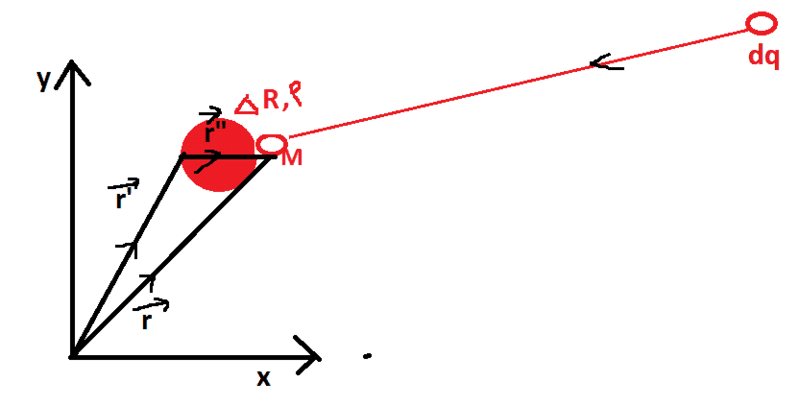
Work done by me in this process is
dW = V(##\vec r ##) dq
##V \left ( \vec r \right ) = k \int _{ΔR}~ \frac { \rho (\vec {r'}) }{r"} d \, τ' ##
## dq = \rho (\vec {r}) dτ ##
So, ## dW = k \int _R~ \frac { \rho (\vec {r'}) }{r"} d \, τ' ~ \rho (\vec {r}) dτ ##
## W = \int _R~ \rho (\vec {r}) \{ k \int _{ΔR}~ \frac { \rho (\vec {r'}) }{r"} d \, τ'\} d\,τ ##
where ΔR depends on r.
Is this correct so far?
Another way:
W = ½ ##\int_R ~ \rho (\vec r) V (\vec r) d \, τ##
## \rho (\vec r) V (\vec r) = ε_0 (∇⋅ \vec E ) V = ε_0 ( ∇⋅( V \vec E ) - \vec E⋅ ∇ V ) ##
## W = ½ \int_R~ ε_0 ( ∇⋅ (V \vec E ) - \vec E⋅ ∇ V ) d \,τ ##
## = ½ \int_S ~ ε_0 V \vec E ⋅ d \vec a + ½ \int_R ε_0 E^2 d \, τ ##
Taking the region of integration to be infinite, (as the charge density outside R is 0), the first integral on R.H.S. becomes 0. Hence, we have,
## W = \frac {\epsilon _0 } 2 \int_{all space} E^2 d \, \tau ##In case of dielectrics, this will be the work required for assembling both free charges and bound charges.
For dielectrics, ## \rho = \rho_b + \rho_f,##
So,
W = ½ ##\int_R ~ \rho (\vec r) V (\vec r) d \, τ##
= ½ ##\int_R~ (\rho_b + \rho_f )V (\vec r) d \, τ##
W =½ ## \int_R~ \rho_b V d \, τ + ½ \int_R \rho_f V (\vec r) d \, τ##
Can I take the first term on the R.H.S. as the work required to assemble the bound charges and the second term as the work required to assemble the free charges ?
If yes, then,
##W_f = ½ \int_R \rho_f V (\vec r) d \, τ
\\ \rho_f=∇.\vec D##
And doing some further calculation,
## W_f = ½ \int_{all space} \vec D . \vec E ~d \, τ ##
Is this correct so far?
To do: To find an expression for energy stored in an electrostatic system with charge density ## \rho ## and volume R.
[ I am using R to denote the region filled with the given charge density as I want to keep 'V' reserved for potential ].
By the term "energy of the system " what we mean is : work required to assemble the system
So, I have to calculate work required to assemble the system i.e. W.
Let's consider the system at the time when its volume is Δ R and I bring charge dq to a point M with position vector ##\vec r ## on its surface.
Work done by me in this process is
dW = V(##\vec r ##) dq
##V \left ( \vec r \right ) = k \int _{ΔR}~ \frac { \rho (\vec {r'}) }{r"} d \, τ' ##
## dq = \rho (\vec {r}) dτ ##
So, ## dW = k \int _R~ \frac { \rho (\vec {r'}) }{r"} d \, τ' ~ \rho (\vec {r}) dτ ##
## W = \int _R~ \rho (\vec {r}) \{ k \int _{ΔR}~ \frac { \rho (\vec {r'}) }{r"} d \, τ'\} d\,τ ##
where ΔR depends on r.
Is this correct so far?
Another way:
W = ½ ##\int_R ~ \rho (\vec r) V (\vec r) d \, τ##
## \rho (\vec r) V (\vec r) = ε_0 (∇⋅ \vec E ) V = ε_0 ( ∇⋅( V \vec E ) - \vec E⋅ ∇ V ) ##
## W = ½ \int_R~ ε_0 ( ∇⋅ (V \vec E ) - \vec E⋅ ∇ V ) d \,τ ##
## = ½ \int_S ~ ε_0 V \vec E ⋅ d \vec a + ½ \int_R ε_0 E^2 d \, τ ##
Taking the region of integration to be infinite, (as the charge density outside R is 0), the first integral on R.H.S. becomes 0. Hence, we have,
## W = \frac {\epsilon _0 } 2 \int_{all space} E^2 d \, \tau ##In case of dielectrics, this will be the work required for assembling both free charges and bound charges.
For dielectrics, ## \rho = \rho_b + \rho_f,##
So,
W = ½ ##\int_R ~ \rho (\vec r) V (\vec r) d \, τ##
= ½ ##\int_R~ (\rho_b + \rho_f )V (\vec r) d \, τ##
W =½ ## \int_R~ \rho_b V d \, τ + ½ \int_R \rho_f V (\vec r) d \, τ##
Can I take the first term on the R.H.S. as the work required to assemble the bound charges and the second term as the work required to assemble the free charges ?
If yes, then,
##W_f = ½ \int_R \rho_f V (\vec r) d \, τ
\\ \rho_f=∇.\vec D##
And doing some further calculation,
## W_f = ½ \int_{all space} \vec D . \vec E ~d \, τ ##
Is this correct so far?
Attachments


Last edited by a moderator:
