Is my equation for projectile trajectory accurate?

Click For Summary
SUMMARY

The discussion focuses on deriving an equation for projectile trajectory, specifically determining the initial angle based on height, distance, and initial velocity. The user initially misrepresented the relationship between kinetic and potential energy but later clarified that the potential energy at the vertex equals half the product of mass and initial vertical velocity squared. The conversation also explores the practical application of testing the derived equations using a makeshift slingshot, with considerations regarding the accuracy of rubber bands versus springs in the experiment.

PREREQUISITES
  • Understanding of projectile motion and parabolic trajectories
  • Familiarity with kinetic and potential energy concepts
  • Knowledge of basic calculus, particularly derivatives
  • Experience with experimental physics and data collection
NEXT STEPS
  • Explore the derivation of projectile motion equations in physics
  • Learn about the application of Hooke's Law in spring mechanics
  • Investigate the effects of air resistance on projectile trajectories
  • Conduct experiments to validate theoretical predictions in projectile motion
USEFUL FOR

Students and educators in physics, hobbyists conducting projectile experiments, and anyone interested in the practical applications of projectile motion equations.

person123
Messages
326
Reaction score
52
I derived an equation for the trajectory of a projectile. Given the height and distance of the projectile, and the initial velocity, it determines the initial angle. When plugging it into desmos, it seemed to make sense (https://www.desmos.com/calculator/pfylvs4tau), but I still can't be sure.

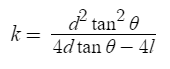
I first determined the vertex of the parabola. I knew two points of the parabola and the derivative at one of these points. This gave me the following:
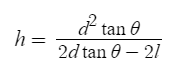
2ziqx5s.png


30kfzit.png


where d is the horizantal distance from the target, l is the vertical distance, and θ is the initial angle.

Since I knew the initial kinetic energy is the same is the product of the mass, acceleration due to gravity, and the height k, I was able to solve for the velocity v. By moving around the variables in this equation, it gave me
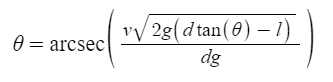
106c9kk.png


Does my method seem correct? Do the equations seem correct? (There's also the problem that I can't get theta completely to one side, although that's not really a physics problem).
 

Attachments

  • 4sd3t5.png
    4sd3t5.png
    1,007 bytes · Views: 515
  • equation for h.png
    equation for h.png
    993 bytes · Views: 459
Last edited:
Physics news on Phys.org
If k is the height, what's h?
person123 said:
Since I knew the initial kinetic energy is the same is the product of the mass, acceleration due to gravity, and the height k,
This is incorrect unless it's a vertical shot. The change in kinetic energy is equal to the change in gravitational potential, but the kinetic energy at the top of the trajectory is not zero in general.
 
Ibix said:
If k is the height, what's h?

h is the horizontal distance from the object's initial location to the vertex of the parabola.

Ibix said:
This is incorrect unless it's a vertical shot. The change in kinetic energy is equal to the change in gravitational potential, but the kinetic energy at the top of the trajectory is not zero in general.

Sorry about that—that is a problem with the explanation of my work. The potential energy at the vertex would be equal to half of the product of mass and the initial vertical velocity squared. My work uses this instead of what I wrote previously.
 
So - you are launching from x=h, y=l to hit a target at x=0, y=0. The shot is initially launched at speed v at angle ##\theta## to the horizontal. The peak of the arc is x=d, y=k.

Is that right?
 
No. You initially launch at position (0,0). For the peak of the arc, I just used the standard notation for a vertex of a parabola, (h,k). The target is the coordinate (d,l). (I used l because I was running out of letters). As you said, the target is launched with velocity v at an angle θ above the horizontal.
 
Sorry - this slipped off my todo list.

I agree all your expressions. To solve your last one, I suggest backing up a couple of steps. You'll have had something like $$\frac{d^2}{\cos^2\theta}=\frac{2v^2}{g}(d\tan\theta-l)$$If you multiply both sides by ##\cos^2\theta## and apply double-angle formulae you should be able to get an expression in terms of the sine and cosine of ##2\theta##. That ought to be solvable.
 
I have decided on putting this equation to the test. I'm going to shoot a projectile (a marble) at different angles and velocities and see if it lands at the predicted location. I decided on using a makeshift slingshot to propel the marble, but I have a question on what to make it out of.

The easiest solution would be to use rubber bands. However, it seems that rubber bands don't follow Hooke's law with nearly as much accuracy as would an actual spring (http://c21.phas.ubc.ca/sites/default/files/rubber_band_write_up.pdf https://www.wired.com/2012/08/do-rubber-bands-act-like-springs/). I'm wondering if that would be a significant enough inaccuracy to make my results unreliable—it's quite difficult to extrapolate the data provided for my situation.

I would use springs instead, but the only ones I found were really too stiff for this experiment.
 
Last edited:
Edit:

I tested the spring constant for rubber bands, and it gave me something pretty linear. I did it for both one rubber band and 4 rubber bands attached in a chain. Here are the results:
https://www.desmos.com/calculator/w0dd8dpuf87.
 
Last edited:
  • Like
Likes   Reactions: vanhees71

Similar threads

  • · Replies 6 ·
Replies
6
Views
2K
  • · Replies 4 ·
Replies
4
Views
2K
  • · Replies 4 ·
Replies
4
Views
2K
  • · Replies 36 ·
2
Replies
36
Views
22K
  • · Replies 25 ·
Replies
25
Views
4K
  • · Replies 5 ·
Replies
5
Views
2K
  • · Replies 2 ·
Replies
2
Views
1K
  • · Replies 4 ·
Replies
4
Views
2K
  • · Replies 2 ·
Replies
2
Views
2K
  • · Replies 4 ·
Replies
4
Views
1K