LostMechE901
- 2
- 1
Moved from a technical forum, so homework template missing
I'm having trouble understanding the forces involved when defining the equation of motion for this particular problem.
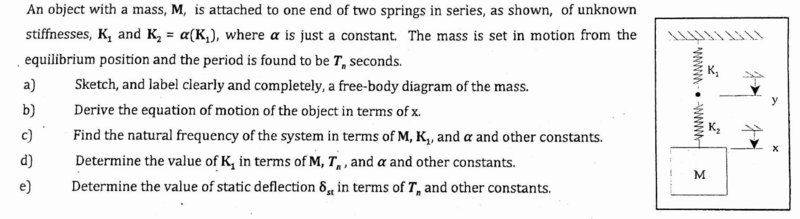
So... I've seen the answer for the eq. of motion worked two different ways. The first way involves combining the spring series into Keq = K1⋅K2/(K1+K2). The answer, plugging in α(K1) for K2, comes out to be M×x" + α(K1)/(1+α) × (x + δst) = mg. The weight and static deflection cancel out, rendering the final answer M×x" + (x) × (α(K1)/(1+α)) = 0.
The 2nd way I've seen this problem worked is as follows:
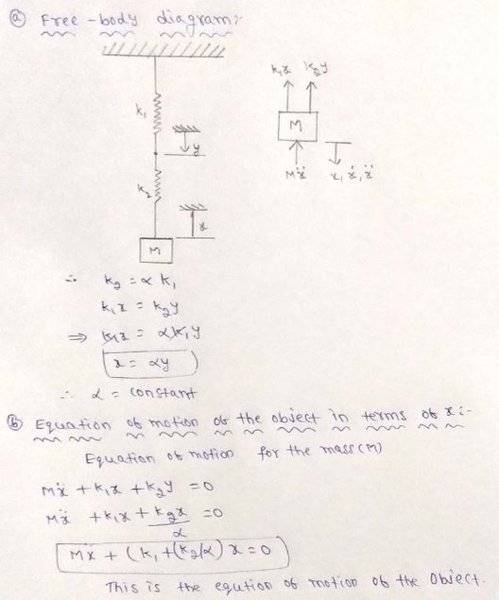
In the 2nd solution, I don't understand how he figured the proportion K1⋅x = K2⋅y. When drawing my free body diagrams of the springs enacting forces upon each other, the only equations I can devise are K2(y-x) ∧ and K1⋅y ∧.
Is the 2nd solution incorrect? If it can be worked that way, how do you figure that relationship?
*Edit* I Just realized there is a specific engineering problem help section for threads like this. I apologize for misplacement in advance.
So... I've seen the answer for the eq. of motion worked two different ways. The first way involves combining the spring series into Keq = K1⋅K2/(K1+K2). The answer, plugging in α(K1) for K2, comes out to be M×x" + α(K1)/(1+α) × (x + δst) = mg. The weight and static deflection cancel out, rendering the final answer M×x" + (x) × (α(K1)/(1+α)) = 0.
The 2nd way I've seen this problem worked is as follows:
In the 2nd solution, I don't understand how he figured the proportion K1⋅x = K2⋅y. When drawing my free body diagrams of the springs enacting forces upon each other, the only equations I can devise are K2(y-x) ∧ and K1⋅y ∧.
Is the 2nd solution incorrect? If it can be worked that way, how do you figure that relationship?
*Edit* I Just realized there is a specific engineering problem help section for threads like this. I apologize for misplacement in advance.
Attachments


Last edited: