Euler Lagrange equation and a varying Lagrangian

Click For Summary
The discussion revolves around the challenges faced in applying the Euler-Lagrange equation to a varying Lagrangian in three-dimensional topological massive gravity. The user encountered a discrepancy with a negative sign in their variation with respect to Ψ and sought clarification on the correct application of the equation. Key points include the necessity of using the Leibniz rule for the covariant derivative and understanding the wedge product of vectors for the second variation. The conversation emphasizes the mathematical intricacies involved in deriving results from the Lagrangian. Overall, the thread highlights the complexities of variational calculus in theoretical physics.
Tamin Ayoub
Messages
1
Reaction score
0
Homework Statement
The variation of the Lagrangian with respect to PSI and X
Relevant Equations
Euler Lagrange equation
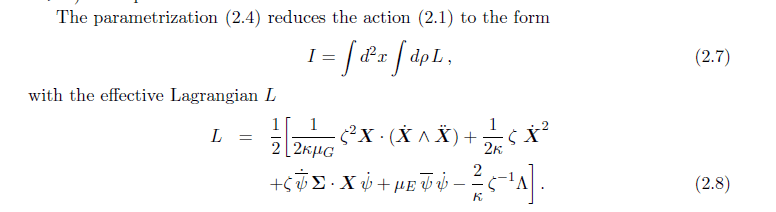
Hello, I have been working on the three-dimensional topological massive gravity (I'm new to this field) and I already faced the first problem concerning the mathematics, after deriving the lagrangian from the action I had a problem in variating it
Here is the Lagrangian
Sans titre.png


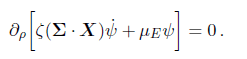
The first variation should be with respect to Ψ I tried to find this result
22.png

but I had a sign different, my result had a Minus sign.

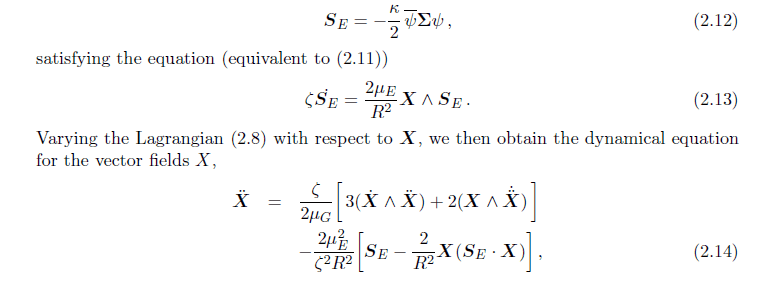
The second variation is with respect to the vector X, note that

55.png

and the result is
1593770698677.png

I tried to use the euler lagrange equation to find this result but i don't have much experience dealing with this wedge product variation

thank you in advanced
 
Physics news on Phys.org
for helping me The Euler-Lagrange equation for the variation with respect to $\Psi$ is given by\begin{align}\frac{\delta L}{\delta \Psi} = \frac{\partial L}{\partial \Psi} - \nabla_\mu \frac{\partial L}{\partial (\nabla_\mu \Psi)} = 0.\end{align}A few notes:1) The second term on the right-hand side, $\nabla_\mu \frac{\partial L}{\partial (\nabla_\mu \Psi)}$, involves taking the partial derivative of the Lagrangian with respect to the covariant derivative of $\Psi$. This is done using the Leibniz rule.2) The wedge product of two vectors, $X$ and $Y$, is defined as\begin{align}X \wedge Y = \frac{1}{2!} (X \cdot \nabla) Y - \frac{1}{2!} (Y \cdot \nabla) X.\end{align}Using this definition, we can rewrite the second variation in terms of derivatives of the Lagrangian with respect to $X$ and $Y$:\begin{align}\frac{\delta^2 L}{\delta X \delta Y} &= \frac{\partial^2 L}{\partial X \partial Y} - \frac{1}{2!}\left(\frac{\partial L}{\partial (\nabla_\mu X)} \cdot \nabla_\mu \right) Y - \frac{1}{2!}\left(\frac{\partial L}{\partial (\nabla_\mu Y)} \cdot \nabla_\mu \right) X \\&+ \frac{1}{4!}\left(\frac{\partial L}{\partial (\nabla_\mu \nabla_\nu X)} \cdot \nabla_\mu \nabla_\nu \right) Y - \frac{1}{4!}\left(\frac{\partial L}{\partial (\nabla_\mu
 

Similar threads

Replies
5
Views
2K
  • · Replies 6 ·
Replies
6
Views
3K
  • · Replies 16 ·
Replies
16
Views
2K
  • · Replies 15 ·
Replies
15
Views
3K
Replies
7
Views
3K
  • · Replies 5 ·
Replies
5
Views
2K
  • · Replies 2 ·
Replies
2
Views
1K
  • · Replies 1 ·
Replies
1
Views
2K
  • · Replies 5 ·
Replies
5
Views
2K
Replies
6
Views
8K