Eval op amp achieves +/- power from single power supply?

Click For Summary
SUMMARY

The discussion centers on the operation of an evaluation module for an operational amplifier (op-amp) that functions with a single power supply while producing a differential voltage output. Users confirmed that the op-amp operated correctly even when connected to only one side of the power supply, despite initial confusion regarding the necessity of a dual power supply setup. Key insights include the requirement that input signals must be higher than the negative rail and lower than the positive rail by a specified margin for proper operation. Additionally, some op-amps can function effectively from a 3.3V supply without a negative voltage.

PREREQUISITES
  • Understanding of operational amplifier (op-amp) configurations
  • Familiarity with single and dual power supply concepts
  • Knowledge of differential voltage principles
  • Basic electronics and circuit schematic interpretation
NEXT STEPS
  • Research the specifications and applications of op-amps that operate from a single supply voltage
  • Learn about input protection diodes in op-amp circuits
  • Explore the concept of offset voltage in operational amplifiers
  • Study the design and functionality of evaluation modules for op-amps
USEFUL FOR

Electronics engineers, hobbyists working with op-amps, and anyone involved in designing or testing circuits that utilize operational amplifiers.

Helmholtzerton
Messages
30
Reaction score
4
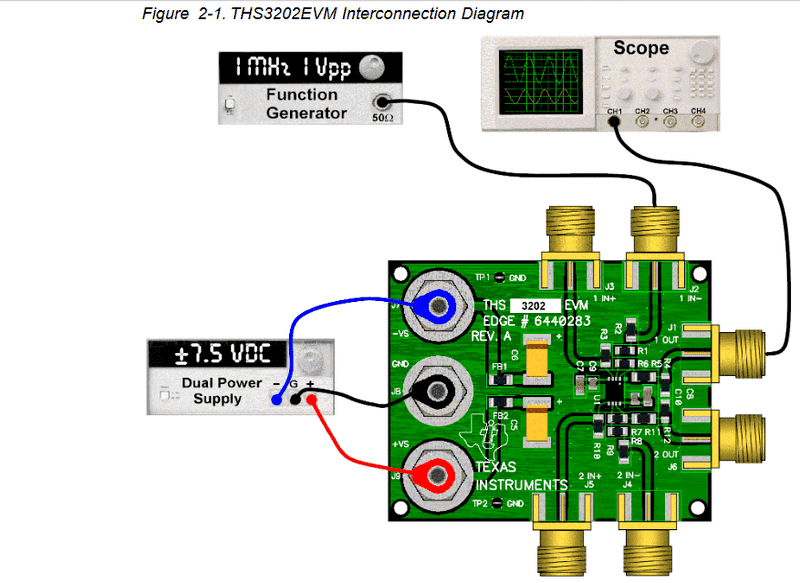
Picture for reference is below.

I'm confused as to how this is able to receive a differential voltage of +/- from a single power supply. (Yes, I know the picture says dual power supply.)

Normally I have to short the negative to ground on one side of a dual power supply, and short the positive on the other side of a power supply in order to get a +/- Vpower to an op amp.

I actually wired up this evaluation module with just using one side of a power supply and it worked. There were no rails on either side.

Looking at the circuit board: http://www.ti.com/lit/ug/slou148/slou148.pdf

I'm not entirely sure how it is able to do this, or how the circuit would look.
Circuit Question.png
 
Engineering news on Phys.org
The little photo in your attachment that represents a power supply of some type does not really mean anything. It SAYS "Dual Power Supply". But how would it be drawn on a schematic if it were a battery or several batteries? If you don't know, then you cannot know whether your op-amp can work or not and cannot expect any predictable results.
 
Helmholtzerton said:
I actually wired up this evaluation module with just using one side of a power supply and it worked.
Are you saying you connected the board to your power supply but omitted the blue connection, and found the differential amplifier on the board still operated as normal under every test you devised?
 
NascentOxygen said:
Are you saying you connected the board to your power supply but omitted the blue connection, and found the differential amplifier on the board still operated as normal under every test you devised?

All the connections where made, however the op amp could not handle much of an offset.

Then when I hooked up in dual mode the op amp operated as expected when applying a large offset on one signal.
 
Helmholtzerton said:
I actually wired up this evaluation module with just using one side of a power supply and it worked. There were no rails on either side.
I'm not sure that I understood this part.

Anyway, the '+' and '-' are not fixed for an opamp. All it requires is that the input signals should be higher than '-' and lower than '+' by a specified margin. If this fits, then it'll work and produce an output voltage higher than '-' and lower than '+'.

There are opamps which will work even from 3.3V (without any negative power supply) perfectly, without any hitch.
 
There also may be input protection diodes or another path from the input to the supply rails. You will essentially be powering the device from the input signal. This will give very poor results as the load on your input will not be constant and your power supply will also not be constant and generally below the peaks of your signal. Check for major distortion on your output.

BoB
 

Similar threads

  • · Replies 36 ·
2
Replies
36
Views
5K
Replies
9
Views
2K
Replies
17
Views
3K
Replies
7
Views
3K
  • · Replies 3 ·
Replies
3
Views
2K
Replies
4
Views
6K
  • · Replies 15 ·
Replies
15
Views
5K
  • · Replies 20 ·
Replies
20
Views
7K
  • · Replies 1 ·
Replies
1
Views
3K
  • · Replies 7 ·
Replies
7
Views
2K