Evaluating an integral of an exponential function

Click For Summary
The integral discussed is related to a Gaussian integral, which can be expressed in a specific form involving exponential functions. Converting the cosine function into an exponential was attempted but did not significantly resolve the issue. A YouTube channel, BlackPenRedPen, is recommended for further insights on similar integrals. The integral can be evaluated independently of the variable k, with k=0 being a useful simplification. Verifying the result can be achieved through differentiation by k or altering the integration path.
dykuma
Messages
55
Reaction score
6
Homework Statement
I've been messing with this integral for a few days now, and have made no progress on it. I know what the the answer will be thanks to mathermatica, but I want to know how to do it myself.
Relevant Equations
N/A
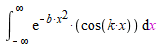
the integral is:
1587172354600.png

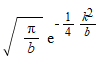
and according to mathematica, it should evaluate to be:
1587172658000.png
.​

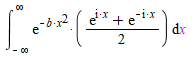
So it looks like some sort of Gaussian integral, but I'm not sure how to get there. I tried turning the cos function into an exponential as well:
1587172567500.png

however, I don't think this helps the issue much.
 
Physics news on Phys.org
jedishrfu said:
There's a cool youtube channel called BlackPenRedPen and I'm sure he has done this integral:

https://www.youtube.com/channel/UC_SvYP0k05UKiJ_2ndB02IA

and here's one that looks like your integral:


I had thought about looking through his channel, but I was not sure what to look for on there. That's exactly what I needed though. Thanks!
 
Your integral can be expressed in terms of a Gaussian integral.
$$\int_{-\infty}^\infty \exp\left(-b \left(x+i \frac{k}{2b}\right)^2\right) \, dt=\int_{-\infty}^\infty \exp\left(-b \left(x+i \frac{0}{2b}\right)^2\right) \, dt$$
Notice the Gaussian integral is independent of k and k=0 is a convenient value.
you can verify this by differentiating by k or deforming the path of integration
$$I=\int_{-\infty}^\infty \exp(-b x^2)\cos(k x) \, dt $$
$$I=\exp\left(-\left(\frac{k} {2b}\right)^2\right)\int_{-\infty}^\infty \exp\left(-b \left(x+i \frac{k}{2b}\right)^2\right) \, dt$$
$$I=\exp\left(-\left(\frac{k} {2b}\right)^2\right)\int_{-\infty}^\infty \exp\left(-b \left(x+i \frac{0}{2b}\right)^2\right) \, dt$$
 
Last edited:
  • Like
Likes dykuma and jedishrfu
Question: A clock's minute hand has length 4 and its hour hand has length 3. What is the distance between the tips at the moment when it is increasing most rapidly?(Putnam Exam Question) Answer: Making assumption that both the hands moves at constant angular velocities, the answer is ## \sqrt{7} .## But don't you think this assumption is somewhat doubtful and wrong?

Similar threads

  • · Replies 3 ·
Replies
3
Views
1K
Replies
8
Views
2K
Replies
2
Views
2K
  • · Replies 3 ·
Replies
3
Views
3K
  • · Replies 1 ·
Replies
1
Views
1K
Replies
3
Views
1K
Replies
2
Views
1K
  • · Replies 7 ·
Replies
7
Views
2K
Replies
7
Views
2K
Replies
7
Views
2K