Undergrad Evaluating Scattering Integral

Click For Summary
SUMMARY

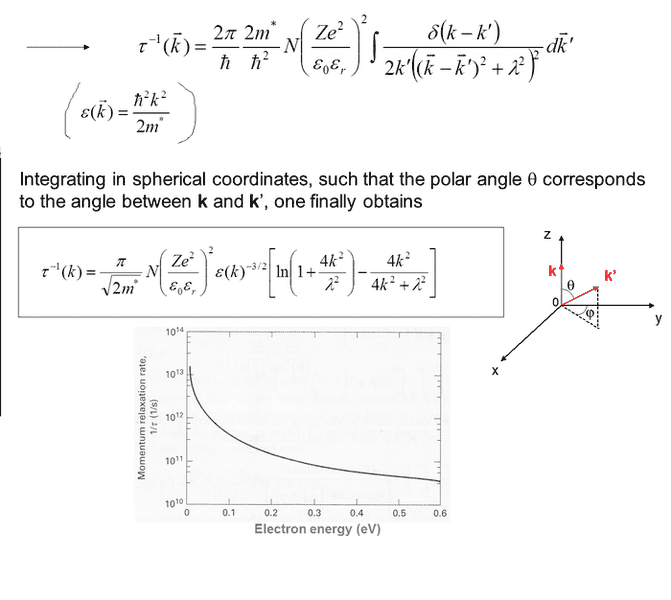
The forum discussion centers on evaluating a scattering integral involving the Dirac delta function and the vector element dk'. Participants emphasize the necessity of converting to spherical coordinates, where the Dirac delta function influences the integral over the radial component, r. Key points include the clarification that dk' represents an infinitesimal vector element rather than a derivative, and the importance of using the cosine law to express the distance between vectors in terms of k, k', and the angle θ. The discussion highlights the confusion surrounding the integration process and the role of the Dirac delta function in the evaluation of the integral.

PREREQUISITES
  • Understanding of Dirac delta functions in integrals
  • Familiarity with spherical coordinates in calculus
  • Knowledge of vector calculus and infinitesimal elements
  • Proficiency in using the cosine law for vector relationships
NEXT STEPS
  • Study the application of Dirac delta functions in quantum mechanics
  • Learn about spherical coordinate transformations in integrals
  • Explore vector calculus, focusing on infinitesimal vector elements
  • Investigate the cosine law and its applications in physics problems
USEFUL FOR

Students and researchers in physics, particularly those dealing with scattering theory, integrals involving Dirac delta functions, and vector calculus applications.

Waxterzz
Messages
82
Reaction score
0
Hi,

I really don't have a clue to solve this.
1SR45bL.png
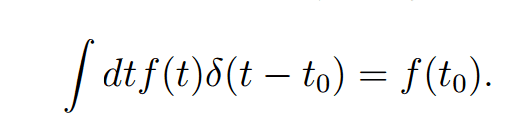
I tried something like the dirac function identity:
utoxnMx.png


But then I saw it's dk' not dk' and couldn't got it straight.

Can someone help me with this?
 
Physics news on Phys.org
As it is said, you have to change to spherical coordinates. The Dirac delta will then only affect the integral over r.
 
DrClaude said:
As it is said, you have to change to spherical coordinates. The Dirac delta will then only affect the integral over r.

I don't see it. dk' is not a volume element?
 
1a83c429226b2c6a2da143ae35a00751.png


dk' is a vector. Then I have an integral comprising of 3 terms each involving unit vectors.

I really don't have a clue.
 
Wait wait, I am extremely confused.

I just have to integrate over the k' first?
 
Mr
DrClaude said:
As it is said, you have to change to spherical coordinates. The Dirac delta will then only affect the integral over r.
6 hours and I still have no clue, can you please hold my hand and solve it with me. I mean, just say what I have to do, I will solve it, but give me instructions.

I mean what's the deal with the dirac function and the dk', it's supposed to be a volume element and the dirac term, why isn't it delta(k-k')
 
##d\vec{k}## is a volume element. Write it as a volume element in spherical coordinate. To make the integrand even more transparent, use the cosine law to express ##|\vec{k}-\vec{k'}|^2## in terms of ##k##, ##k'##, and ##\theta##.
 
blue_leaf77 said:
##d\vec{k}## is a volume element. Write it as a volume element in spherical coordinate. To make the integrand even more transparent, use the cosine law to express ##|\vec{k}-\vec{k'}|^2## in terms of ##k##, ##k'##, and ##\theta##.
mW21BmR.png


How come dk' is a volume element, it's the derivative of a vector. Most textbooks, the volume element is called a d tau or a dV

My head is a mess. It's like I completely forgot how to calculus.

Good news: I know I'm wrong.

Really don't see it
 
What happened to the Dirac delta? You should do the integral over k' first.
 
  • #10
Waxterzz said:
How come dk' is a volume element, it's the derivative of a vector. Most textbooks, the volume element is called a d tau or a dV
It's not a derivative, it is an infinitesimal vector element.
 
  • #11
DrClaude said:
It's not a derivative, it is an infinitesimal vector element.

It's been this the whole time?, with r being k'

eqn_vol_e.gif


Ps: After this I'm going to finally learn LaTeX
 
  • #12
Why did the Dirac delta disappear in the second equation from the last one?
 
  • #13
TEAEU8n.png
sv97Qux.png


This is what I got uptil now, but I have to leave.

Thanks for help, give me feedback if you want to, and I will post update when I'm back, probably tomorrow. Thanks for the patience anyway!
 
  • #14
DrClaude said:
It's not a derivative, it is an infinitesimal vector element.

blue_leaf77 said:
Why did the Dirac delta disappear in the second equation from the last one?

Hi,

Sorry for the late reply.

Hope this is somewhat more clear, because last post was a bit messy. Still haven't learned LaTex.

34XvfUc.png


Is this valid?

I couldn't evaluatie the last integral, because of the square.

Do I need to use partial fractions?

Thanks
 
  • #15
Hi myself,

I found out I need to include something like 1- ( stuff going in the z direction after k scattering) / (stuff that would go in z direction if there was no scattering at all), so 1 - k' projected on z axis /k = 1 - (k cos theta) / k

Yes, I'm a noob.

So I'll start over. :')
 

Similar threads

  • · Replies 2 ·
Replies
2
Views
3K
  • · Replies 1 ·
Replies
1
Views
3K
  • · Replies 4 ·
Replies
4
Views
3K
Replies
5
Views
2K
  • · Replies 8 ·
Replies
8
Views
2K
  • · Replies 3 ·
Replies
3
Views
2K
  • · Replies 8 ·
Replies
8
Views
3K
  • · Replies 3 ·
Replies
3
Views
2K
Replies
8
Views
2K
  • · Replies 5 ·
Replies
5
Views
2K