Evaluation of Surface Integral in Gauss's Law

Click For Summary
SUMMARY

This discussion focuses on evaluating surface integrals in the context of Gauss's Law, specifically for a tenth grader new to Advanced Calculus. The key takeaway is that a surface integral can be approached as nested ordinary integrals, allowing for integration over two variables, x and y. The process involves integrating one variable while treating the other as a constant, which can be done in either order. This foundational understanding is crucial for tackling problems related to surface integrals effectively.

PREREQUISITES
  • Understanding of basic calculus concepts, including integration.
  • Familiarity with Gauss's Law and its applications in physics.
  • Knowledge of functions of two variables, specifically f(x,y).
  • Experience with double integrals and their geometric interpretations.
NEXT STEPS
  • Study the concept of double integrals in calculus.
  • Learn about the applications of Gauss's Law in electromagnetism.
  • Explore the geometric interpretation of surface integrals.
  • Practice solving problems involving surface integrals in the x-y plane.
USEFUL FOR

This discussion is beneficial for high school students studying Advanced Calculus, particularly those interested in physics applications of calculus, as well as educators looking for ways to explain surface integrals and Gauss's Law.
Swapnil Das
Messages
15
Reaction score
6
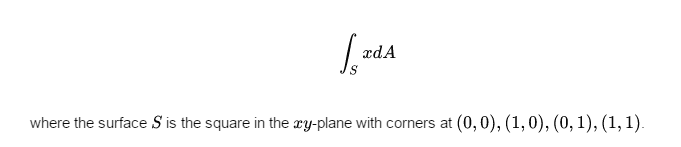
I am a tenth grader, and a newbie to Advanced Calculus. While working out problems sets for Gauss's Law, I encountered the following Surface Integral:

upload_2016-7-7_10-54-41.png
I couldn't attempt anything, having no knowledge over surface integration. So please help.
 
Physics news on Phys.org
Swapnil Das said:
I am a tenth grader, and a newbie to Advanced Calculus. While working out problems sets for Gauss's Law, I encountered the following Surface Integral:

View attachment 102941I couldn't attempt anything, having no knowledge over surface integration. So please help.

Well, for the specific problem you are interested in, a surface integral can be thought of as just nested ordinary integrals: If f(x,y) is some function that depends on two variables, x and y, then \int f(x,y) dA = \int dx (\int dy f(x,y)). So you first do the integral over y, treating x as a constant. That gives you an expression that may involve the variable x. Then you do the integral over x. Or you can do it in the opposite order: first integrate over x, then integrate over y.
 
  • Like
Likes   Reactions: Swapnil Das and Tallus Bryne
Since the surface integral is an integration over a square area in the x-y plane, a single variable integration would also work. I'm not sure how far you've gone in your study of calculus, but if you're new to the subject it's possible you've seen the problem of finding area in the x-y plane via integration with respect to x or y. You could use the same basic approach for this problem (although I would personally lean towards stevendaryl 's approach in general):

\int x dA = \int x y dx = \int x dx
y = 1 corresponds to the distance between the top of the square and the x-axis
 

Similar threads

  • · Replies 3 ·
Replies
3
Views
2K
Replies
2
Views
1K
Replies
18
Views
2K
  • · Replies 1 ·
Replies
1
Views
2K
Replies
6
Views
3K
Replies
2
Views
2K
  • · Replies 1 ·
Replies
1
Views
1K
  • · Replies 3 ·
Replies
3
Views
3K
  • · Replies 6 ·
Replies
6
Views
3K
Replies
10
Views
4K