Example of torque-free rotation with a fixed point

Click For Summary
An example of torque-free rotation with a fixed point is a cone rolling without slipping on a flat plane, where the apex acts as the fixed point. However, there is debate about whether this scenario involves a net applied torque. A bicycle wheel suspended off its center of mass and precessing also demonstrates no net torque due to the absence of angular acceleration. A simplified model involves a disk constrained to roll on its edge while fixed to a pivot, completing a circle without changing its angular velocity, indicating no net work is done. These examples illustrate rigid body rotation without unbalanced torques effectively.
Happiness
Messages
686
Reaction score
30
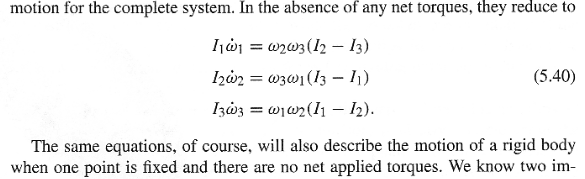
What is an example of a rigid body rotating when one point is fixed and there are no net applied torques? And the fixed point is not the center of mass.
Screen Shot 2016-04-14 at 12.26.52 am.png


I considered a cone rolling without slipping on a flat plane is such an example; the apex is the fixed point, but is there a net applied torque? I think there is.
 
Last edited:
Physics news on Phys.org
The usual bike weel suspended off its com and precessing... there is no net torque because no net angular acceleration. Same with a tilted gyroscope. Though... suffers similar analysis issues as the cone.

... I need my whiteboard to check and I am stuck in hospital (Im fine).
(I imagine it is easy with lagrangian mechanics.)
But consider, if it completes a circle, then it has returned to its initial state (its trivial to rig), so the net work is zero. So I'll say there is no unbalanced torque... but may change my mind later.

___ where I am up to ____________
For analysis... a simplified verion is: a disk of unit circumference on one end of an axle... the other end of the axle is fixed to a pivot - the whole rests on a horizontal table. The length of the axel is such that the disk is constrained to a circle with N units circumference, must stay perpendicular to the axle which is so thin and light it has zero moment of inertia. The disk rolls on its edge without slipping and has non zero initial angular velocity. Sound good?

This means that the disk rotates exactly N times when it completes one circle... so initial and final states are totally the same (after one circuit, if angular velocity is constant) so no net work was done (no non conservative forces present).
 
Last edited:
Simpler yet... just an upright disk tethered to a pole at the z axis so it is contrained to move on a circle.
I think that has the features you want without the awkward mass distribution.
 
For simple comparison, I think the same thought process can be followed as a block slides down a hill, - for block down hill, simple starting PE of mgh to final max KE 0.5mv^2 - comparing PE1 to max KE2 would result in finding the work friction did through the process. efficiency is just 100*KE2/PE1. If a mousetrap car travels along a flat surface, a starting PE of 0.5 k th^2 can be measured and maximum velocity of the car can also be measured. If energy efficiency is defined by...

Similar threads

  • · Replies 4 ·
Replies
4
Views
2K
  • · Replies 21 ·
Replies
21
Views
2K
  • · Replies 16 ·
Replies
16
Views
1K
  • · Replies 5 ·
Replies
5
Views
3K
  • · Replies 7 ·
Replies
7
Views
5K
  • · Replies 7 ·
Replies
7
Views
2K
  • · Replies 3 ·
Replies
3
Views
1K
  • · Replies 3 ·
Replies
3
Views
2K
  • · Replies 9 ·
Replies
9
Views
2K
  • · Replies 52 ·
2
Replies
52
Views
7K